
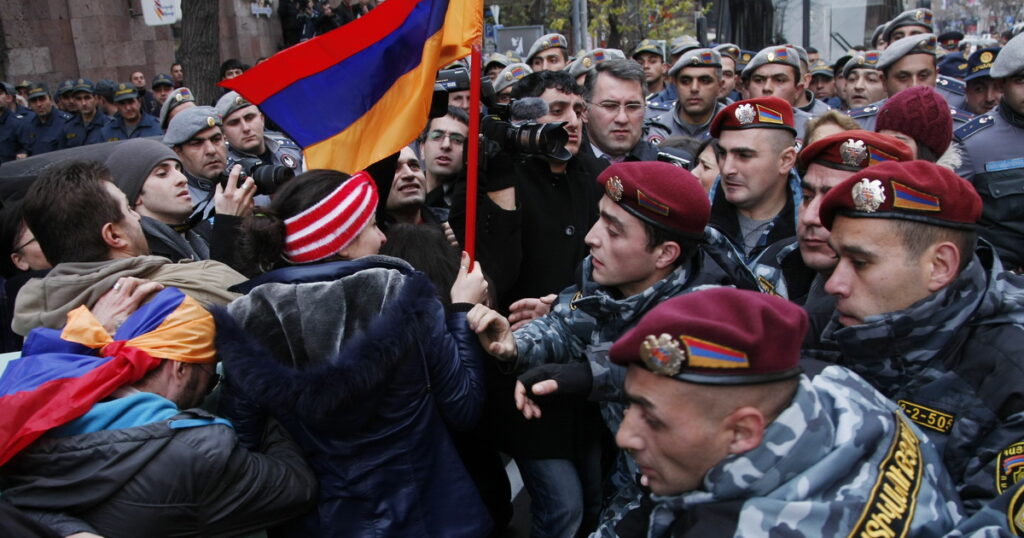
Today’s internal political processes in Armenia are raising growing concerns among observers. Amid increasing pressure on individual public and political figures, assessments are emerging that link these developments to historical parallels and a crisis of democratic values.
According to historian Pietro Shakaryan, Armenia is currently witnessing a de facto revival of mass political repression, similar to that seen in the 1930s. He emphasized that the current government exhibits behavior that can be described as “fundamentally anti-democratic.”
The historian noted that, in his view, these events logically stem from the authorities’ prior actions. Shakaryan recalled that the late 1980s movement, known as the Karabakh Movement, focused on the right to self-determination and the democratic rights and freedoms of the Armenians of Artsakh. However, he argued that the current prime minister, by recognizing Nagorno-Karabakh as part of Azerbaijan, has betrayed both the democratic rights of the region’s residents and the very essence of democracy itself.
Shakaryan found it alarming that the current actions of the authorities are accompanied by support from the European Union, which, in his opinion, is increasingly backing countries displaying authoritarian traits. “We are moving toward a reality that looks quite grim for both Armenia and the region,” he concluded.
Similar concerns were expressed by political analyst Artur Khachikyan. He stated that the West has lost all credibility, and the very idea of “Western democracy” has been compromised. He pointed out that, alongside claims of implementing so-called “democratic reforms” in Armenia, mass repressions are taking place today: peaceful demonstrations are being dispersed, force is used against youth, and women are arrested even with infants. “And after all this, Western representatives come to Yerevan and speak of progress in developing democracy. This is shameful,” the political analyst declared.