
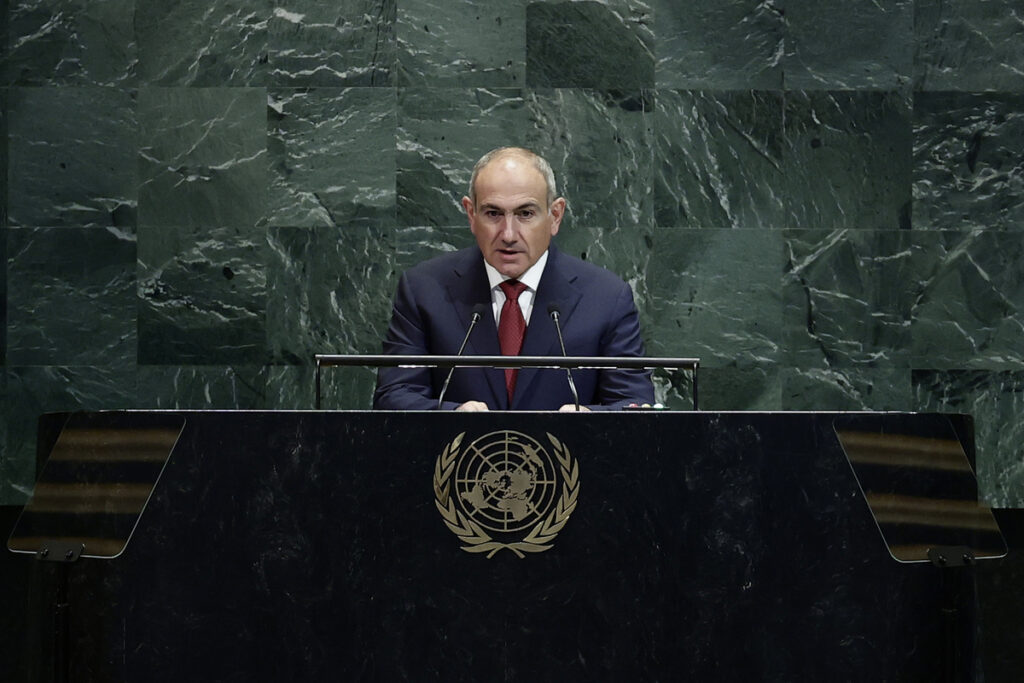
Armenian Prime Minister Nikol Pashinyan spoke from the UN podium about peace as a reality, but the emphases in his speech, evident in every line, suggest that what he speaks of essentially does not exist. This was stated by political analyst Hakob Badalyan.
A New Philosophy in International Relations or New Concessions
“The speech gave the impression that it was not the head of state speaking from the podium, not the leader of a subject of international politics, even one with modest capabilities, but rather some mid-level official. His speech, both in content and in its presentation, rather indicated that there is no peace in reality, because if peace were truly established, his speech would have had entirely different content, addressing steps in the context of an already achieved peace,” Badalyan noted.
According to him, in conditions of peace, there would not be diverse interpretations from the parties regarding the so-called Zangezur Corridor, nor other issues. “There was a rather interesting formulation in Pashinyan’s speech, suggesting that peace generates questions, while conflict, in essence, does not. This appears to be some new philosophy in international relations, because peace is usually established when answers are provided to questions that arose during a conflict. Peace is the answer to questions, not a process that creates them,” the political analyst emphasized. Badalyan is convinced that such emphases in the prime minister’s speech were a kind of preparation for new concessions.
“Peace” as Part of Propaganda
In his view, Pashinyan’s statement about peace is merely propaganda, which was to some extent necessary for U.S. President Donald Trump to use in his political agenda. “We see that he (Trump) is keeping some sort of tally, counting how many peace agreements have been reached, although upon closer examination, it becomes clear that Trump’s role in them is minimal. The claim of established peace was also necessary for Nikol Pashinyan for electoral purposes,” the political commentator noted.
Dangerous Formulations
According to Badalyan’s assessment, a particularly dangerous aspect of Pashinyan’s speech was the conflation of the issue of prisoners with the fate of missing persons. “If these issues are linked, directly or indirectly, if Azerbaijan is given the opportunity to connect them, it means Azerbaijan gains an almost unlimited ability to evade responsibility regarding our prisoners, who are de facto hostages. Therefore, in my view, from the perspective of formulations, these two issues should not have been placed in the same sentence, at the very least. They are distinct. Of course, Armenia must address the fate of missing persons, which is an extremely important issue. But the issue of prisoners should not be tied to it. Even indirectly, Azerbaijan should not be given the opportunity to establish such a connection,” he said.
Badalyan added that over the years, there have been numerous instances when Azerbaijan raised certain issues, and Armenia, through its policies, contributed to their international legitimization, after which they were reflected in the agenda in that context.
“In my opinion, this speech was quite dangerous. The danger lies in ensuring it does not become a new pretext for Azerbaijan, through which Baku could link the issue of our detained compatriots with the fate of missing persons, as there is significant uncertainty in this regard. Especially since we know the emphases Azerbaijan places on missing persons; they even raise questions of legal responsibility, which is reflected in the so-called ‘peace treaty,’” he stressed.