
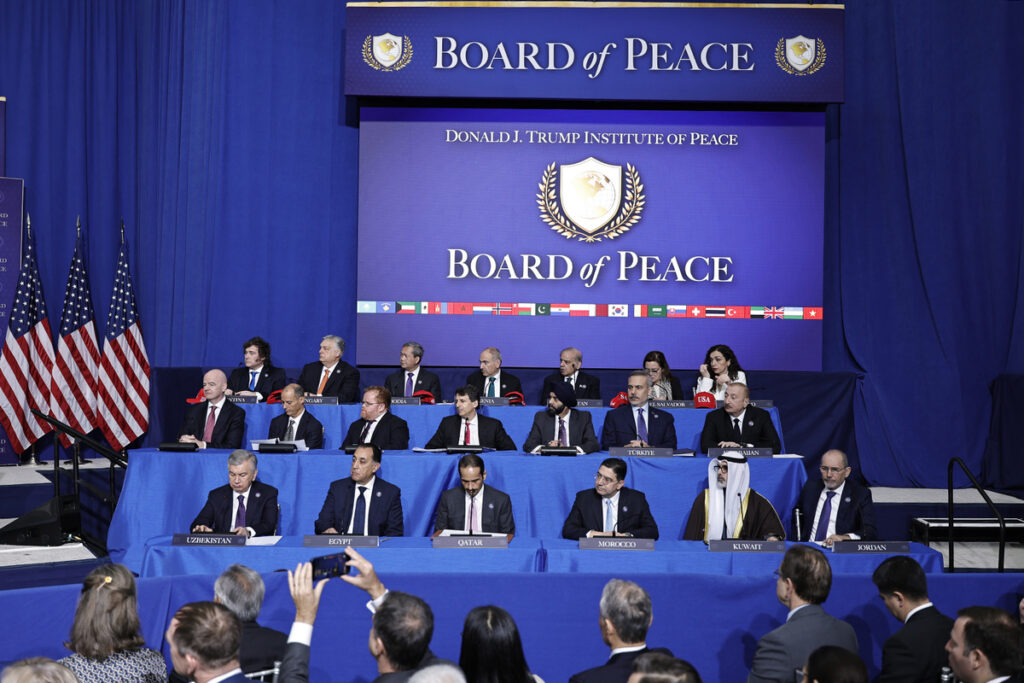
The formation of the “Peace Council” is part of a new geopolitical process. This was stated by international affairs specialist and political analyst David Karapetyan.
A structure formed under US leadership
According to Karapetyan, it cannot be ruled out that the emerging structure is viewed as a counterbalance — or even an alternative platform bypassing — the UN and other international institutions. He notes that the American side has recently stated directly that the UN is no longer relevant and does not fulfill its mission, meaning the world faces the need to create a new institutional format.
“If we follow this logic, we see that under US leadership a platform is being formed that may act as a supranational structure with its own agenda,” the analyst says.
He points out that the leaders of countries participating in the initiative mostly represent states that either have close relations with Washington, depend on the United States, or simply do not want problems with the US. Karapetyan believes the presence of the leaders of Armenia and Azerbaijan also had an imperative nature — to demonstrate that the structure already has a “peace-making precedent.”
Showcase platform or soft power tool
Karapetyan describes the “Peace Council” as a demonstrative peace platform that can also serve as a tool of soft power.
According to him, the key actor of the initiative simultaneously promotes a peace agenda while making hardline statements in different regions — including toward Iran, Venezuela and other directions. He also recalls statements regarding Greenland being considered a potential “51st state,” as well as contradictory comments about Canada, Mexico, Cuba and Colombia.
“This is both a demonstration of peace and an attempt to shape the world order from the position of a hegemonic superpower,” he says, adding that such a structure could become a platform where decisions are made not through universal consensus but through leverage.
Importance of financial participation
Speaking about possible benefits for Armenia and Azerbaijan, Karapetyan stresses that financial contributions in such structures are not only support for Gaza reconstruction but also a tool of influence. “There is a well-known saying: whoever pays calls the tune,” he notes.
According to him, disagreements are already visible around the announced multi-billion investment package for Gaza’s reconstruction. Although there were initial reports that Azerbaijan might join the financial package, this component later disappeared from official statements, which the analyst says may indicate the first internal cracks.
Armenia, for its part, has officially stated it will not provide financial participation. Karapetyan argues that if both countries limit themselves to symbolic presence without financial commitments, they may lack serious leverage over decisions in the future.
In his view, if the “Peace Council” truly seeks supranational status, decisions will inevitably be made by voting, meaning financial contributions could translate into political weight.
Karapetyan believes the initiative currently has a largely demonstrative and image-political character, but its future development may significantly affect both regional and global power balances.