
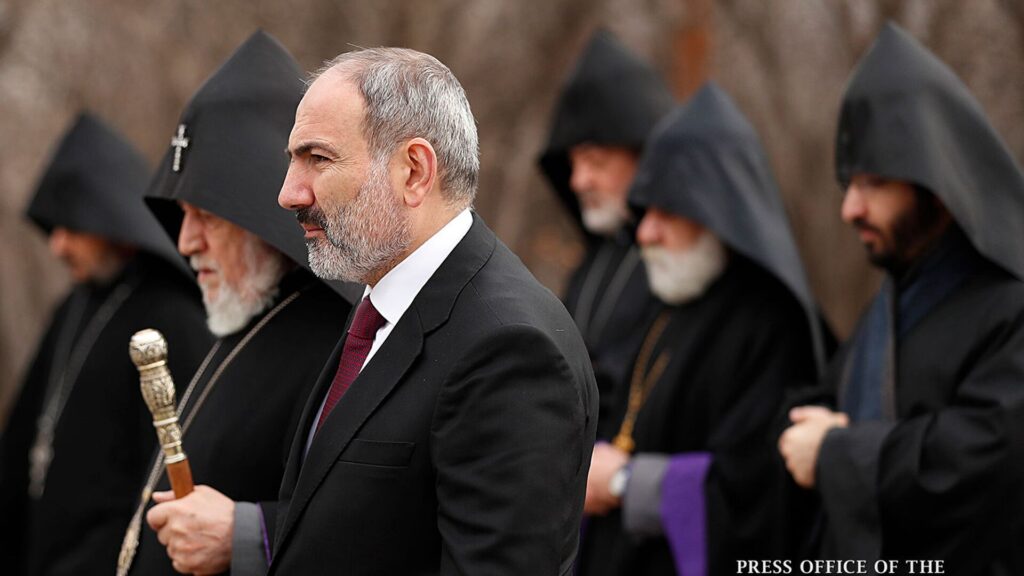
The Prime Minister of the Republic of Armenia, Nikol Pashinyan, has published an action plan he developed for the removal of Catholicos of All Armenians Karekin II from office.
Azerbaijan specialist Tatevik Hayrapetyan, referring to Pashinyan’s recent post on reforms in the Church, suggests comparing his proposals from June 10 and July 23 regarding the dismantling of the Armenian Apostolic Church.
“If on June 10 he spoke about ‘the need to take effective steps to free the Mother See of Holy Etchmiadzin and organize new elections of the Catholicos’, which may have given some naïve observers the impression that his struggle was directed solely against the Catholicos and motivated by concerns about his morality or alleged misconduct, then on July 23, Pashinyan goes further and openly reveals his true goal.
He proposes to replace the Catholicos of All Armenians with ‘some virtuous, celibate priest’, and then plans to drag the Church and the clergy into long, endless, and fruitless scholastic debates around the Statute of the Armenian Church. Only after that does he foresee the election of a new Catholicos — and even that, contingent on a ‘virtue check’ for all candidates, using methods known only to him.
Pashinyan’s post of July 23 leaves no doubt about his true goal: to disorganize and dismantle the Armenian Apostolic Church, delivering a decisive blow to one of the most essential pillars of Armenian national identity.
The issue of selecting an ‘organizational group’ and its leader, who must meet the established ‘criteria’, also deserves special analysis. Fully aware of the practical impossibility of enforcing these requirements, Pashinyan nonetheless believes he will find suitable candidates — ‘with God’s help’, through ‘spiritual vision’ (as he said on June 10), or by relying on ‘the logic of verification in communication’ (as he said on July 23). As for the leader of the movement, in his view, there can be no debate: it must be ‘the prophet of all Armenians’. After all, only he — and no one else — could allow himself such a mystical and irrational claim: “It is also clear that by declaring I will lead the ‘Let the Catholicosate Be Glorious’ movement, I must meet all the criteria myself. And since I have declared that I will lead this movement, it means I do meet the criteria.”
Bravo. What a slap in the face to human reason. This thought defies rational analysis because it is pure sophistry and fully deserves a place in the archive of impermissible intellectual manipulations and logical fallacies,” she notes.
Political commentator Arman Abovyan admits he would prefer to avoid “deliberately abnormal discussions” on the topic. “I categorically refuse to comment on these ‘velvet ideas’ regarding the Armenian Apostolic Church, as I am neither a psychotherapist nor a theologian. But when I hear a secular man propose to amend the Statute of the Armenian Apostolic Church — a document over 1700 years old — simply because ‘he feels’ that it was written by some mysterious ‘empires’, I just want to remind him that all the ‘empires’ where the Armenian Apostolic Church operated and which tried to destroy or subjugate us have turned to dust. They no longer exist. But we remain, and our Church was, is, and will forever be — as the guardian of the Armenian spirit,” he adds.
Pashinyan’s post effectively confirms the prediction made by political analyst Stepan Danielyan several weeks ago. At the beginning of the conflict between Pashinyan and the Armenian Apostolic Church, Danielyan pointed out that Pashinyan is trying to implement a Protestant model.
“Prime Minister Nikol Pashinyan has initiated a process of apostasy. Apostasy is tied to specific steps. When Martin Luther launched his famous reform of the Catholic Church, his main concern was the Church’s structure and unity. He proposed that clergy should have the right to marry — and he himself married a nun — and that preachers should be elected, as is the case in Protestant churches. When Pashinyan says that the Church must be returned to the people, he means he is trying to carry out a Protestant-style reform — essentially turning the Armenian Apostolic Church into one of the Protestant churches, where the Catholicos is elected by the people.”
Danielyan explains that the next step would involve each community electing its own preacher, effectively dismantling the unified structure of the Armenian Apostolic Church. “In other words, the AAC will cease to exist as a national structure. And in the preservation of Armenian identity, it is precisely the Church that plays a crucial role — because it is a network, and that network is centrally governed,” he emphasized.