
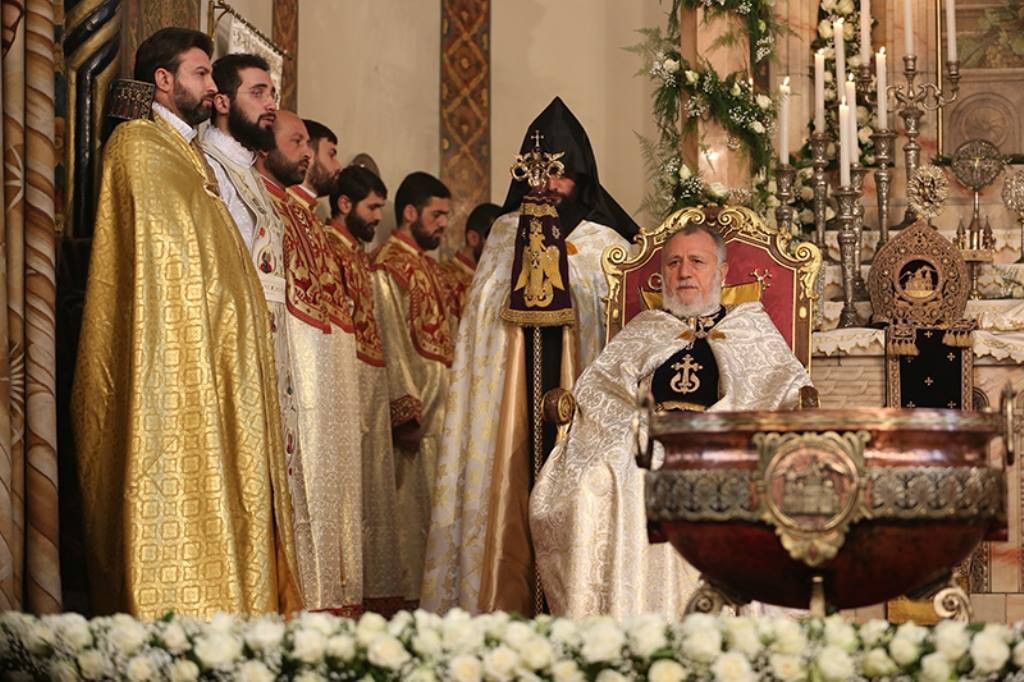
The recent statement by Prime Minister Nikol Pashinyan regarding the Armenian Apostolic Church represents an event that goes far beyond routine domestic political debate. At first glance, it appears to concern moral renewal and spiritual purity. However, beneath this ideological cover lies an initiative that, by its nature and consequences, more closely resembles an attempt at restructuring — if not subordinating — the Church by the secular authorities.
Pashinyan has presented a rather concrete program. He deems it necessary to remove the current Catholicos Karekin II from office, appoint an interim guardian, and block the possibility of holding new elections until a new canonical statute is adopted in accessible language. Only then should elections be held — exclusively among candidates who pass a “moral” examination. Pashinyan proposes that the criteria for “morality” be defined in a new document, citing examples such as daily prayer, participation in the Great Lent, full reading of the Bible, and firm faith in Christ.
Pashinyan seeks to formally create the impression that this is about inner cleansing. But when the initiative is examined as a whole, it becomes evident: for the first time in the history of independent Armenia, the secular government is proposing to change the very principle of how the Church operates — its hierarchy, canonical law, electoral system, and the authority of its traditions. This is not taking place in the form of consultation with the Church, but through a direct political statement by the head of the executive branch, who simultaneously claims personal compliance with the spiritual criteria and declares his intent to lead the movement for Church reform.
This approach raises a number of troubling questions. First and foremost, it constitutes a violation of the constitutional principle of separation between Church and state. According to the Constitution, the Armenian Apostolic Church is an independent religious institution, and its internal affairs are not subject to interference by the government or the parliamentary majority. Furthermore, Pashinyan’s formulations create a dangerous precedent whereby a state official defines spiritual norms and claims moral authority to lead within the religious domain.
The substance of the proposed “reform” also raises serious concerns. The indefinite postponement of Catholicos elections, the effective disqualification of candidates without a pre-approved “moral certificate,” and the creation of a new canon without a clear understanding of who will draft it and how — all of this risks causing a schism within the Church, alienating parts of the faithful, and paralyzing Church activity for years to come. Pashinyan may be aware of this but insists that the goal is not political, but purely spiritual. Yet the fact remains: such an initiative is bound to have political and international repercussions.
Particular concern is also caused by the rhetoric used by the Prime Minister. He states that he personally meets all declared criteria for spiritual leadership and, therefore — according to the logic of his own statement — has the right to lead the movement “Վեհարանը վեհի՛” (“Let the Catholicosate be exalted”). This kind of argument, built on a closed logical loop, essentially asserts: “I have the right because I’ve already declared I have the right.” This is not merely a weak line of reasoning — it is a claim to exceptional messianic leadership, which is unacceptable in a democratic state and incompatible with the traditions of humility and modesty that lie at the heart of Christian worldview.