
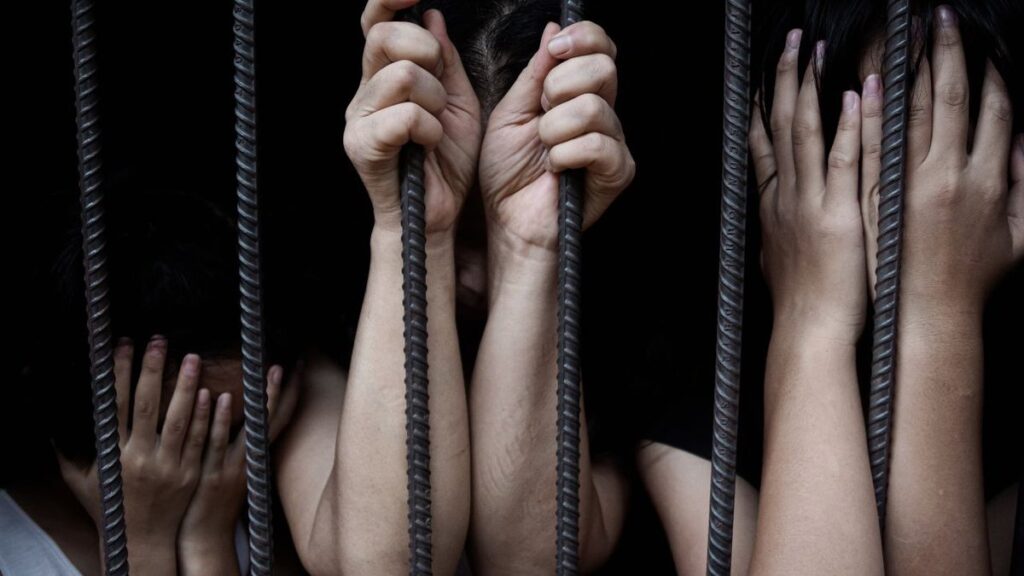
According to data from Armenia’s Investigative Committee, the number of criminal cases related to human trafficking has shown a steady increase over the past five years. While only 10 cases were initiated in 2020, the first half of 2025 saw 22 cases. Notably, for the first time since 2021, sexual exploitation cases have significantly outnumbered labor exploitation cases: 15 versus 7. However, experts emphasize that this is merely the tip of the iceberg, as most victims either do not recognize their status or refuse to speak out.
Tigran Kirakosyan, Deputy Head of the Department for Investigation of Crimes Related to Human Trafficking, Sexual Violence Against Minors, and Illegal Drug Trafficking at the Main Department for Especially Important Cases of Armenia’s Investigative Committee, identifies the growing trend of internal trafficking—both sexual and labor—as the primary development in recent years. In 2021, 16 cases were recorded (9 for sexual exploitation and 7 for labor exploitation), followed by 8 in 2022, and 27 in 2023, of which 23 were related to labor exploitation. In 2024, the number of cases reached 38—20 for sexual exploitation and 18 for labor exploitation. In 2025, 22 cases have already been initiated in just six months.
Kirakosyan highlights a 2021 case as an example of new forms of trafficking, where a man used social media to blackmail several individuals into sending him nude photos and videos. He was sentenced to eight years in prison. According to Kirakosyan, the perpetrator exploited the vulnerable emotional state of victims affected by the 2020 war.
The Investigative Committee reports a significant reduction in cases of trafficking of Armenian citizens abroad in recent years, with such incidents now being rare. Nevertheless, Kirakosyan notes that in previous years, cases of labor exploitation of Armenian citizens in construction and agriculture in Russia, as well as sexual exploitation in the UAE, were recorded.
At the same time, the vector of human trafficking in Armenia is shifting: while the country was previously seen as a transit or source country, it is now becoming a destination country. According to Arzuman Harutyunyan, head of the Association of Audiovisual Journalists, recent years have seen cases of exploitation of foreign nationals, particularly from India, Tajikistan, and Uzbekistan, with criminal cases initiated in response.
When a Man Is a Victim: Breaking Stereotypes
Experts are paying particular attention to the changing gender profile of victims. While it was previously assumed that trafficking victims were exclusively women, cases of male exploitation are now being recorded. As Harutyunyan emphasizes, “In the past, no one believed that an Armenian man could be a victim. It didn’t fit into societal consciousness.” Many affected men refused to acknowledge their victim status, even when facing exploitation, due to shame, pride, fear, and a lack of basic legal literacy. According to Harutyunyan, this is starting to change, thanks in part to the efforts of law enforcement and awareness-raising campaigns. “The challenges faced by male and female trafficking victims are increasingly converging, and this is a very important shift,” he believes.
Nevertheless, victims’ willingness to seek help remains extremely low. One of the most pressing issues is publicity: even with full anonymity and protection of personal data, victims often refuse to share their stories. The reasons include fear of judgment, secondary victimization, and traumatic experiences of betrayal by loved ones.
“It’s Your Own Fault”: How Society Re-Traumatizes Victims
Harutyunyan stresses, “When a victim dares to speak out, society often rejects them. On the contrary, it labels and condemns them, and as a result, the victim becomes a victim twice over.” He cites examples where neighbors, relatives, or friends, instead of offering support, blamed the victim, triggering even more severe consequences. “There have been cases where individuals, unable to find support, turned to crime themselves, becoming involved in trafficking from the other side. This is a terrifying trend.”
Experts agree that the problem runs deeper than it may seem. One of the most significant barriers is victims’ lack of awareness. According to Tigran Kirakosyan, many victims not only fail to recognize themselves as such but also “deify” their exploiters, a phenomenon reminiscent of Stockholm syndrome—a psychological condition in which victims begin to justify or even defend their perpetrators. “They say, ‘He’s our savior.’ We encounter people who either have only primary education or no education at all; they don’t understand what’s happening to them. The level of legal awareness is very low,” Kirakosyan says.
He provides an example: a person works all day, earns 1,000 drams, and genuinely believes this is fair compensation. Awareness of the injustice does not come, and investigators must make significant efforts to explain to the victim that they are a victim of a serious crime.
Harutyunyan also highlights a cultural barrier: “In our society, almost everyone knows everyone. People are afraid: what if someone finds out? Admitting that you were exploited is a tremendous source of shame. We encounter this in both awareness-raising efforts and legal protection work.”