
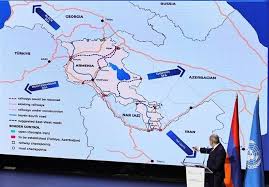
For a long time, Armenia’s authorities firmly denied any discussions about granting long-term land use rights in the Syunik region under the “Trump Route for International Peace and Prosperity” (TRIPP) project. Officials called such claims speculation and political manipulation. However, the moment has now come when the government was forced to admit that such a scenario is indeed being discussed.
What Is the Core Issue?
Prime Minister Nikol Pashinyan stated that the government is considering granting development rights for 49 or even 99 years.
According to him, the company would receive the right to build on the land, while the land itself remains the property of Armenia. After the development rights expire, all infrastructure on that land would become state property.
Pashinyan argued that long-term development rights are needed to attract investors. An investor must be confident that they will recover their costs and secure a predictable profit margin.
A development right is a special form of long-term lease. The investor receives not only the land for use but also broad powers: the ability to build, manage and operate infrastructure without additional state approval. The investor can also set transit tariffs and keep all revenue for decades.
In practice, this transfers economic control over a strategic corridor to a foreign company for a period comparable to the lifetime of two or three generations.
Risks for Armenia
Granting long-term development rights to a foreign company carries serious risks. Armenia may formally retain ownership of the land, but real control shifts to the investor. This creates dependency on the company’s pricing, management decisions and geopolitical interests.
A 99-year framework is especially dangerous. It effectively freezes Armenia’s sovereignty over a transport corridor for a century. The investor may block alternative uses of the land, dictate operational conditions or influence regional dynamics.
Given the tense relationship with Azerbaijan, such a corridor could become a “grey zone” under foreign control, escalating national security risks.
A similar case occurred in Sri Lanka. In 2017, the Hambantota port was leased to China for 99 years under the Belt and Road Initiative. The project initially promised economic growth but led to a “debt trap”. China gained control over 70% of the port’s shares and 15,000 acres of land. By 2025 the port processed 150,000 containers (35% growth in a year), yet the new Sri Lankan president called the deal a “mistake” due to sovereignty losses.
Financial Risk
Financial concerns deepen the problem. Experts estimate that Armenia may receive less than 0.1% of GDP from transit fees.
If project traffic is lower than expected, Armenia’s revenue becomes symbolic.
Long-term contracts often include arbitration in foreign courts (London, Geneva or the US). Historically, developing countries frequently lose such cases, which increases economic vulnerability.
Environmental Risks
Long-term development rights also create ecological and social risks. They allow the investor to build without additional state approval. This may result in ignoring local environmental standards, land degradation or forced resettlement.
For Armenia, and especially for the fragile ecosystems of Syunik, these risks could lead to environmental damage, local protests and long-term social tension.