
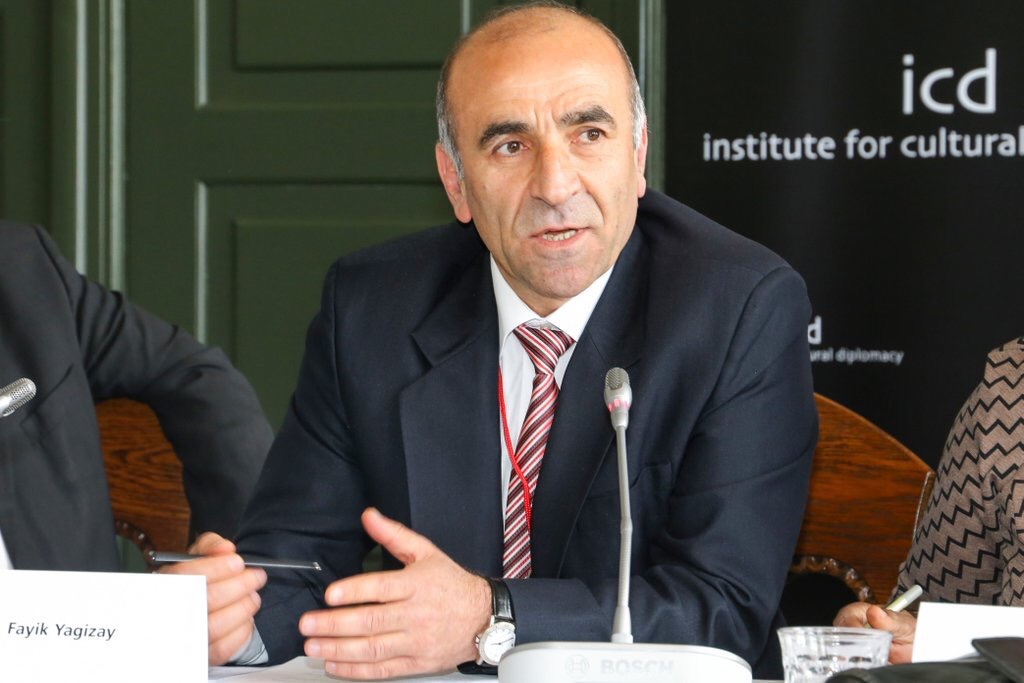
Interview with Fayik Yagizay, Peoples’ Equality and Democracy Party (DEM-Party) Representative to the European Institutions in Strasbourg for VECTORS.
Öcalan ’s call for disarmament — do you believe this was his voluntary decision, or was he pressured?
There’s no doubt — he made this decision voluntarily. He’s carefully observing the current political situation and understands that continuing the armed struggle will no longer achieve any political gains. Instead, it would only waste time, human lives, and resources.
That’s why he chose this path. I’m convinced his decision was entirely voluntary. Yes, he’s imprisoned, isolated on an island under Turkish state control, but his mind and his will have never been controlled by the state. He has remained free in spirit.
Given the ongoing shelling in Iraqi Kurdistan, how realistic is it to follow his advice? Do you believe full disarmament is possible under such circumstances?
Of course, this is a major challenge. On one hand, there’s a clear desire to end the conflict — Öcalan has called on the PKK to dissolve itself, to lay down arms, and to shift the struggle to the political arena. Yet despite this, the Turkish state continues its bombardments and military operations. This is a serious obstacle, and it highlights the biggest problem: there’s no progress in the actual peace process.
We’re faced with a contradiction. On one side, military attacks continue; on the other, no meaningful steps have been taken toward peace. Öcalan is urging the Turkish state to act, but so far, all the initiatives have come from him and the PKK — the state has taken none.
This seems like a one-sided concession. There’s clearly no trust, especially since nothing has changed on the Turkish side. Do you think this situation could lead to the rise of a new Kurdish leader?
No, that’s unlikely. The vast majority of Kurds support Öcalan . They stand behind his decision, and they celebrated it. Across Kurdistan, people welcomed his call for peace. The Kurdish struggle has lasted more than 40 years. While we can’t claim full independence — which was the PKK’s original goal — we’ve achieved important victories. Above all, we’ve ended the policy of denial. In the past, the Turkish state refused to acknowledge that Kurds even existed. They claimed there were no Kurds in Turkey, only so-called “mountain Turks.” They denied the existence of the Kurdish language, saying it was merely a dialect of other languages.
That era is over. The Kurdish people exist, and they’re recognized as such. That in itself is a significant achievement. But now, these denial policies have ended. Even though, officially, in the constitution and in state institutions, the Kurdish language is still not allowed to be used or taught as a language of education, at least now nobody in Turkey can claim that Kurdish people do not exist. This is important. Another example is the DEM Party, which now receives more than 10 percent of the vote. Under normal democratic conditions, we would get more — perhaps 15 or even 20 percent of the votes in Turkey. This is one of the most important achievements after this struggle. Kurdish society itself has also changed. Before the PKK, it was a very feudal and patriarchal society. Now, in the Middle East, I can say that Kurdish people are among the most progressive — advocating for women’s rights, gender equality, minority rights, and freedom of religion. All of this is thanks to the PKK, which transformed society. Today, the Kurdish people are more self-confident and better organized. In Rojava, for example, we have a de facto autonomous administration system — also thanks to the PKK’s struggle. I can tell you that even in Iraq, without the PKK’s influence, Barzani and the Talabani would never have achieved autonomous status. Ironically, in its efforts to stop the PKK, the Turkish state itself supported this autonomous administration in various ways. So, in a sense, this too can be seen as a result of the PKK’s actions. In Iranian Kurdistan, the Jin, Jiyan, Azadi movement and related demonstrations were also organized by the PJAK. So, the PKK achieved many gains beyond Turkey itself. From now on, as Öcalan said, in order to defend and strengthen these gains, we no longer need to fight in Turkey. Our struggle can continue through democratic and peaceful means. Unlike Syria, Iran, or Iraq, Turkey is a member of NATO, the Council of Europe, and a candidate for the European Union. Officially, Turkey is considered a democratic state, as it belongs to these institutions. Although in reality this is questionable, we believe that now we can pursue our goals through democratic and parliamentary processes — peaceful struggle, and all forms of activism except armed struggle. It is possible. However, the Turkish state now claims that Öcalan ’s disarmament call applies to Kurds in Syria, Iran, and elsewhere — but this is not true. Mr. Öcalan himself said it would be impossible for the Kurdish people in Syria to lay down their arms. Today, Kurdish people in Syria are fighting against ISIS. There is a serious threat to the existence of Rojava. In Iranian Kurdistan, the situation is even more dangerous. The state there could easily suppress Kurdish rights. In Iraq, the situation is somewhat better due to the federal system. But in other regions, it remains extremely dangerous. And in Turkey, as I said, if we can truly democratize the country — which should be the norm if it wants to be part of the Western world — then, as a member of the Council of Europe, Turkey would be expected to follow the rules that all member states are supposed to respect.
But Turkey has been a member of the Council of Europe for decades, and nothing changed… Do you have any plans? How will you address the recent shelling of Iraqi Kurds by Turkey?
We’re in contact with the opposition, and we’re calling on the Turkish government to stop the shelling. For any peace process to succeed, this must end. Shelling on one side and calls for disarmament on the other will not lead anywhere. This contradiction blocks progress. If this process is to succeed, Turkey must stop its military operations and pass legal reforms. There must be laws ensuring that those who lay down their arms can return to Turkey without fear of imprisonment, execution, or repression. These are basic conditions for the process to work. The Turkish state claims that there are no conditions, no negotiations, no bargaining — yet, there are basic principles that must be respected for peace to be possible. The Turkish state must change the conditions created under Öcalan , who now controls this process. He should be freed, and he should be allowed to play his role. Another key issue is the thousands of political prisoners in Turkey. For example, our former co-chair Selahattin Demirtas, Figen Yuksekdag, as well as some former mayors and members of parliament — not just from the HDP, but from other opposition parties — are still in prison. The CHP’s presidential candidate, Ekrem Imamoglu, and the mayor of Istanbul himself are also in prison. All political prisoners should be released.
So, is this a precondition — a clear precondition — for the Turkish state?
It is a condition for us. However, before we set these conditions officially, Öcalan did take some steps. He showed willingness and made initial moves, signaling his commitment to this process. Now, we are waiting to see how Turkey responds. Öcalan called on the PKK to dissolve itself — and the PKK did. He called on the PKK to lay down arms — and they began disarmament. Now that PKK members have complied and laid down their arms, the responsibility lies with Turkey. It is Turkey’s turn to take concrete steps. For now, we will wait and see.
If nothing happens, will you change tactics and return to armed struggle?
This is currently being debated. This week, discussions are underway to establish a parliamentary commission specifically dedicated to addressing this issue—how to move forward and what practical steps need to be taken by the Turkish state. We see the formation of this commission as an important development. It would include representatives from all political parties in parliament: the DEM Party, MHP, AK Party, CHP, and smaller parties as well. The participation of the opposition, not just the government, could open the door to more balanced negotiations. Only one or two extreme right-wing parties have refused to participate in the commission. But this isn’t a significant issue—it’s neither surprising nor a serious obstacle to the process.
What are your expectations from this commission?
We expect the commission to recommend legal reforms to the parliament—specifically, changes to the law that would allow those who laid down their arms to return to Turkey without facing imprisonment. We also hope for progress regarding Mr. Öcalan ’s situation. Ideally, a general amnesty could be considered, allowing all those in exile to return freely. This commission can propose such measures to parliament, and from there, the parliament and government will have to decide whether to accept them.
Beyond ending the conflict itself, we hope the commission will also address the root cause of the issue: the Kurdish question. This includes long-standing demands like recognizing Kurdish as a language of education. We’re not asking for it to replace Turkish, but at least to offer Kurdish as an option in schools—especially in regions where Kurds are the majority. Today, there are schools in Turkey where the language of education is entirely in English or French. Why should Kurdish be treated differently? In parts of Kurdistan, Kurdish-language education should be possible. This would be a meaningful step towards democratizing Turkey.
There are already numerous recommendations to Turkey from the Council of Europe on these issues: from the use of minority languages to principles of local self-governance. Turkey is bound by several conventions under the Council of Europe framework. If Turkey fully complies with these standards, we believe that many things in the country will improve.
The struggle of the PKK has already transformed Kurdish society in a democratic direction. As Mr. Öcalan highlighted in his statement on February 27th and in his most recent message: when the PKK began its struggle, the world was divided between two blocs—the Soviet bloc and the NATO bloc. But after the collapse of the Soviet Union in 1991, the entire global system shifted. Since then, Mr. Öcalan has been working to achieve peace with the Turkish state—not by seeking an independent, socialist Kurdistan, but by pursuing a democratic solution within Turkey itself. Since as early as 1993, Mr. Öcalan has made multiple attempts to find peace, but unfortunately, Turkey wasn’t ready.
There were some attempts by Turkish governments, most recently between 2013 and 2015, but those efforts failed. One reason was that Erdoğan tried to manage the process exclusively through his government, without including broader actors in society. We repeatedly urged him to involve everyone, as peace in Turkey requires national consensus. Unfortunately, that process collapsed.
This time, however, things are different. Not only is Erdoğan involved, but even the MHP—the most nationalist party in Turkey—under Devlet Bahçeli, is participating. That gives us hope. Even the CHP, which previously rejected the peace process, is now showing support. Overall, I can say that around 90% of the political parties currently represented in the Turkish parliament support this process. So yes, we believe that this time, success is possible.
Your main demand focuses on equal rights and reforms, but what about the right to self-determination? Is this part of your agenda too?
There are two main stages in this process. First, stopping the fighting and ensuring that armed struggle does not return. Second, addressing the political dimension of the Kurdish question. But this isn’t just a Kurdish issue—it’s fundamentally about the democratization of Turkey itself. If Turkey genuinely becomes a democratic state, operating according to democratic norms and principles, we believe most of the Kurdish people’s demands will naturally be met. And not only Kurds—there are other minorities in Turkey too: Assyrians, Armenians, Yazidis, and others. Many of these communities are much smaller than the Kurds and have been heavily assimilated, but they should still have their languages, cultures, and identities officially recognized and protected.
At this stage, we are calling for basic, concrete steps to make peace possible. Those who lay down arms should be allowed to return to Turkey and participate in democratic politics without fear of imprisonment or execution. Mr. Öcalan should be freed and allowed to contribute directly to this process. But more importantly, the root cause—the Kurdish question—must be resolved. Without addressing this, there’s always the risk that new movements, potentially even stronger or more radical than the PKK, could emerge. Ending this war isn’t enough. A political solution must be found for the Kurdish people, who, as you know, are divided across four different states.
Do you envision these four Kurdish communities uniting in some way, despite their different realities?
Originally, Öcalan and the PKK aimed for a united, independent, socialist Kurdistan, bringing together Kurds from Turkey, Syria, Iraq, and Iran. That was the strategy at the start of the armed struggle. But after the collapse of the Soviet Union, and after decades of fighting, the PKK recognized that the conditions had changed. Achieving that vision was no longer realistic.
Today, Öcalan’s philosophy rejects the nation-state model entirely. He argues that the nation-state, which has dominated since the French Revolution, is itself the problem. No nation-state in the world today is made up of a single, homogenous population. Borders always contain multiple peoples. Nation-states tend to assimilate or suppress minorities, trying to force one national identity on everyone, as we see in Turkey. In authoritarian regimes, this leads to direct repression. In democracies, the situation is better, but not without problems.
If Turkey becomes a true democracy, we believe coexistence is possible without needing a separate Kurdish state. Smaller minorities that already feel assimilated may not seek cultural or linguistic rights, but the Kurdish people are different. We are 25 to 30 million in Turkey alone, and around 50 to 60 million globally. We haven’t been assimilated. We have our language, our culture, and we live concentrated in a distinct region. Therefore, the solution cannot only be about culture and language. The problem is systemic—Turkey’s over-centralized state structure. All decisions are made in Ankara, which doesn’t understand local needs. Even when Kurds elect their own mayors and local councils, the Turkish government removes them, imprisons them, and appoints state trustees. This undermines democracy itself.
For the peace process to succeed, urgent legal reforms are necessary. People who lay down arms must be allowed to return safely. They must be given the conditions to participate freely in democratic life. The Kurdish question must be openly discussed in parliament—with all political parties involved.
But beyond parliament, civil society must also have a voice. NGOs, local communities, and different segments of Turkish society all suffer from this conflict and should be part of the dialogue. War affects everyone—not just Kurds. A broad, inclusive process is essential.
This time, I’m more hopeful. Even if Erdoğan himself hesitates, this is now a decision of the state, not just one political leader. The state must think beyond Erdoğan’s personal future. They must consider Turkey’s future. That’s why I believe, more than before, that peace is possible.