
Armenia is expected to hold what could be described as the most geopolitically significant elections in its history this June. This view is shared by political analyst Tigran Grigoryan.
“When discussing the geopolitical nature of elections in Armenia, it is important to distinguish between two main dimensions — internal and external,” the expert noted.
Internal dimension
According to him, for the first time in Armenia’s history, the main political actors with realistic chances of entering parliament have clearly defined geopolitical preferences.
The ruling force, as Grigoryan describes it, has in recent years pursued a policy of “diversification,” aimed at reducing one-sided dependence on Russia. Active engagement is underway with the European Union and the United States, including in the military-technical sphere. “While a complete shift in foreign policy orientation is unlikely in the near term, there is a clear emphasis on deepening ties with the West and a noticeably active public criticism of Russia’s policies,” he said.
The main opposition forces, he continued, hold largely pro-Russian positions. They argue for restoring relations with Russia and link many of the recent challenges to the policies of the current authorities, including their approach toward Moscow. These groups emphasize the need for a “strong ally” and external “guarantors,” viewing Russia as one of the key actors in ensuring peace.
External dimension
Grigoryan also notes that, for the first time in the South Caucasus, all major external actors — Russia, the European Union, and the United States — are demonstrating clear and explicit preferences.
Russia, in his view, is openly targeting Armenia’s current authorities using hybrid tools. The recent meeting between Vladimir Putin and Nikol Pashinyan was illustrative: it included economic pressure signals and open references to pro-Russian forces, as well as discussions about the participation of political figures holding Russian citizenship.
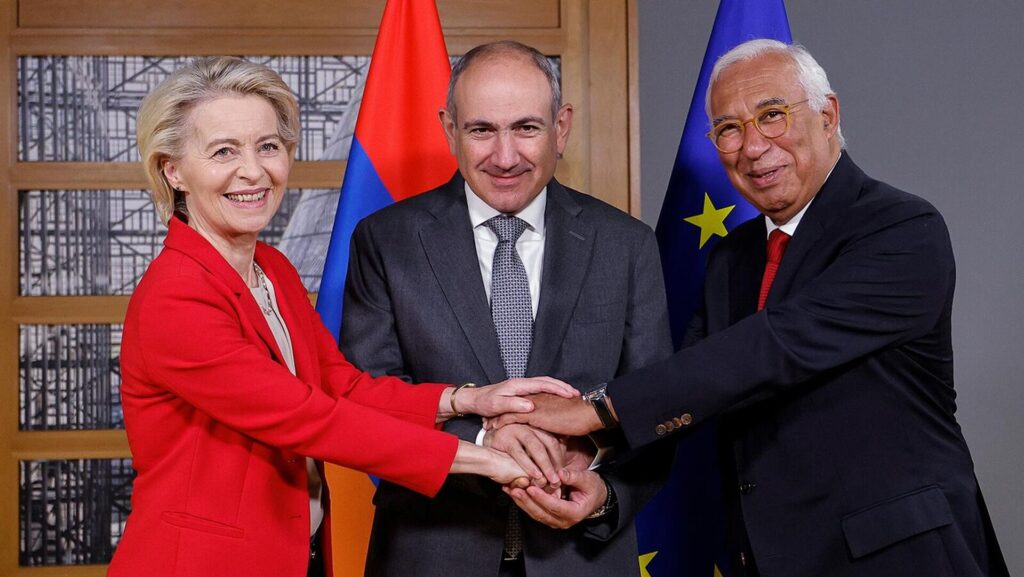
The European Union and the United States also maintain defined positions. Brussels does not explicitly endorse Pashinyan’s re-election, but its actions suggest support for the current government. This includes the planned European Political Community summit in Armenia one month before the elections, followed by the first-ever EU–Armenia summit. The EU is also seen as overlooking certain controversial actions by the authorities.
In the case of the United States, support has been more openly expressed. During his visit, the US Vice President stated a preference for Pashinyan’s re-election. A key factor is also the “Crossroads of Peace” (TRIPP) project, whose success the current US administration associates with the continuation of the existing leadership.