
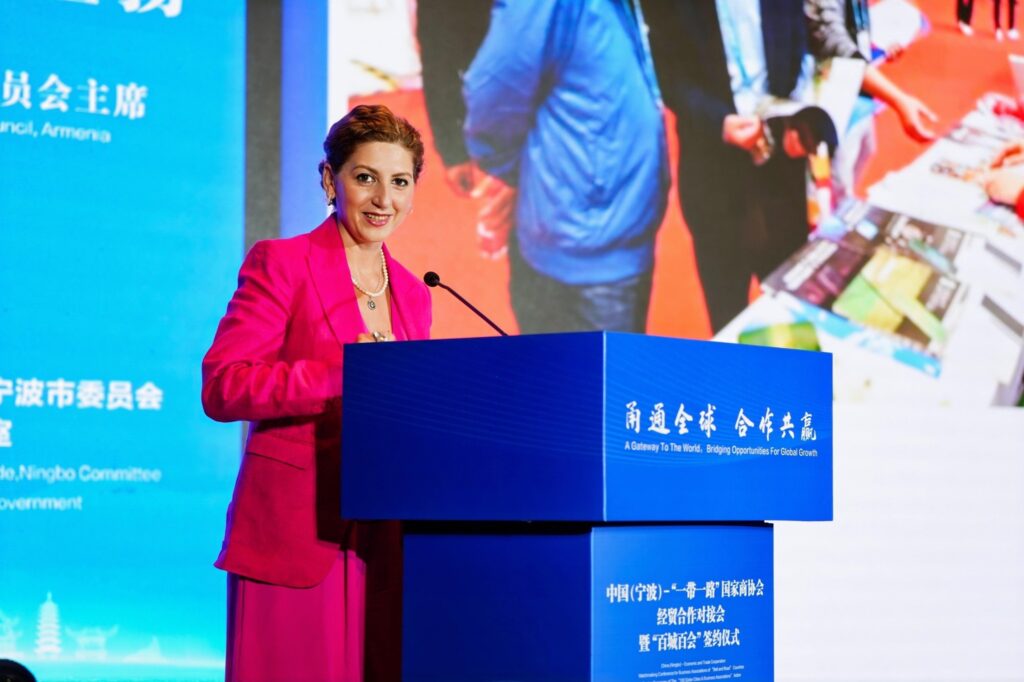
The Armenian economy faces a critical choice: continue relying on the EAEU market or seek new directions for growth. Mariam Manukyan, President of the Council for the Support of International Business Relations, believes that without diversifying its export markets, the country risks hitting its own limits.
According to her, in recent years there have been increasingly frequent statements about a possible choice between the European direction and the EAEU market, and this issue is no longer purely theoretical.
“I’ll be honest: the EAEU has significantly hindered the quality promotion of Armenian products. Today we have exactly what we have,” Manukyan stated.
She explains that the problem lies not only in politics, but also in the very architecture of economic processes. Armenia’s customs and tax systems were built to meet EAEU requirements, which, in her opinion, has complicated exports to other directions.
“If, for example, China enjoys free customs procedures with Georgia, Armenia does not have such opportunities. We cannot simply export to Europe today without additional tax and procedural barriers,” she noted.
At the same time, Manukyan does not call for an immediate withdrawal from the EAEU, stressing that this would be a political decision. However, she believes the country must be prepared for any scenario.
“If such a political decision is made, Armenia must already have ready alternative directions and a clear roadmap,” she emphasized.
One of these directions, according to her, is the opening of the border with Turkey. Despite the sensitivity of the issue, Manukyan advocates a pragmatic approach:
“As a specialist, I support opening the borders. Yes, it carries risks — primarily increased price competition. But Turkey is already our competitor today, for example, in the dried fruit market,” she said.
In her view, Armenian producers have already reached a level that allows them to compete in international markets, including the United States. As an example, she cited a dried fruit company that cannot keep up with export orders due to their high volume. “This is proof that we have potential,” Manukyan stressed.
She also does not rule out economic cooperation with Turkish producers, but emphasizes that this should be purely a business approach, not a revision of historical memory. She drew a parallel with France and Germany, which managed to build close economic ties after World War II.
“Today, when traveling across Europe, you can’t even tell where one country ends and another begins,” she remarked.
Nevertheless, Manukyan warns of the risks associated with opening the market, particularly the possibility of dumping by Turkish companies.
“We are already receiving offers — for example, glass containers supplied at three times lower prices than on the Armenian market. This is classic dumping policy aimed at pushing out the local producer,” she stated.
In this regard, she believes clear regulatory mechanisms are necessary. “This requires joint work by specialists — lawyers, financiers, and international experts — to develop norms that will not harm the economy,” Manukyan emphasized, adding that protective tariffs could be one of the tools.
In the long term, she sees the solution in developing unique sectors where Armenia can compete not on price, but on the quality and uniqueness of the product itself. She specifically mentioned the production of basalt fiber — a segment whose global market is valued in billions of dollars.
“We need to clearly understand our strengths and develop precisely those directions. Only then will we be able not just to compete, but to occupy our own niche,” Manukyan concluded.
Thus, according to her, Armenia’s key task is to move from dependence to flexibility — through market diversification, the development of new logistics routes, and the search for its own competitive advantages.