
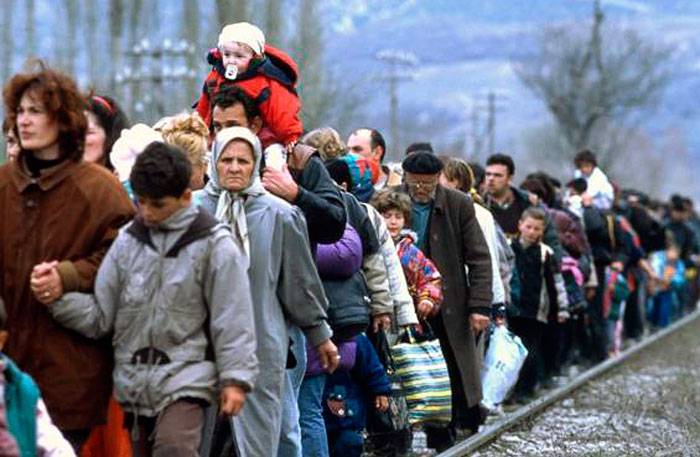
In Armenia, the refugee issue has been deliberately pushed into the shadows for many years. This was stated by former Foreign Minister of the Republic of Artsakh and Extraordinary and Plenipotentiary Ambassador of the Republic of Armenia Arman Melikyan. In his assessment, Armenian political elites not only failed to offer adequate solutions to the problem but generally refused to discuss it seriously.
Half a Million Refugees — Amid Political Silence
Melikyan noted that more than half a million Armenian refugees were forcibly displaced from Baku and other settlements in Azerbaijan. At the same time, according to him, roughly the same number of Azerbaijani population was displaced overall.
“Since the mid-1990s, all Armenian authorities have effectively removed the issue of Armenian refugees from political circulation,” he emphasizes.
He compares the approaches of Armenia and Azerbaijan, pointing out that Azerbaijan developed a “Great Return” program, attracting international donors for its implementation, and work in that direction continues. In Armenia, according to Melikyan, the path of refugee integration was chosen — without sufficient resources or strategic vision.
Integration — At the Cost of Emigration and Disillusionment
According to the diplomat, the integration policy carried out with minimal funding has led to a significant portion of refugees simply leaving Armenia. Others, unable to fully find their place in public life and restore their rights to compensation for the damage caused, became disillusioned with Armenian statehood.
“People, seeing no prospect of compensation for their losses or restoration of rights, eventually gave up not only on the issue but on Armenian statehood itself,” Melikyan stresses.
The Same Danger — in the Case of Artsakh Armenians
Speaking about the forcibly displaced Artsakh Armenians, he notes that the same approach — integration with limited resources — is currently being implemented in practice.
In Melikyan’s conviction, if Artsakh Armenians do not take active steps to preserve their identity, over time they may dissolve into the population of Armenia. “In that case, Artsakh as one of the cradles of Armenian identity will be lost, because the bearers of historical memory will assimilate and cease to have their unique face,” he says.
A Question of Political Choice
Melikyan emphasizes that if the issue is properly framed and returned to the political agenda, opportunities exist. “Such opportunities have existed, exist now, and will exist in the future. This is a matter for the political elite to decide,” he notes.
In his view, an incompetent elite or one adapting to the external environment may try to push the issue back into the shadows again. However, as the former minister stresses, this does not mean it can be kept in a “dark basement” forever: the refugee issue will continue to remain one of the key problems on the Armenian political and national agenda.