
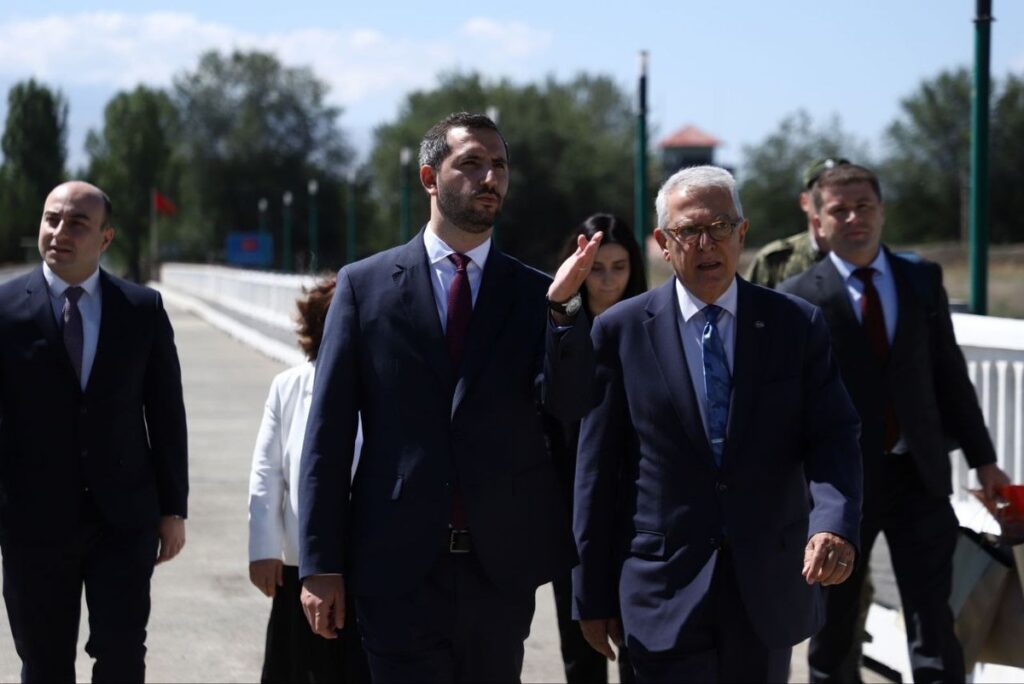
The Armenian Foreign Ministry announced an upcoming meeting of intergovernmental delegations with Turkey in the coming days, confirming earlier reports by the NTV channel. According to media reports, the delegation led by Ambassador Serdar Kılıç will travel to Armenia through the Alican checkpoint. At the first meeting, the parties may discuss practical steps toward normalizing relations and implementing previously reached agreements. Amid rumors of the meeting and optimism from authorities about the prospects for settling relations with Turkey and Azerbaijan within the framework of the TRIPP project and the signing of a peace treaty, discussions have intensified about the new opportunities and challenges that may await Armenia’s economy.
The most complex myth
Economist Tigran Jrbashyan noted that, in the context of border reopening, “we are dealing with the most complex myth rooted in our deep perception of security.” He mentioned that he first conducted research on this topic in 2006–2007. The results of the study revealed far less optimistic prospects than many had assumed, debunking the myth of multibillion-dollar profits.
“To ensure the analysis was as objective as possible, we used one of the most complex econometric models—the so-called Computable General Equilibrium (CGE) model—which allows us to assess the impact of political decisions on the entire economy. We reached several conclusions regarding the potential impact on various economic sectors, evaluating effects at both macro and micro levels. The study results were sent to Cambridge and Harvard Universities for preliminary review,” he stated.
Jrbashyan noted that, according to the study, opening the border would bring modest short-term benefits related to reduced logistics and transit costs. This could lead to some redistribution in certain market segments, but overall, GDP growth would amount to 1.5–3% within three years of the border reopening. These findings sparked significant discussion, and at a subsequent international conference on the issue, several experts using different analytical models reached similar conclusions.
This is not just about the Armenian-Turkish border
However, Jrbashyan emphasized that he would not directly apply the results of this study to today’s realities. “Today, we are dealing with a completely different structure, a different Turkey with altered logistical connections,” he explained. Nevertheless, certain fundamental aspects remain unchanged and should be considered.
First and foremost, the expert pointed out that, unlike Turkey, where Armenian goods are virtually absent, Armenia has a significant volume of Turkish products imported via Georgia, incurring additional transit costs paid to the Georgian side. If the border were opened, prices for these goods could hypothetically decrease due to reduced transit costs, and the volume of supplies could increase. At the same time, opening the border would lead to the formal establishment of trade relations, as Turkey voted for Armenia’s accession to the WTO but with a reservation that WTO rules would not fully apply to Armenia. Consequently, after the border opens, the parties would need to negotiate trade terms, which could drag on for years. For Armenia, this is less significant since exports to Turkey are practically nonexistent, whereas for Turkey, opening the border creates certain challenges.
Additionally, the expert urged not to forget that this is not just about the Armenian-Turkish border. “Turkey is part of the EU Customs Union, while Armenia is a member of the EAEU. In essence, this is the border between the EAEU and the EU Customs Union. Both sides have a say, which further complicates the processes,” he stated.