
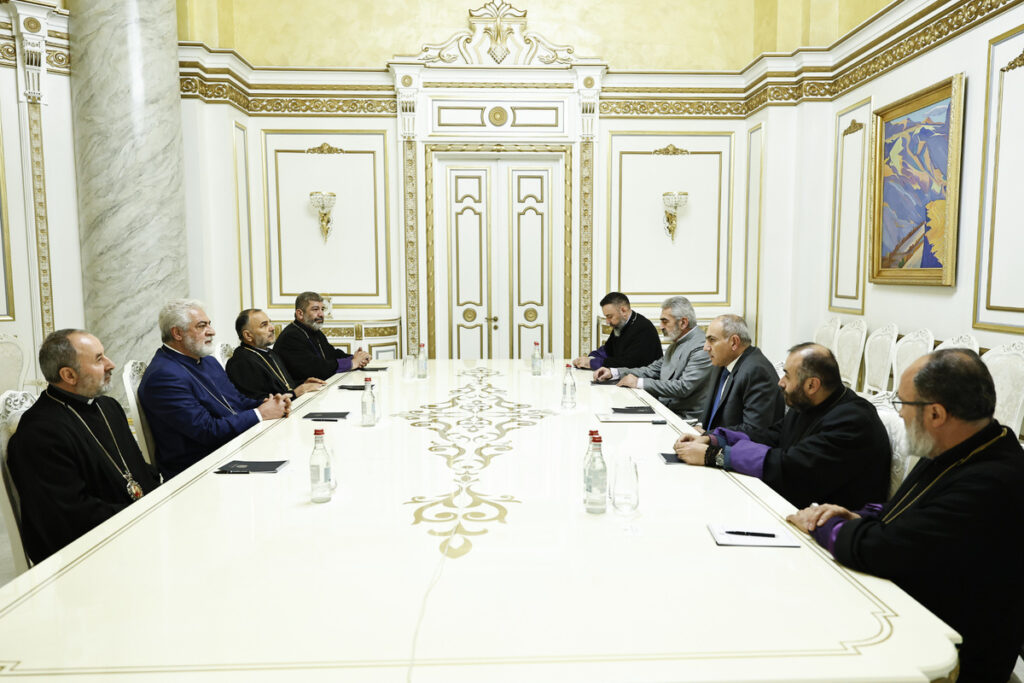
Prime Minister Nikol Pashinyan’s meeting with a group of bishops, archbishops and senior clergy became an event that many describe as a critical — and perhaps turning — point in the government’s actions against the Armenian Apostolic Church. The meeting exposed deep internal tensions and showed the limits of state influence over the Church.
Pressure From the Government and Pashinyan’s “Last Card”
According to political strategist Tigran Kocharyan, this was the peak of a long process.
“This was Pashinyan’s last card. Months of pressure attempts reached their logical conclusion,” he said.
He adds that everyone understood: the process would not be limited to individual priests.
“Work was carried out at much higher levels — inside the episcopal class. This meeting fully revealed Pashinyan’s ‘network’ in Armenia, if we can call it that.”
Why the Government Intensified Its Actions
Kocharyan notes that the government’s activation was not accidental. Previous attempts — from Ohanavan to Talin — had failed.
“In Talin, Pashinyan had huge electoral support. But even there people did not join the initiatives. This showed that the authorities were not getting what they wanted. So stronger steps followed.”
The Symbolic Importance of Archbishop Navasard Kchoyan
The expert believes the government’s resources are nearly exhausted.
“Maybe one or two more bishops will appear on Pashinyan’s side. But the peak is already clear — the presence of Archbishop Navasard Kchoyan. As head of the Ararat Diocese, he has long been seen as a leading candidate for Catholicos. His participation carries heavy symbolic weight.”
Kocharyan adds that Pashinyan’s real goal is not only to influence the next Catholicos but also to weaken or dismantle the Church as a national institution.
The Risk of a “Compromat War”
Kocharyan warns about a dangerous trend — a “compromat war” among clergy.
“This must not be allowed. It would cause irreversible damage. Clergy, under pressure or not, are dealing with the 1700-year authority of the Church. If this turns into mutual attacks, people will be disgusted. And that creates ideal conditions for sects.”
He also stresses that the Church is not a “shop” that can be replaced. Its loss would be a national and global issue.
The Legitimacy of the Catholicos Is Not Decided Only in Armenia
The expert notes that the Catholicos behaved flexibly by avoiding escalation.
“If he had escalated the situation, that would be exactly what Pashinyan was waiting for.”
He adds that some internal problems do exist, and they require careful, balanced handling.
“The Catholicos’ legitimacy is defined not only by bishops in Armenia. There are two Patriarchates, the Jerusalem Patriarchate, and the support of Aram I. This entire structure is beyond Pashinyan’s control.”
Even members of the dissenting group are not demanding the Catholicos’ removal.
“They speak about addressing an issue related to a specific person. That is another topic. But there is a red line — and it must not be crossed.”