
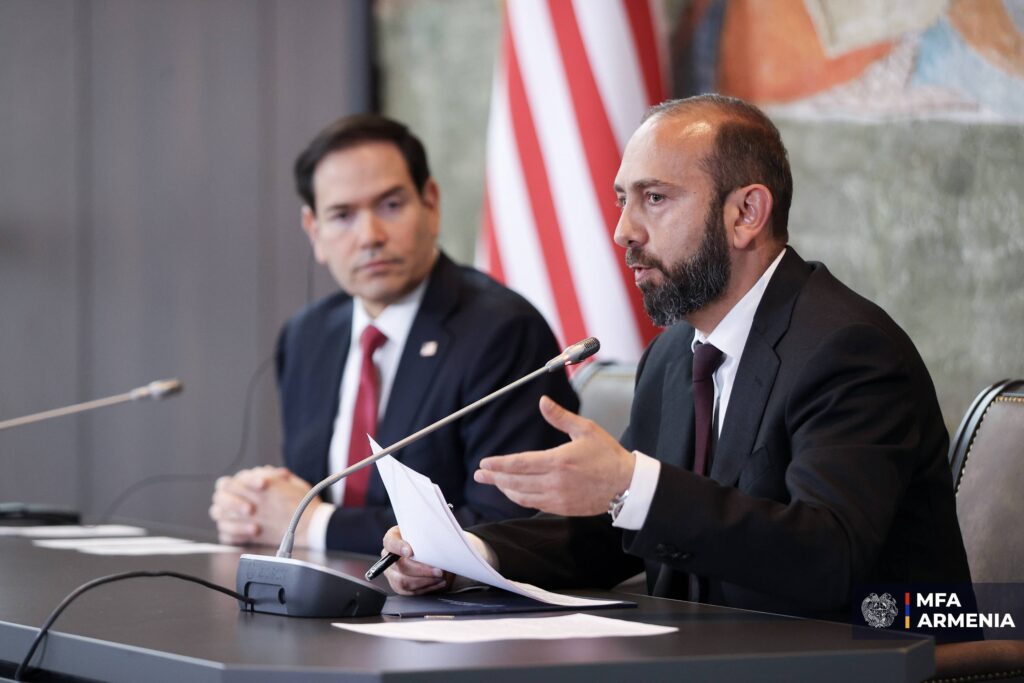
The document signed with the United States regarding the TRIPP project contains serious political and legal risks. This opinion was expressed by political analyst Arsen Gasparyan.
According to him, the diplomats who negotiated the agreement should be removed from their positions immediately. Gasparyan argues that the document contains at least six fundamental problems that could create long-term and, in some cases, irreversible consequences for Armenia.
Transfer of Sovereign Powers
The first and most important issue, according to the analyst, concerns Armenia’s status within the project.
Although the agreement does not formally involve territorial concessions, Gasparyan believes it effectively transfers part of Armenia’s sovereign powers.
“Armenia becomes a minority shareholder. There is no territorial exchange, but there is a functional transfer of sovereign authority. The transfer of 74 percent to the United States already creates a serious problem. If there was no alternative, the maximum acceptable level would have been 25 percent,” he said.
Length of the Concession
The second concern relates to the duration of the concession.
The agreement provides for a 49-year concession with the possibility of extending it for another 50 years.
Gasparyan argues that agreements of such length often become politically irreversible and create long-term dependencies.
He points to Moldova’s experience, where an airport was transferred under a 49-year concession agreement, and to Djibouti, where a port concession generated significant controversy after authorities reconsidered the long-term implications of the arrangement.
Exceptions to Armenian Law
The third issue concerns Armenian legislation.
According to Gasparyan, the document allows for deviations from Armenia’s existing legal framework.
He believes such provisions could create significant legal and political complications in the future.
“If a state agrees to legislative exceptions, it inevitably creates serious legal and political questions,” he stated.
No Dispute Resolution Mechanism
The fourth problem is the absence of a clearly defined dispute resolution mechanism.
Gasparyan notes that the document does not establish an independent arbitration body or a neutral court to handle disagreements between the parties.
“The agreement only says that disputes should be resolved through consultations. But what happens if those consultations fail? The document provides no answer,” he explained.
Undefined Project Territory
The fifth concern is the lack of geographical clarity.
According to the analyst, the agreement does not specify the exact territory covered by the project, its geographical scope, or where its operational boundaries begin and end.
“An obvious question arises: what exactly is the project area? No geographical framework is defined. Sovereign states usually determine the territory first and only then sign such agreements,” he noted.
Unequal Language of Obligations
The sixth issue concerns the wording of the document.
Gasparyan argues that the obligations assigned to the United States and Armenia are formulated using different legal standards.
“When describing American commitments, the text uses phrases such as ‘expected,’ ‘intend,’ or ‘will seek to.’ When describing Armenia’s obligations, it uses ‘must,’ ‘shall,’ and ‘is obligated to.’ This creates a clear asymmetry between the two sides,” he said.
In his view, such wording could lead to significant imbalances during implementation because one side faces binding obligations while the other operates largely within the framework of political intentions.
Potential Consequences
Summarizing his assessment, Gasparyan stated that the TRIPP agreement contains substantial political, legal, economic, and governance risks.
He believes that officials involved in negotiating and approving the document under these conditions should bear responsibility for the outcome.