
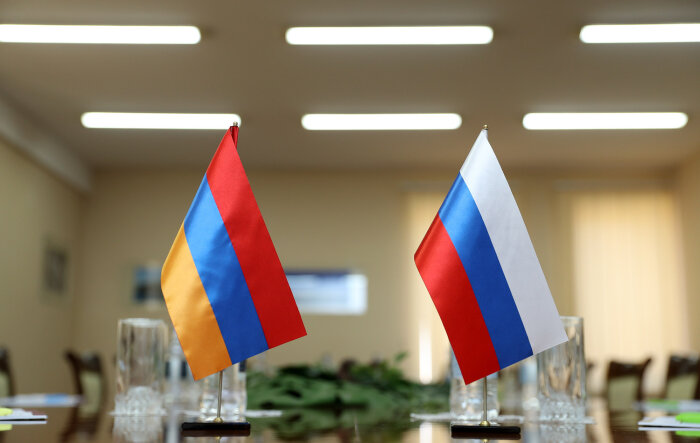
If Russia introduces long-term restrictions on imports of Armenian products, Armenia’s economy could face significant challenges. This view was expressed by former Armenian Finance Minister Vardan Aramyan while discussing the depth of trade and economic ties between Armenia and Russia.
According to Aramyan, Armenia’s total trade turnover reached approximately $21 billion in 2025, with around $8 billion linked to Russia.
Speaking about exports, he noted that direct exports to Russia amount to roughly $3 billion, while the figure rises to nearly $5 billion when re-exports are included. At the same time, Armenia’s nominal GDP in 2025 stood at approximately $30 billion.
He emphasized that re-export volumes have expanded dramatically in recent years.
“If we look at exports to the United Arab Emirates, for example, they did not exceed $200–300 million in 2022, whereas today we are talking about several billion dollars,” he said.
The Scale of the Impact Depends on the Restrictions
Aramyan believes that the consequences of possible restrictions will largely depend on their scope, direction, and speed of implementation.
If the measures target only specific product categories, each sector and company will need to be assessed separately.
According to him, the most vulnerable industries are those that rely heavily on the Russian market for sales.
These include producers of processed foods, agricultural products, mineral water, flowers, fish products, and several other export-oriented goods.
Risks for Businesses and Employment
Aramyan noted that some companies send up to 80 percent of their exports to Russia.
Such businesses would likely face liquidity problems first, as they could lose access to their primary market and struggle to sell their products.
“After that, solvency issues may emerge, especially for companies with existing loan obligations,” he explained.
The former minister stressed that the problem extends far beyond a decline in production volumes.
The suspension or reduction of operations at these enterprises could trigger a chain reaction affecting other sectors of the economy.
“These companies do not simply produce goods. They pay taxes, purchase services and products from other businesses, and create jobs. Therefore, the overall impact would be much broader than it may initially appear,” he said.
Dependence Goes Beyond Trade
Aramyan also reminded that Armenia’s economic dependence on Russia is not limited to trade alone.
There are also important links through remittances, factor income, energy supplies, and other economic channels.
“The scale of these connections is substantial. If we theoretically imagine a sudden disruption of those ties, the consequences for the economy would be significant,” he noted.
The Full Effect Will Take Time
According to Aramyan, economies function as living systems, meaning that the consequences of major disruptions rarely become visible immediately.
Even if trade relations deteriorate sharply, the full economic impact tends to unfold gradually.
“The real consequences may only become fully visible after three to six months,” the former finance minister concluded.
In his assessment, that period will reveal the true effect of potential Russian restrictions on exports, employment, tax revenues, and overall economic activity.