
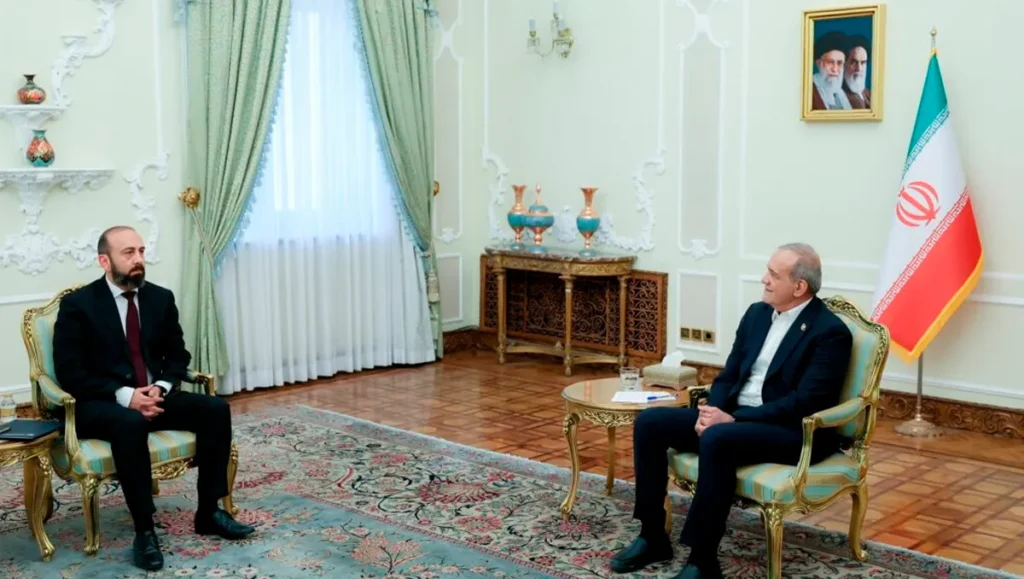
As Armenia deepens its relations with the United States, Yerevan is also seeking to preserve the trust established with Iran and develop bilateral ties. These two directions came together on the agenda during Ararat Mirzoyan’s visit to Tehran: TRIPP was presented to the Iranian side. Discussions also focused on a second Armenia–Iran bridge, the third power transmission line, energy, freight transport and other economic cooperation projects.
According to Iran expert Nver Davtyan, Tehran currently places particular importance on developing relations between Armenia and Iran.
“Judging by the statement from the spokesperson for Iran’s Foreign Ministry, one of the purposes of the visit was to develop bilateral relations,” Davtyan said. In his view, this means Tehran sees new opportunities with Armenia and expects them to be used.
Armenia–Iran cooperation has an economic foundation
Davtyan said Armenia’s geographical position and Iran’s resources create mutual interest for both countries.
“Given our geographical position, whether we want to or not, we need to strengthen and develop relations with a neighbouring country that is also friendly towards Armenia, possesses substantial industrial and energy resources, and plays a transit role,” he said.
The expert believes Iran’s capabilities have practical significance for Armenia. These include energy resources, essential products, industrial capacity and transit opportunities.
According to Davtyan, ignoring this potential would be a major loss for Armenia. He also stressed that such cooperation serves both countries’ interests and does not imply a policy directed against any third country.
Tehran is watching whether Armenia can maintain freedom in its relations
In Davtyan’s assessment, the deepening strategic partnership between Armenia and the United States raises questions in Iran about Armenia’s ability to act independently.
The expert said Iran trusts Armenia. Problems could arise if external pressure on Yerevan began to affect Armenia’s relations with its neighbours.
“Can Armenia command sufficient resources to avoid yielding to certain pressures from the United States? This is a concern for them,” Davtyan said.
In his account, Iran’s principal boundaries on this issue concern Armenia’s territorial integrity and sovereignty, as well as full Armenian control over projects implemented within the country.
Davtyan also referred in this context to the Armenia–US Strategic Partnership Charter. In his assessment, if external pressure forced Armenia to restrict relations with neighbouring countries, that could conflict with the relevant provisions of the charter.
Tehran may also see economic benefits in TRIPP
TRIPP has become a distinct issue on the Armenia–Iran agenda. Davtyan believes the project could interest Tehran if the development of regional transport links also creates new opportunities for Iran.
He discussed routes through Iran’s Julfa, Nakhchivan, Yeraskh and Armenia, followed by the possibility of reaching the Black Sea through Georgia.
“On the one hand, this involves reopening east–west transport links. On the other, reopening regional transport infrastructure also involves Iran’s Julfa, Nakhchivan, Yeraskh and Armenia, with an onward connection through Georgian territory to the Black Sea,” the expert said.
Davtyan believes such a transport system could provide new transit opportunities for Iran as well. Armenia’s involvement in this process could therefore have economic significance for Tehran.
Iran also views its links with Armenia in the EAEU context
According to Davtyan, Armenia’s membership of the Eurasian Economic Union is another factor behind Iran’s interest in the country.
The expert noted that Iran has done considerable work in recent years to develop economic ties with the EAEU. He said simplified customs procedures cover around 3,000 product categories.
Under these circumstances, Armenia is also important to Iran as an EAEU member with which it shares a land border.
“They have considerable expectations concerning Armenia as an EAEU member that shares a land border with them,” Davtyan said.
In his view, this brings together the two countries’ transit interests. Iran wants to keep its overland connection to the north open, while this route could create additional economic opportunities for Armenia.
Iran offers Armenia energy opportunities
Davtyan also discussed Iran’s significance for Armenia’s energy diversification.
He said Armenia could draw on Iran’s own energy resources while also considering imports of energy supplies from third countries through Iranian territory.
As an example, the expert mentioned Turkmen gas. The possibility of supplying it to Armenia through Iran has been discussed in the past.
“From this perspective, it is a useful country for us, and naturally we are useful to them as well,” Davtyan said, referring to energy, fuel and Iran’s industrial capabilities.
Yerevan should make clear that its relations are not directed against Iran
According to Davtyan, the further development of Armenia–Iran relations also depends heavily on trust.
He considers it important for Yerevan to make clear to both Washington and Tehran that Armenia’s relations are not directed against anyone.
“We cannot become a platform for one side against the other,” the expert stressed.
He attached particular importance to this principle given the longstanding disagreements between the United States and Iran. Davtyan said Armenia cannot expect tensions between the two countries to disappear quickly and should base its policy on long-term considerations.
“Bilateral trust is extremely important. Until now, they have regarded us as a reliable neighbour. We have not taken steps where we said one thing in our statements and did something different in practice,” he said.
Davtyan believes this trust is one of the important foundations of Armenia–Iran relations. Preserving it should go hand in hand with concrete economic and infrastructure projects.
👉 Politics