
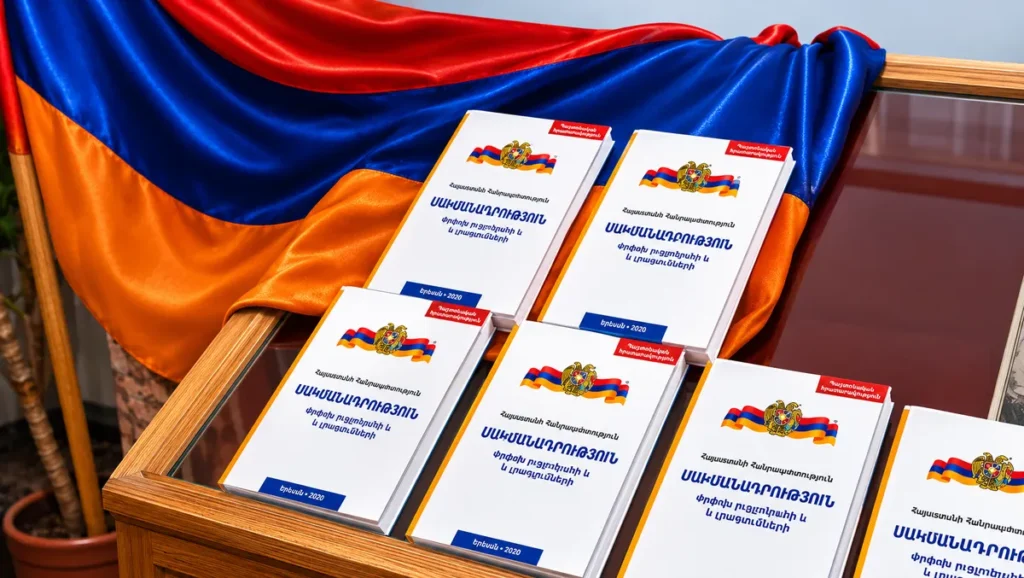
Armenia’s draft Constitution fails to strengthen the foundations of democracy and the rule of law, constitutional law expert Vardan Poghosyan said. In his assessment, the published draft removes constitutional safeguards for judicial independence, weakens parliamentary oversight and threatens the foundations of Armenia’s statehood.
“What surprises me most is how anyone could present a draft like this as a new constitution for a democratic country. There is nothing left here of democracy or the rule of law,” Poghosyan said.
The Republic of Armenia without historical or legal continuity
Poghosyan said the wording of the draft’s first article already raises a fundamental problem. In his reading, it treats the Republic of Armenia as a state to be founded by the new Constitution, without establishing legal succession.
He pointed out that the first article names the people of the Republic of Armenia as its founder. Poghosyan compared this wording to the process of setting up a new legal entity, in which the founder is identified when the entity is created.
“With this draft Constitution, we are founding the Republic of Armenia all over again, and that state has no historical roots. We are tearing down everything we have gained through struggle and bloodshed since 1990 and saying that the Republic of Armenia is founded by this draft Constitution,” he said, commenting on the removal of the reference to the Declaration of Independence from the proposed preamble.
In Poghosyan’s view, dropping the reference to the Declaration of Independence also removes the foundations of Armenia’s statehood.
The draft drops the two-thirds majority requirement
Poghosyan also discussed how the Constitution could be amended in the future. He said the draft still requires the National Assembly’s approval but lowers the threshold from two-thirds to three-fifths. “The two-thirds constitutional majority has been written out of this Constitution entirely,” he said.
Poghosyan also sees the abolition of interpellation as a problem for parliamentary oversight. Under the current Constitution, parliamentary factions can submit an interpellation to the government. The government must respond in writing, and parliament can debate the response.
According to Poghosyan, the draft retains the option of submitting written questions but removes interpellation as a distinct tool for parliamentary oversight of the government.
Sitting judges would effectively serve in an acting capacity
Poghosyan considers the provisions on the judiciary and the draft Constitution’s transitional rules the most problematic.
He said new elections are generally held after a new constitution is adopted, and governing bodies are formed under the new constitutional rules. The draft’s transitional provisions, however, provide for no change in political leadership while calling for the judiciary to be reorganized.
In his reading, all sitting judges in Armenia except Constitutional Court judges would effectively serve in an acting capacity. A five-member reassessment commission would decide whether they could remain in office.
The commission would be formed by a simple majority of all members of the National Assembly. Poghosyan stressed that even the draft’s three-fifths threshold would not apply to the formation of a commission with such significant powers.
In his assessment, commission members would have discretion to decide whether a judge had breached integrity rules or other requirements and whether that judge could remain in office. Judges subject to reassessment would still have to hear and decide cases. “What does that leave us with? This draft Constitution reduces judicial independence to zero,” Poghosyan said.
The parliamentary majority would control appointments to the Constitutional Court and the Supreme Judicial Council
Poghosyan also criticized the proposed method for electing Constitutional Court judges. If a judge cannot be elected by three-fifths of all members of parliament, a simple majority would suffice in the second round.
The draft also proposes significant changes to the way the Supreme Judicial Council is formed. Under the current Constitution, the General Assembly of Judges elects five of the council’s ten members, and the National Assembly elects the other five. Under the draft, judges could still nominate candidates but would lose the right to elect council members directly. The National Assembly would make the final choice.
Poghosyan said judges would thus lose even the formal ability to choose members of the body charged with safeguarding judicial independence. He also pointed to longer terms for court presidents and the heads of the Court of Cassation’s chambers. In his view, that provision could allow the authorities to use court presidents to influence judges and obtain rulings favorable to the government.
The draft removes the constitutional guarantee for the Administrative Court
Poghosyan also noted that the draft no longer mentions the Administrative Court. In his view, this would allow a future constitutional law to dispense with the court altogether. He described it as one of the most important bodies for protecting human rights because it hears disputes between the state and citizens.
According to Poghosyan, the Administrative Court still delivers justice in some cases, even under current conditions and considerable pressure. He therefore sees the removal of the constitutional guarantee for its existence as a serious concern for human rights protection.
The president would take part in decisions to end judges’ terms
The draft also changes the procedure for ending a judge’s term in office. Under the current Constitution, that authority rests with the Supreme Judicial Council. The draft gives the president of the Republic a role in the process. “In other words, they have directly involved a political officeholder in removing a judge from office,” Poghosyan said, calling the provision incompatible with the rule of law.
Another provision concerns the age at which judges must leave office. The current Constitution sets the age at 70 for Constitutional Court judges and 65 for other judges. Under the draft, those limits would be set by constitutional law. Poghosyan said a three-fifths parliamentary majority could then lower the age limit to 60 or 55, for example, ending the terms of judges who had reached that age.
Absolute power in the hands of one political center
In Poghosyan’s assessment, the draft threatens judicial independence and imposes restrictions on citizenship, voting rights and other fundamental rights that he considers unacceptable in a modern state governed by the rule of law.
He said the authors’ claims that the draft strengthens democracy and the rule of law are contradicted by its own provisions.
“Reading the chapter on the judiciary and the relevant article in the transitional provisions is enough to see that this Constitution gives absolute power to one center: Civil Contract under its leader,” Poghosyan concluded.
👉Law