
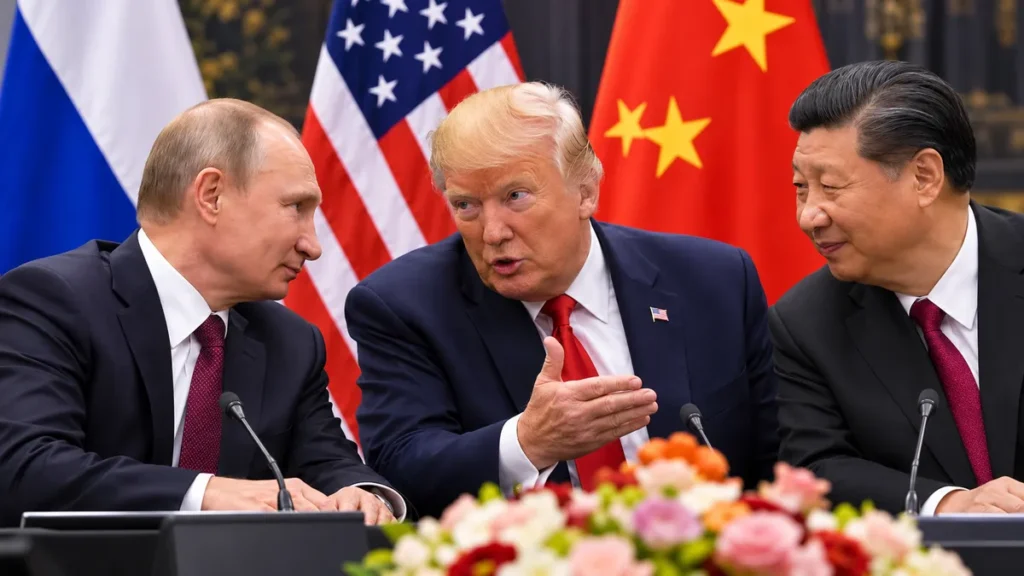
The meeting between US President Donald Trump, Chinese President Xi Jinping and Russian President Vladimir Putin mattered for the issues they discussed, how the public perceived it and the signals conveyed through diplomatic protocol, political analyst Gayane Abrahamyan said.
In her view, several of Xi’s gestures showed that he was taking the lead and that Putin did not have the same standing at the meeting.
Diplomatic protocol as a political signal
Abrahamyan said the meeting was full of symbolic moments. Xi personally welcomed Trump, which she took as a sign of special regard. It was also a reciprocal gesture, she said, as Trump had given the Chinese president a similar welcome in the United States.
Xi did not personally greet Putin. According to Abrahamyan, a Chinese official ranked fifth in the country’s leadership hierarchy welcomed him instead. She said such details matter in diplomatic protocol because they send clear signals about each leader’s status and place at the meeting.
Abrahamyan also pointed out that the official who greeted Putin was considerably taller than him. In her view, organizers of such events take physical appearance into account to avoid moments that could be perceived as humiliating. She suggested that the choice of official might therefore have been deliberate.
Another notable moment came during the group photo. When Putin tried to stand next to Trump and Xi, Trump invited him to stand between them. Xi, however, pointed to a different spot, on the far side of the woman standing beside him. Abrahamyan said that who stands to whose right also matters in diplomatic protocol. In her view, Xi’s gesture showed that Putin did not get the position he might have expected.
The trilateral meeting was largely ceremonial
Abrahamyan said the trilateral meeting took place on the sidelines of the main summit and was largely ceremonial. It lasted about an hour, she said, but only around ten minutes of the opening session were made public.
In her assessment, it was unrealistic to expect the meeting to produce a specific decision. Discussions on mechanisms for limiting nuclear arms are continuing, however.
Abrahamyan noted that Putin had said during the meeting that the parties had already agreed on a text. At the time of her remarks, she said, it was still unclear what provisions the document contained or what oversight mechanisms it envisaged.
“We haven’t seen the text yet,” she said, adding that its contents would become clear once it was published.
China’s Foreign Ministry published a joint declaration on November 19. It calls for dialogue on reducing nuclear risks and preventing proliferation, and contains no specific arms limits or oversight mechanisms. mfa.gov.cn
The world order cannot be reduced to three centers of power
Abrahamyan said she does not share the view that a new international system could emerge around three centers of power: the United States, China and Russia. In her assessment, the recent meeting does not warrant comparison with the Yalta Conference.
The difference goes beyond the agendas, she said. The Yalta Conference lasted eight days, followed lengthy and careful preparations, and involved discussions that continued day and night. The meeting between Trump, Xi and Putin lasted about an hour and was largely ceremonial.
“I don’t think it is right to compare a one-hour, largely ceremonial meeting with an eight-day conference that took serious preparation and lengthy discussions, or to assign it a similar role, as the Russian side in particular has done,” Abrahamyan said.
Turning to the prospect of a tripolar world order, she said it was a source of concern in political circles in Europe and across the Arab world. In her view, it would be a mistake to overlook Europe’s role as an independent geopolitical power and counterweight. The situation in 1945, when Europe lay devastated and the United States took on the main burden of rebuilding it, cannot recur today, she argued. The European Union has considerable economic and technological capacity, while France and the United Kingdom are nuclear powers.
Abrahamyan also pointed to the roles of India and the Arab world. The international system, she said, is far more complex than a division of influence among three countries.
China and the United States have geopolitical ambitions, she said, and so does Russia. That does not mean Washington and Beijing see Moscow as their equal. The fact that three leaders sat at the same table does not in itself mean they were discussing how to divide the world or redraw spheres of influence.