
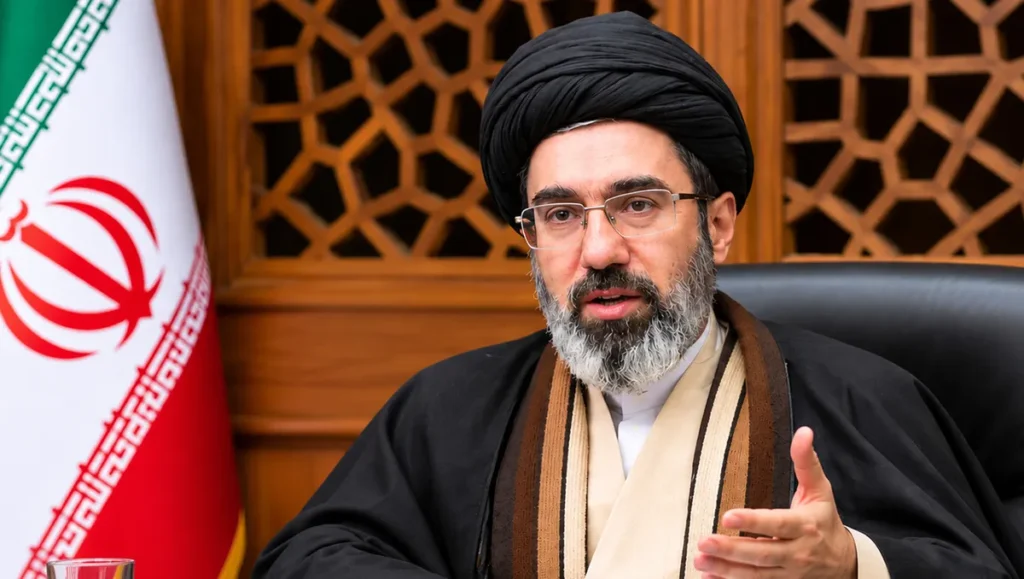
Since the war earlier this year, certain signs of divided authority have emerged in Iran’s foreign policy. This is partly due to a shift in the balance of power established under the country’s previous political system, Iran specialist Anna Gevorgyan said.
According to her, before the war and the death of Supreme Leader Ali Khamenei, Iran had a system in which various government agencies and security institutions competed with one another. Ultimate decision-making authority and standing, however, belonged to the Supreme Leader.
“A system had developed in which, although different agencies and security, so to speak, clans competed, they all accepted that there was one supreme authority and that Ali Khamenei had the final say,” Gevorgyan said.
As a clear example of earlier disagreements, she recalled a public interview with former Iranian Foreign Minister Mohammad Javad Zarif. Zarif had said that, after returning from negotiations in the P5+1 format, he learned that General Qasem Soleimani, a commander in the Islamic Revolutionary Guard Corps, had visited Russia, returned and created a situation in Iran that made further negotiations impossible.
Gevorgyan said foreign ministry officials often complained that, although they were formally responsible for foreign policy, the IRGC sometimes made decisions that hindered diplomatic efforts or prevented final decisions from being reached.
In her assessment, however, this was not seen in Iran as a sign of disorganized government. Rather, it showed how powerful various agencies and security institutions had become since the establishment of the Islamic Republic: they were able to impose their decisions on others.
The absence of the former Supreme Leader has changed the balance of power
According to Gevorgyan, this was why the Supreme Leader’s unquestioned authority had been so important. It enabled him to make final decisions and maintain a balance among the various centers of power.
Turning to Iran’s current Supreme Leader, Mojtaba Khamenei, Gevorgyan said there were differing analyses and assessments of his health and his actual ability to make decisions. Whatever the reality — whether Mojtaba Khamenei makes decisions personally or they are made in his name — the present situation is fundamentally different from the past, she said.
“It is an entirely different situation to have a Supreme Leader whom people cannot see publicly or hear speak directly. There are suspicions that he has died and that decisions are simply being made in his name. In Iran, they are trying to dispel those suspicions and state clearly that he is alive, directs policy himself and makes decisions himself. But the fact is that he has not appeared in public, there are no recordings of him speaking, and there are only written statements issued in his name,” Gevorgyan said.
She stressed that she did not want to assess Mojtaba Khamenei’s health or his actual status because there was insufficient evidence to do so. What matters, in her view, is that his condition remains unclear, as does whether he can make decisions independently or whether decisions are being made by his office.
In this uncertainty, Gevorgyan said, each of the established centers of power — the foreign ministry, the IRGC and the clergy — is seeking greater influence over decision-making. There may also be other, informal centers of influence that cannot be identified with certainty but have a substantial effect on the economy and foreign policy through family ties and other mechanisms. “In this situation, every link in that chain is trying to show that it can speak more loudly about its priorities,” she said.
Velayati has no influence over foreign policy decisions
Discussing the views of Ali Akbar Velayati, Iran’s former foreign minister and current adviser to the Supreme Leader on foreign policy, as well as his criticism of the Armenian government, Gevorgyan said both his personal standing and the characteristics of Iran’s political culture must be taken into account.
Velayati headed the foreign ministry for many years, she said, and many of its employees regard him as their teacher. Even if they disagree with his views, his public criticism can therefore create difficulties, particularly given the culture of professional relationships in Iran.
Nevertheless, Gevorgyan said an analysis of Velayati’s published texts reveals contradictions and, in some cases, misinformation.
“Even taking Velayati’s standing into account, it should be recognized that he currently has no influence over contemporary foreign policy decisions,” Gevorgyan concluded.