
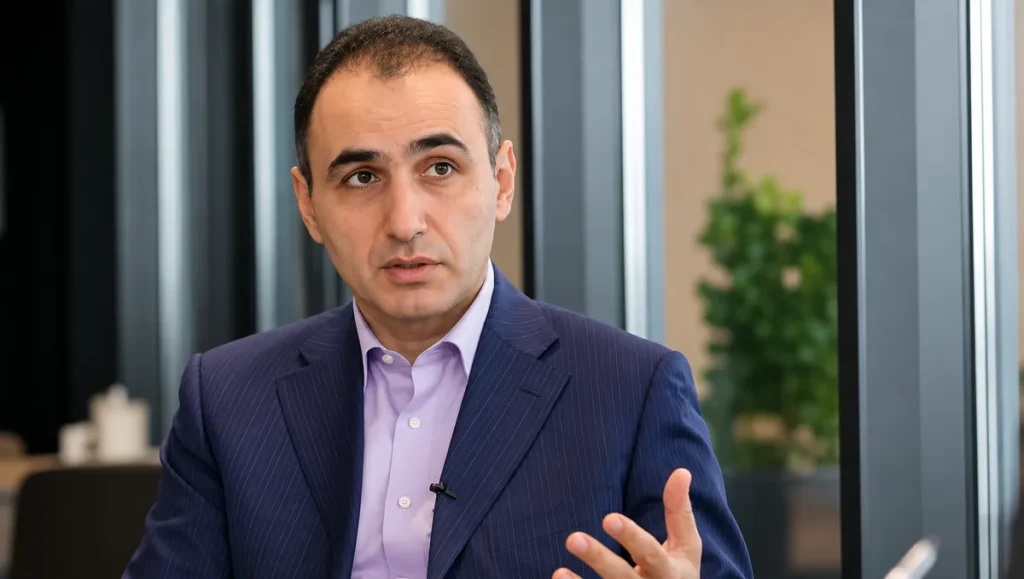
Certain provisions of Armenia’s Criminal Procedure Code need to be amended to clarify the grounds for pretrial detention and strengthen judicial oversight of its use, according to Avetik Chalabyan, coordinator of the Hayakve national civic association.
He said the current rules lack sufficient clarity. As a result, pretrial detention, which should be an exceptional preventive measure, is applied disproportionately in Armenia and often without adequate justification.
According to figures presented by Chalabyan, 48 percent of people deprived of liberty in Armenia are currently being held in pretrial detention. Their number has increased by more than 100 over the past three months. He emphasized that almost half of those deprived of liberty have not yet been convicted.
For comparison, he cited a European average of 25 percent, 30 percent in Russia, 22 percent each in Georgia and Azerbaijan, 17 percent in Türkiye and just 7 percent in Bulgaria.
The need to clarify detention criteria
According to Chalabyan, one of the main causes of the problem is the inadequacy of Article 118 of the Criminal Procedure Code. Although it provides that detention may be imposed only by a court when alternative preventive measures are insufficient, the rules do not ensure proportionate use in practice, he said. The investigator or prosecutor must substantiate the conditions that make detention lawful, and the court must confirm them in a reasoned decision.
In his assessment, the law does not set clear criteria for courts to assess the possibility of improper conduct by an accused person. As a result, detention decisions often simply state that the grounds for detention exist, without setting out specific facts or explaining their relevance to the person and the case.
Another problem, Chalabyan said, is the lack of criteria for assessing whether alternative preventive measures could be used. The Code provides for several measures less restrictive than detention. It does not, however, specify the grounds or sequence by which a court should rule them out before ordering detention. According to him, court decisions often state that “other preventive measures cannot ensure proper conduct” without explaining why.
Chalabyan also proposes clearer proportionality criteria that take account of the seriousness of the alleged offense. He observed that the current rules allow detention even in cases involving minor or moderately serious crimes. In many countries, he said, less restrictive measures are preferred in such cases and detention is excluded.
A special procedure for cases with a political context
Another of Chalabyan’s proposals is a special procedure for examining criminal cases with a political context and deciding whether to impose detention in them.
He noted that the Criminal Code contains provisions on crimes against the state which, by their nature, may have a political context. In his view, additional safeguards are therefore needed to prevent detention from being used as a means of political pressure.
Chalabyan also considers the current rules from a constitutional perspective. In his assessment, the lack of clarity in Article 118 of the Criminal Procedure Code may conflict with the principle of legal certainty enshrined in Article 79 of the Constitution, as well as the principle of proportionality set out in Article 78.
A proposal to appeal to the Constitutional Court and initiate legislative changes
Chalabyan called on the opposition factions in the National Assembly to exercise the right of at least one fifth of lawmakers to apply to the Constitutional Court. He proposed challenging the compatibility of Article 118 of the Criminal Procedure Code with Articles 79 and 78 of the Constitution.
At the same time, he proposed that the parliamentary opposition introduce legislation to revise Article 118. In particular, he called for clearer criteria for detention, a mandatory requirement to justify the rejection of alternative preventive measures, and stronger judicial oversight of detention decisions.
Chalabyan believes these steps can be taken without waiting for a change of government. He stressed that initiating legislative amendments following parliamentary hearings should be identified as an important next step.