
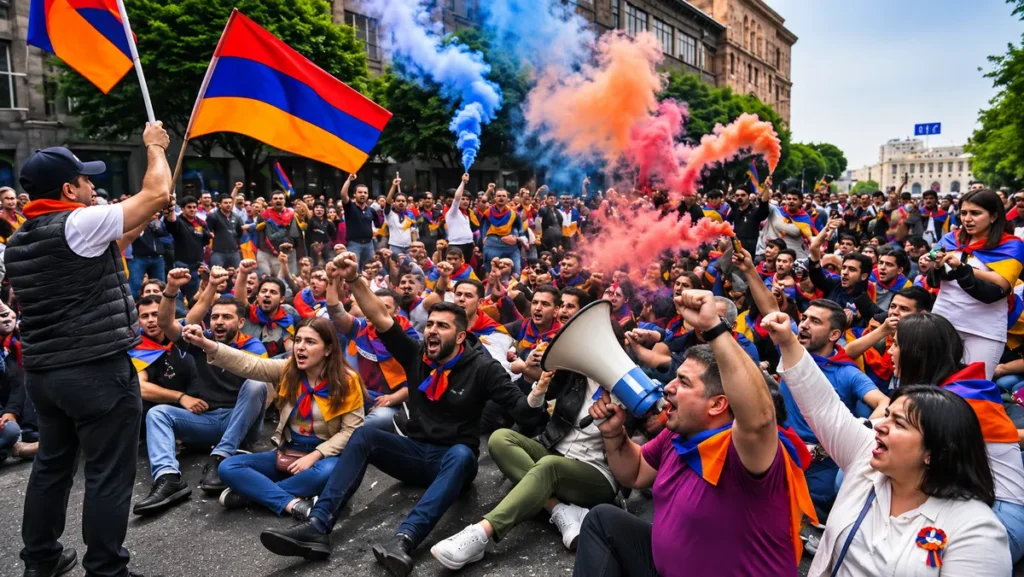
Armenia’s domestic political situation will inevitably become more tense, and the authorities will bear primary responsibility, political analyst Ara Papyan said.
In his view, Nikol Pashinyan’s statement about generating public pressure is evidence of this. Papyan said the authorities are now trying to adopt the opposition’s methods. The opposition may call on its supporters to take to the streets, he argued, but the authorities should not act in the same way because they exercise state powers and are funded by taxpayers.
“What the opposition can allow itself to do, the authorities cannot. Unlike the opposition, which does not live off people’s taxes or receive salaries and resources from them, the authorities do. Their responsibility is therefore broader and deeper,” the analyst stressed.
In Papyan’s assessment, it would benefit the authorities to let the situation develop into clashes and then use state powers to suppress the opposition. He did not rule out the possibility that the aim is not only to weaken the current opposition but also to shape an opposition field acceptable to the authorities.
Are the authorities trying to create an opposition that suits them?
In this context, Papyan recalled a position put forward by one political force during the previous elections: the priority, it argued, was to replace the opposition rather than the government. In Papyan’s interpretation, the authorities may now try to reshape the opposition field and present political forces that suit them as alternatives to the public and international partners.
Papyan sees snap elections as one possible route to such an outcome. He said the authorities could use elections to secure parliamentary seats for political forces they favor, creating the appearance of an opposition. “After all, as Stalin used to say, what matters is not how people vote but how the votes are counted. They will count them and get the result,” the analyst said.
He recalled that there had previously been parties which, in his assessment, gained a certain number of votes in elections with the authorities’ support and then received state funding. Papyan believes such forces could again be used to contest elections and create a picture of the opposition acceptable to those in power.
Society is tired, and the demographic picture has changed
Papyan said the social situation in Armenia today differs from that of the 1990s. In his assessment, people have grown tired and fearful, while demographic changes in the country also affect public participation.
“Armenia is now in a state where, whatever you say or do, nothing changes anymore. These are not the 1990s, when uncovering some failure by the authorities would bring thousands or tens of thousands of people into the streets. People are tired, people are afraid, and the population has undergone serious demographic change,” he said.
The analyst compared the demographics of the 1990s with those of today. He said the numbers of schoolchildren and pensioners in Armenia used to be roughly equal, whereas pensioners now outnumber young people by almost two to one. In his view, that also affects society’s potential for protest.
According to Papyan, this change has a direct effect on public activity. Older people, he argued, are not part of a social group with revolutionary sentiments that is ready to take to the streets. The authorities can also influence this group’s attitudes, for example by raising pensions.
👉 Politics