
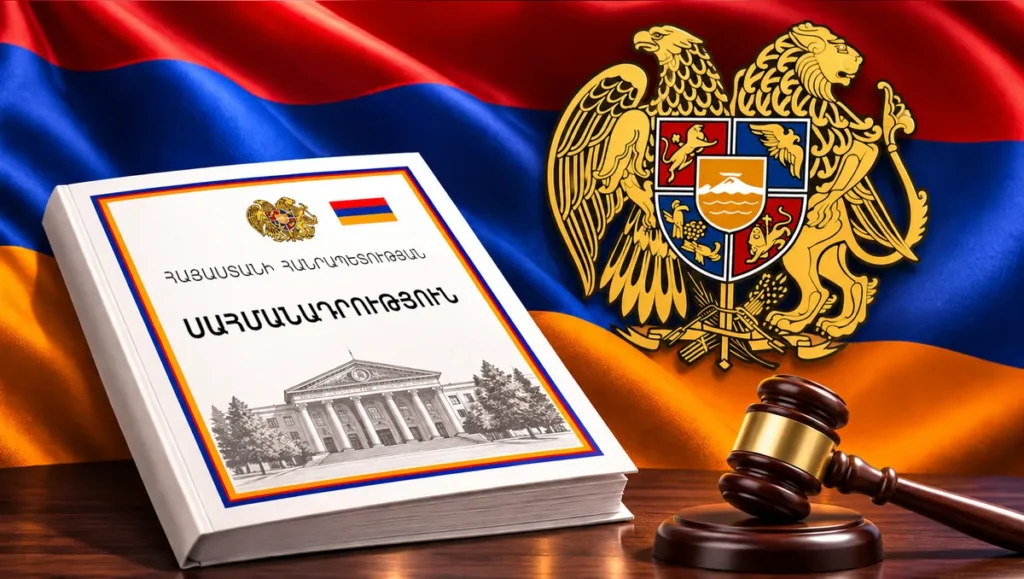
Armenian Prime Minister Nikol Pashinyan presents a new Constitution as necessary to make peace irreversible. He is offering the opposition a political deal: if the “yes” vote wins in the referendum, he says he will not stand for prime minister again. But the dispute over constitutional change raises deeper questions: Who is the Constitution being changed for, and why? Can peace be established amid domestic political divisions?
A constitution adopted without public agreement risks a crisis from the start
Former Armenian Justice Minister Arpine Hovhannisyan said a constitution sets the basic rules for how people live together within a state. Adopting one requires broad public agreement, she said.
Constitutions are generally adopted in peacetime, Hovhannisyan said. That is when limits should be put in place to guard against decisions made in response to short-term pressures. She said the high threshold for adopting a constitution helps ensure public agreement. If a constitution is adopted solely at the will of a political majority, without genuine public agreement, it carries the seeds of a crisis from the start.
Hovhannisyan also recalled Armenia’s 2015 constitutional changes and said she had learned from the experience. “If a constitution is adopted at the behest of one political force or a majority and there is no real agreement, it does not actually secure consensus. Without that consensus, it will not last as long, and the seeds of a crisis are already in the constitution the moment it is adopted,” she said.
A constitution cannot guarantee peace on its own, Hovhannisyan said. Its primary purpose is to embody agreement within the country. She added that it was important to understand both the wording of the new Constitution and the assumptions behind it. She said there had already been a statement that one of the most important principles would be left out of the new Constitution, making it necessary to clarify what was planned.
Pashinyan’s offer is a rhetorical trap for the opposition
Hovhannisyan said Pashinyan’s political offer may look like an excellent deal at first glance. In practice, she argued, it puts the opposition in a difficult position.
She said Pashinyan had outlined two scenarios. If the “yes” vote wins in the referendum, he will sign the new Constitution and will not stand for prime minister again. If the opposition rejects the offer, the government will call a snap election and accuse the opposition of standing in the way of peace.
“He says: if the answer is ‘no,’ I’ll resign, call a snap election, explain that they were the ones standing in the way of peace, and get reelected. That’s the snap election scenario. If the answer is ‘yes,’ he says he’ll sign the Constitution and won’t stand for prime minister again,” Hovhannisyan said, describing his position.
In her view, Pashinyan is using a familiar political communication tactic. When accused of acting in his own interest, he sends the opposite signal by saying he is prepared to give up power.
The former minister said the offer leaves many questions unanswered. In particular, signing the peace agreement depends on the other party as well as on Armenia’s prime minister.
Hovhannisyan also questioned whether Pashinyan was in a hurry to complete the process of adopting a new Constitution. In her assessment, he could keep the process going on his own timetable until the next elections and decide when it would be most advantageous to hold the referendum.
Who can guarantee there will be no further concessions?
Hovhannisyan said many questions would remain even if the opposition accepted Pashinyan’s offer. It is unclear when the referendum would take place, when the provisions of the new Constitution would be agreed, when the peace agreement would be signed, or whether Azerbaijan would make new demands.
She also asked what guarantees there were that changing the Constitution’s preamble or revising some of its provisions would not pave the way for further concessions. “Who says the concessions are over? Where is the guarantee, and can it convince the government, the opposition and those who don’t like either of them?” Hovhannisyan said.