
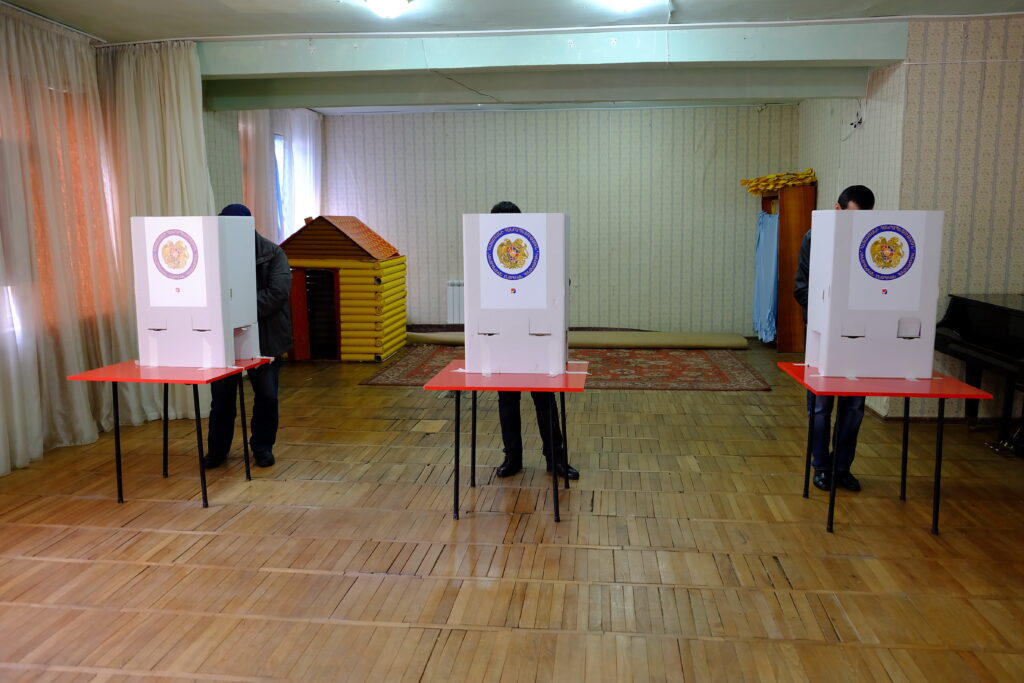
The Armenian opposition continues to debate the strategy to choose for the 2026 parliamentary elections. One camp, recalling the experience of 2021, insists that opposition forces should present a united front to prevent voter dispersion and achieve real results. The other, however, is inclined to believe that independent participation is a more correct tactic, as it will ensure political diversity, which in turn will encourage the disillusioned electorate to engage in the upcoming electoral processes.
Against the backdrop of ongoing discussions in the Armenian opposition, political analyst Edgar Elbakyan warns that the opposition’s strategic choice for the 2026 elections should be based not on emotions or mechanical calculations, but on a deep analysis of political realities. According to him, the minimum threshold for passing into parliament in the current legislative system is about 92 thousand votes; this number is much higher than what even large parties like the Prosperous Armenia Party collected in 2021.
According to Elbakyan, the local success in Gyumri cannot be considered a generalizable model. “At the national level, the issue has not only quantitative, but also qualitative parameters,” he emphasizes. According to the analyst, if more than two dozen forces participate in the elections, this will lead to a sharp decrease in participation. This is a well-known political pattern: in the case of great diversity, “electoral paralysis” occurs among voters, the logic of “everyone is the same” wins, as a result of which the opposition electorate in particular becomes passive. The participation of the ruling electorate, contrary to this logic, remains stable or even increases.
In addition, many small forces simply do not overcome the threshold, as a result of which the votes they collect “disintegrate”, not reaching the opposition pole. At the same time, in the public perception, the competition between different opposition groups is perceived not as ideological diversity, but as a struggle for power, which in turn only deepens disappointment and distrust.
“Politics is not a computer game where only quantitative calculations work. People’s psychological and emotional mechanisms are at work here,” Elbakyan notes, concluding that the only realistic way for the opposition to win is a broad consolidation. According to him, only two, maximum three opposition blocs can ensure real competition and achieve success.