
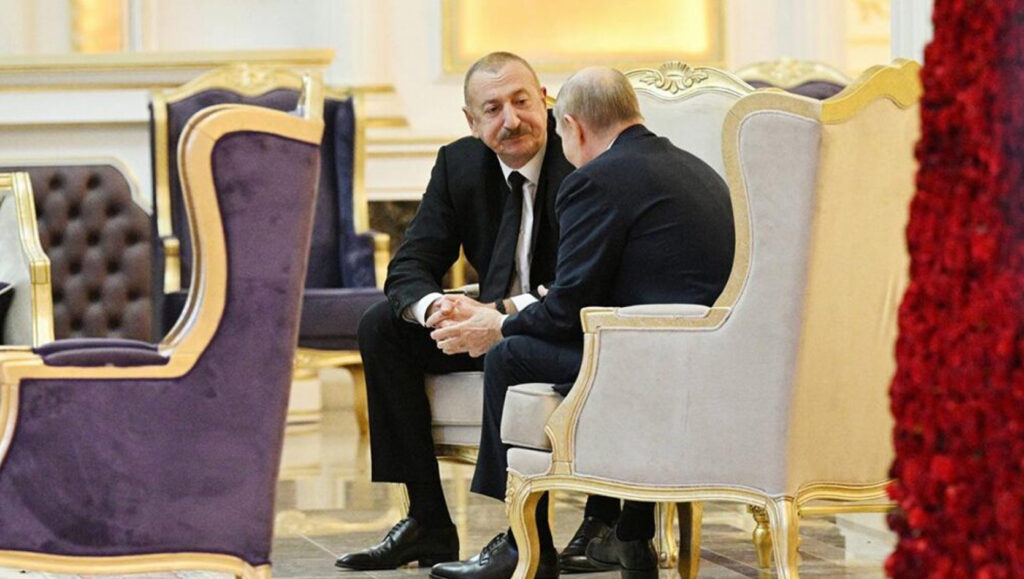
The displacement of the Armenian population of Artsakh, the ethnic cleansing that took place there and the destruction of the Republic of Artsakh have created a fundamentally new situation in the South Caucasus. Regional affairs expert Beniamin Poghosyan made this assessment while discussing Russia’s changing position in the region and the current stage of Azerbaijani-Russian relations.
According to him, the decline of Russian influence in the South Caucasus is linked not only to the Russia-Ukraine war and Moscow’s reduced ability to allocate resources to the region. The elimination of the Republic of Artsakh has also been a major factor.
“It is clear that the displacement of the Armenian population, the ethnic cleansing and the destruction of the Republic of Artsakh created a new situation in the South Caucasus and significantly affected Russia’s position. Russia always used the conflict, sometimes as an instrument of pressure and sometimes as leverage for offering different forms of support to Armenia and Azerbaijan,” Poghosyan said.
Azerbaijan Feels Freer in Its Relations With Russia
According to the expert, the displacement of Artsakh’s Armenian population gave Baku greater freedom of action. Azerbaijan now behaves with considerably more confidence in its relations with Moscow.
“Aliyev allows himself to make statements toward Russia that would have been almost impossible to imagine ten years ago,” Poghosyan noted.
As an example, he referred to the Azerbaijani president’s statements about Ukraine. According to Poghosyan, Aliyev has publicly argued that Ukraine should not accept the loss of occupied territories and must restore its territorial integrity, including Crimea.
Russia’s reaction to those statements, however, has remained relatively restrained.
“When Peskov was asked about Azerbaijan’s support for Ukraine’s territorial integrity within its 1991 borders and calls to continue fighting, he had to give a fairly diplomatic response. He said Russia disagreed with that position but acknowledged that some friendly countries held such views,” the expert said.
Transport Projects Increase Azerbaijan’s Influence
Poghosyan argues that one of the principal reasons for Azerbaijan’s growing confidence is its importance in regional transport projects.
Regardless of the final route of the so-called Middle Corridor, Azerbaijan cannot be bypassed.
“If the objective is to connect Central Asia with Turkey and Europe without passing through Russia and Iran, that cannot be achieved without Azerbaijan. At the same time, Russia and Iran are also interested in maintaining their connection through Azerbaijani territory along the so-called North-South route,” Poghosyan said.
He noted that freight transport between Russia and Iran through Azerbaijan has increased in recent months, giving Baku an additional instrument of influence.
“Aliyev understands that this is also leverage, including leverage over Russia,” the expert emphasized.
Energy Projects Also Require Baku’s Approval
Poghosyan also pointed to discussions about possible Russian electricity and gas supplies to Iran through Azerbaijani territory.
According to him, such projects cannot be implemented without Baku’s approval, which further increases Azerbaijan’s political importance.
Azerbaijan has become an indispensable participant in several major transport and energy initiatives at the same time. This allows its leadership to adopt a tougher position not only toward Armenia but also toward Russia and Iran.
“President Aliyev’s agreement is required in all these matters. Therefore, yes, for now he can afford to act defiantly toward Russia,” Beniamin Poghosyan concluded.