
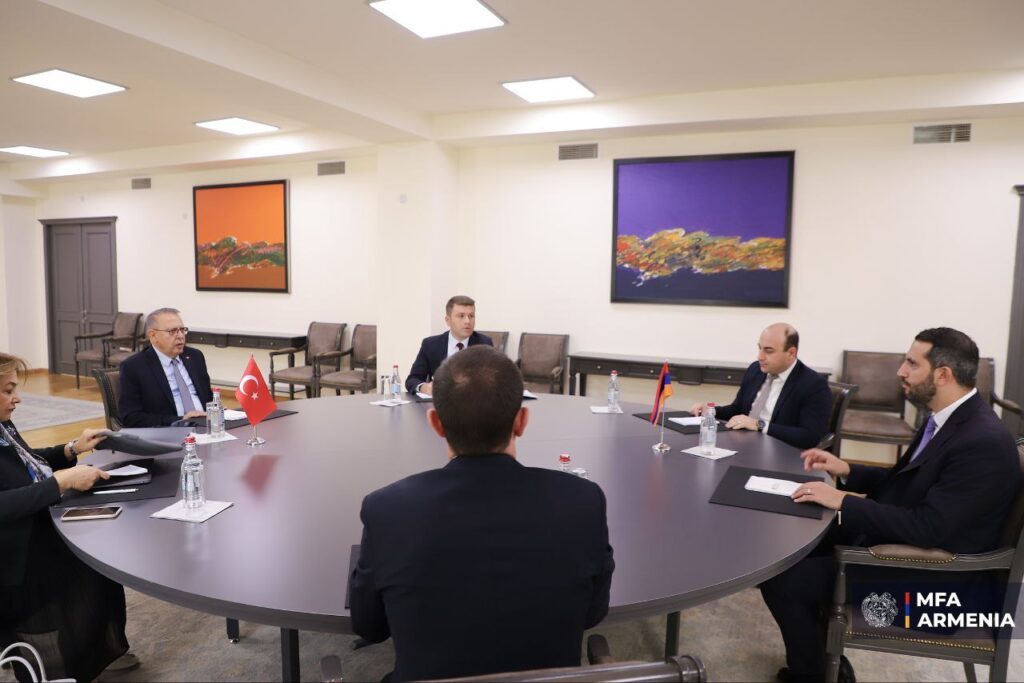
Turkish diplomacy is inherently “transactional”: Ankara strives to “sell” each of its actions, turning even the smallest step in foreign policy into a tool for securing concessions or benefits from the opposing side. This was stated by political analyst Alen Ghevondyan, commenting on the recent meeting of special representatives from Armenia and Turkey.
According to him, the Turkish side does not limit itself to “selling” its actions: it deliberately breaks them down into small steps, turning each into a separate bargaining chip and attempting to extract benefits “by the gram.” “This is a fairly pragmatic method of conducting diplomacy, as it ensures maximum gains by the end of negotiations,” he noted. In the case of Armenia, the political analyst believes Turkey’s primary goal is to bring Yerevan as much as possible into its sphere of influence, taking advantage of Moscow’s preoccupation.
From this perspective, the Armenian-Turkish process represents a kind of third stage in pushing Russia out of the region. At this stage, the goal is to address the issue of withdrawing the Russian military base from Armenia. “The withdrawal of the Russian base needs to be presented ‘skillfully.’ If there are no issues with Turkey and both sides intend to implement joint cultural and educational projects, this will serve as a strong argument in favor of removing the Russian military base,” Ghevondyan explained.
In turn, the Armenian authorities are attempting to “sell” the fact of contacts with the Turkish side as significant progress, opening up broad opportunities for Armenia.
As a reminder, the special representatives for the normalization process between Armenia and Turkey—Deputy Speaker of the Armenian National Assembly Ruben Rubinyan and Ambassador Serdar Kılıç—held their sixth meeting on September 12. According to official information, during the meeting, the special representatives reaffirmed the agreements reached and coordinated during previous meetings, with the aim of advancing the process of full normalization of relations between Armenia and Turkey. In this context, they exchanged views on implementing the agreement reached on July 1, 2022, regarding border crossing. The special representatives agreed to accelerate this process.
They also agreed that the competent authorities of both countries would conduct the necessary technical studies to restore and launch the Gyumri-Kars railway and the electricity transmission line. According to Rubinyan, restoring the electricity transmission line would enable Armenia to sell electricity to Turkey.
The parties also committed to making efforts to strengthen cooperation in the fields of culture and academic ties, particularly by creating opportunities for university student scholarships and jointly restoring the bridge on the historic Ani/Silk Road.
Furthermore, the special representatives agreed to take the necessary steps to enable various airlines to operate flights on new routes starting from the summer of 2026, which would increase the number of air routes and flights between the two countries.
In conclusion, both sides reaffirmed their commitment to continuing this process without any preconditions.