
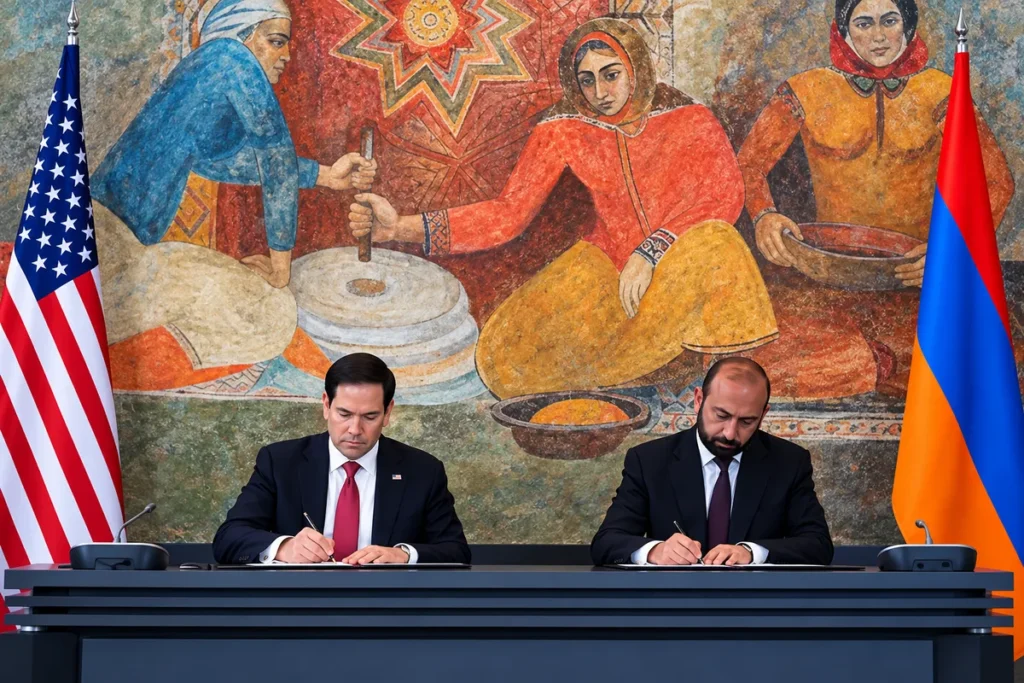
The U.S. Embassy in Armenia recently published a notable message. In a post on its Facebook page, the embassy said that the United States and Armenia were moving from agreements on critical minerals to practical steps, advancing the implementation of a memorandum of understanding between the two countries.
According to the statement, Paul Huper, director of the Office of Energy Supply Chains at the U.S. State Department’s Bureau of Economic, Energy and Business Affairs, met with representatives of the Armenian government, the private sector and civil society. The meetings were intended to examine the needs and opportunities of Armenia’s mining sector and discuss possible areas of U.S. technical assistance.
The wider context of the Armenia–Azerbaijan process
Political commentator Hakob Badalyan believes the latest message on Armenian–U.S. cooperation in critical minerals should be viewed in a context broader than mining or bilateral economic relations. He is particularly interested in when that cooperation took shape, against the backdrop of events involving Armenia, the United States and Azerbaijan in late May and early June.
Badalyan recalls that on May 26, U.S. Secretary of State Marco Rubio made a roughly 40-minute stop at Zvartnots Airport on his way back from India. During that stop, Armenia and the United States signed a framework memorandum on cooperation concerning critical minerals, including rare earths. The two sides also initialed a framework agreement concerning the Trump Route.
Only days later, a delegation from the State Department’s economic, energy and business affairs bureau traveled to Azerbaijan. The talks in Baku were followed on June 1 by announcements of arrangements and deals valued in reports at approximately $8 billion. On the same day, Rubio signed in Washington the Trump Route framework agreement that had been initialed in Yerevan on May 26.
In Badalyan’s view, the sequence raises a central question: why was the agreement not signed in Yerevan on May 26?
The decisive arrangement is reached in Baku
Badalyan suggests one possible explanation: the understandings reached in Yerevan on May 26 may have served as a resource for the United States in its subsequent talks with Azerbaijan. “Having obtained the initialing of the Trump Route framework agreement in Yerevan, alongside the signing of the framework memorandum on cooperation with Armenia in minerals, the United States then capitalizes on all of this in its $8 billion arrangements with Azerbaijan,” the commentator says.
In his words, “the decisive arrangement is reached in Baku; Yerevan merely provides a certain favorable negotiating resource for it.”
If Armenia’s transport infrastructure can become a tool for U.S. arrangements with Azerbaijan, he asks, could the same happen with Armenia’s mineral resources?
“Could the memorandum on cooperation with Armenia in rare earth metals and other minerals follow the same logic? Just as the United States may view Armenia’s road resources as an opportunity to reach arrangements with Azerbaijan, might Armenia’s mineral resources and rare earth metals also be viewed as a means or resource for arrangements with Azerbaijan?” Badalyan asks.
He emphasizes that, according to the information published about the deals announced in Baku on June 1, they contain no disclosed scheme or provision for using Armenian resources. In his view, however, that makes the question all the more important.
“Could Azerbaijan, under a U.S. label, obtain access to Armenia’s mineral resources as well—just as it obtains a route through Armenia under the package of a U.S.–Armenian consortium?” he asks.
Armenian minerals and Azerbaijan’s ambitions
Badalyan also places the question against the backdrop of the growing global importance of minerals, particularly rare earth metals. He says the current U.S. administration pays close attention to the sector, making Armenia one of the places of interest to Washington.
At the same time, he argues, Armenia’s mineral resources have long attracted Azerbaijan’s attention. Badalyan points to Baku’s repeated criticism of Armenia’s mining industry, the Metsamor nuclear power plant and nuclear energy, which it presents as threats to regional security.
“Given Baku’s ambitions toward Armenia, to put it mildly, we should not rule out the possibility that Azerbaijan’s threats are also aimed at gaining influence and predominance over these resources in one way or another,” he says.
According to the commentator, if Baku’s strategy is understood as an effort to establish the greatest possible dominance over Armenian statehood, including through long-term mechanisms, Armenia’s most important resources could also fall within the scope of those ambitions.
In this context, Badalyan points to a mechanism he says already exists. An American-backed approach to transport links has been developed and has entered an initial stage of implementation. He does not rule out an attempt to use a similar approach in the minerals sector.
“And where is that resource? In Syunik, a region of the highest strategic importance,” he stresses. In his view, if Azerbaijan were to gain a foothold in that sector through any mechanism, it could obtain a positional and strategic advantage over Armenia.
Why is there no mention of U.S. investment?
Badalyan nevertheless distinguishes between two fundamentally different scenarios. If major American companies show genuine interest in Armenia’s mining industry and invest in the sector, he says, that would be a different kind of process. Large foreign capital could support the state’s economic viability and, in turn, its political viability. Foreign investment could also add another layer to the political partnership.
He also emphasizes the industry standards of American mining companies. “It is very important for mining to be conducted to high standards. That means high environmental standards, with mining using people’s resources while also serving people, both in environmental protection and in corporate social responsibility,” he says. For that reason, Badalyan says he would “only welcome” interest from major American mining investors.
The concern, he says, is that the latest U.S. message does not mention such interest. It describes practical steps in cooperation but does not say that investment projects, ways to attract investors or the interest of major American mining companies in Armenia are under discussion.
This is where Badalyan sees the main cause for concern. He asks whether the United States might view Armenia’s mineral resources as a way to reach certain arrangements with Azerbaijan and provide it with an “access package” in Armenia, rather than as a basis for bringing American capital into the country and developing the Armenian economy.
“The situation deserves sustained public attention so that we can understand what is happening, or what may follow, under this Armenian–U.S. framework memorandum on minerals cooperation—and whether, beneath a prominent label, it may in practice carry risks of opening a path for Azerbaijani ambitions in Armenia,” Badalyan concludes.
👉 Politics