
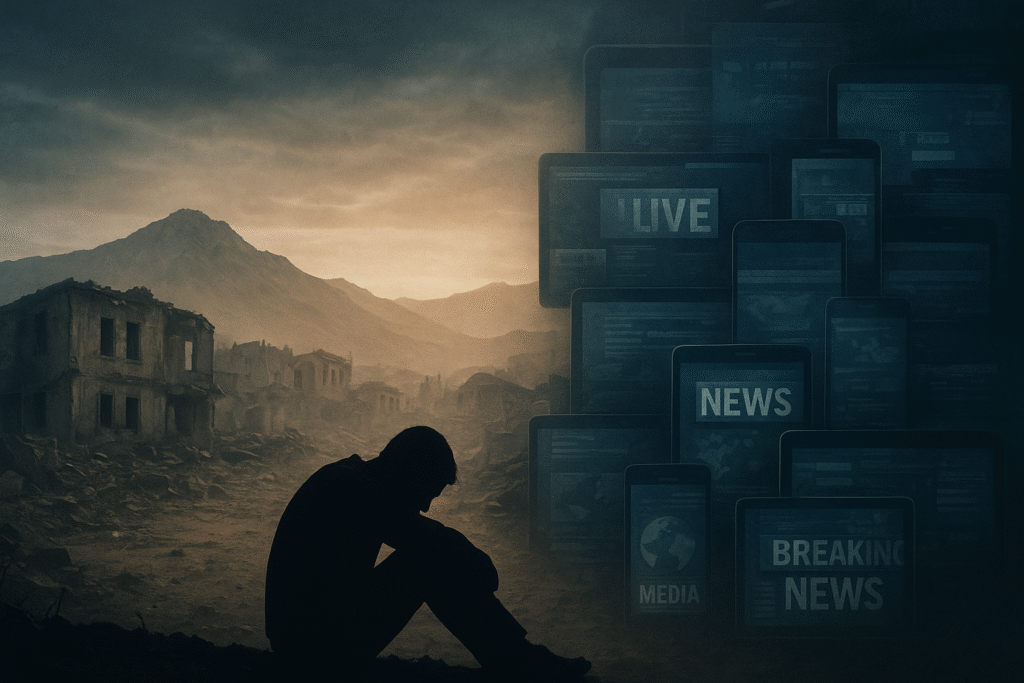
The contradiction between past and present seems to have become one of the most tragic realities of our time. On one side — the lost Artsakh with its pain, fallen heroes, politico-military leadership held in Baku prisons, and the unfulfilled dream of statehood. On the other — “victorious” news about wheat imports through Azerbaijani territory, presented as a historic achievement. Have we really reconciled ourselves to the idea that dignity and dreams can be traded for wheat and a full stomach?
“Chaotic Noise” — The Result of the Information Revolution
According to historian and former MP Samvel Farmanyan, the asymmetrical picture of public perception in Armenia stems from three main factors. The first is the drastic transformation of the country’s information landscape.
“We are living through an information revolution,” he stresses, adding that information flows and the public agenda have changed radically.
In the past, he says, the center of public discourse was occupied by authorities and experts. Today, under the influence of smartphones and social media, everyone talks about everything and has an opinion.
“This is the era we live in — authorities no longer exist. Twenty years ago, if you journalists had approached Babken Harutyunyan on any issue, you would have received his professional opinion, and it would have been read as truth or at least an authoritative assessment. Today, such an opinion simply isn’t heard; it isn’t in demand,” Farmanyan notes.
He emphasizes that this situation has created “chaotic noise” in the public sphere, where everyone speaks but no one listens. Amid this information noise, society loses its ability to navigate and stops understanding what real truth is.
A Deliberately Engineered Deep Identity Crisis
In Farmanyan’s view, the crushing defeat in the Artsakh war and the subsequent capitulation have profoundly shaken national consciousness. Today, the Armenian people are experiencing a deep identity crisis that manifests in a complete loss of faith in their own strength.
“We no longer believe in ourselves. We question our past, our historical consciousness, our notions of hero and anti-hero, good and evil,” Farmanyan said.
He is convinced that this very crisis holds the key to why, during the war, Nikol Pashinyan refused — with Russia’s president mediating — to halt the fighting.
“I am almost certain it was done for one reason: the enemy didn’t just need victory — they needed our crushing, bloody defeat that would plunge the nation into the deepest identity crisis. Only with such a broken society could they do what is being done now,” he remarked.
Control Over the Information Space
The third reason, according to him, is the government’s control over the information field. He stresses that today the largest material and technical resources for shaping the news agenda and public opinion are in the hands of the current authorities.
“This government has every means to direct information flows in its favor. And unfortunately, it is interested in exploiting the first two factors to advance its own agenda,” Farmanyan noted.
He says that if the government consisted of people with state-minded thinking and national goals, they would be searching for mechanisms to help the nation emerge from the identity crisis or to harness the information revolution for the nation’s benefit.
“With them, everything is the opposite: they have monopolized the field and are using it to harm the state,” he added.
Beneath the Chaos — Destruction; Beneath the Rubble — Emptiness
Farmanyan also pointed out that the opposition’s inability to channel public discontent adds to the situation. As a result, an environment has formed where noise conceals chaos, chaos conceals destruction, and beneath the destruction lies emptiness.
“The protest segment of society — which today constitutes the majority — watches, listens, grows disillusioned, and ultimately withdraws into itself, retreating from public processes. We call them indifferent, but in reality this is the consequence of disillusionment. Meanwhile, against this backdrop, the government continues doing whatever it wants,” he emphasized, adding that he does not share the view that the Armenian people traded Artsakh for a wagon of wheat.
In Farmanyan’s opinion, that impression is simply the result of the interplay of these three fundamental causes.