
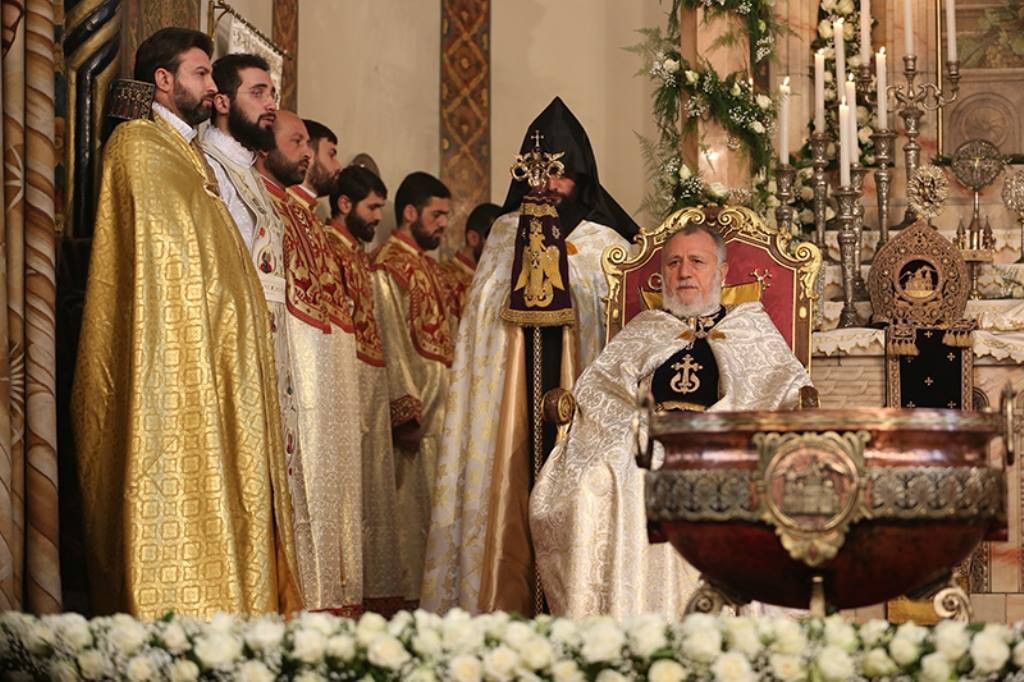
These days in Armenia the entire apparatus of the authorities — from the judiciary and the prosecutor’s office to pro-government media — is concentrated on the question of whether the head of the Armenian Apostolic Church should remain in office if he has violated the law on political parties. This was stated by the historian Vardan Khachatryan.
In other words, the whole weight of the authorities is focused on an issue that, in essence, does not exist. The point is that the church’s traditional order — a system formed over centuries — cannot be breached. That is inevitable for any church, and even more so for such an ancient institution as the Armenian Apostolic Church. If Gregory the Illuminator was married, and many of our bishops lived in families for centuries, it is groundless today to raise such an issue and try to find any legal or canonical justification for it, whether in church canons or in Mkhitar Gosh’s jurisprudence. Such a provision simply does not exist, the historian argues. According to him, the contested provisions relate not to celibacy but to marriage.
Today, Khachatryan continues, we actually face a much deeper danger — we are moving toward a systemic crisis, a process that is becoming almost irreversible.
The problem is not only in the political or governance field; we are touching the sacral core of society — the spiritual and identity foundations that have carried the historical trajectory of the Armenian people across centuries, passed down through generations and reached our times. This is the archetypal core of our national identity; its disruption is not only unacceptable but, in essence, anti-state, he said.
When attempts are made to shake that sacred foundation, one must understand that every such move will inevitably provoke a sharp public reaction, he insists. Plainly put: if we strike that sacral core with a slingstone, expect an “atomic bomb” response from the public masses. It is necessary to understand clearly which path will bring our people back from the edge of the abyss and which will lead to destruction, he said.
Most worrying, the historian continued, is that this process appears to be deliberately accelerating, and there are no visible “brakes” that should prevent such a dangerous course. This trend may have deep and long-term consequences for both national identity and state stability, he noted.