
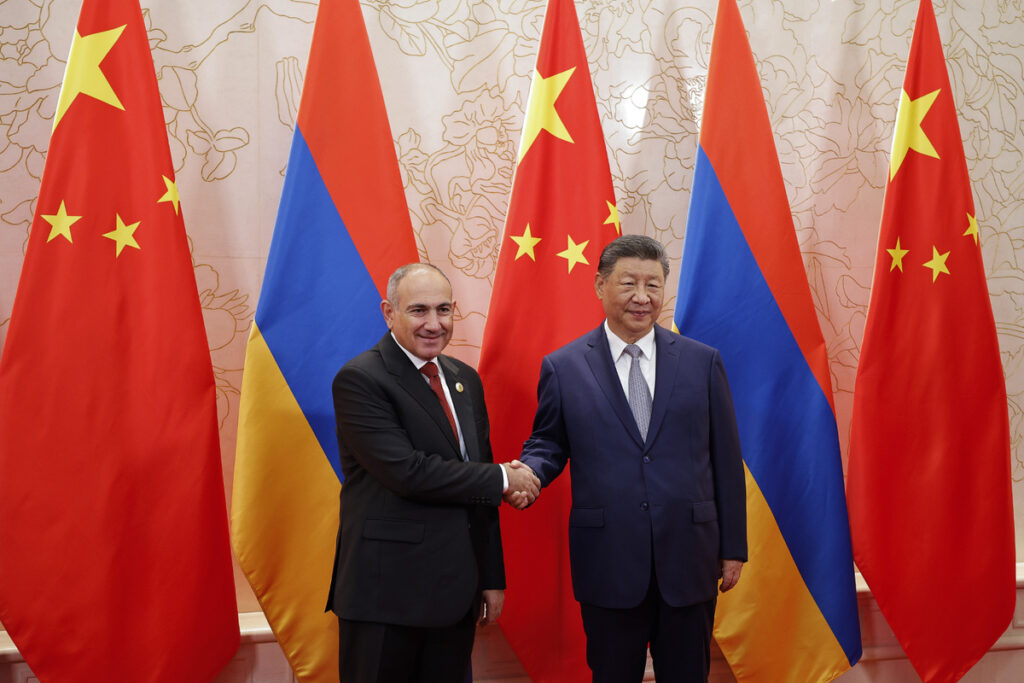
Armenian Prime Minister Nikol Pashinyan visited China to attend the Shanghai Cooperation Organization (SCO) summit, where he also took part in a parade commemorating the 80th anniversary of Japan’s surrender and the end of World War II. On September 4, the Armenian premier traveled to Japan — and this particular sequence of visits sparked lively debate.
Critics were quick to note: “Pashinyan went straight from a parade celebrating the defeat of militarist Japan to Japan itself.” The government was accused of inconsistency and contradictions in its foreign policy. Some pointed to the memorandums of cooperation with the United States, followed by agreements on strategic partnership with China — Washington’s main rival. Others highlighted that Yerevan had officially announced its intention to pursue EU membership, adopted the relevant law, but simultaneously initiated efforts to join the SCO.
The key question arises: do Armenia’s authorities truly follow a chain of diplomatic missteps and “nervous searches for new patrons,” as the opposition claims, or is there a calculated effort behind these actions to pursue a multi-vector maneuver in a changing global order?
From the Parade in China to the Visit to Tokyo: Contradiction or Balance?
At first glance, the Armenian premier’s participation in a parade celebrating Japan’s defeat followed by a visit to Japan itself appears diplomatically contradictory. However, considering the contemporary context, such moves align with global political logic, where historical grievances often take a back seat to economic interests.
Despite the United States playing a major role in Japan’s defeat, current relations with Washington are characterized by close strategic partnership and high-level allied ties. Relations with China are more complex, yet China remains one of Japan’s largest trading partners. Bilateral trade volumes between Japan and China continue to grow steadily, almost matching those between Japan and the U.S.
For Armenia, visits to Beijing and Tokyo represent attempts to benefit from cooperation with economic giants. Participation in the SCO summit and the parade in China opens access to the “Belt and Road” initiative, while the visit to Japan aims to attract investment in technology and infrastructure, potentially balancing regional engagement. The challenge is that both expert and political circles, in Armenia and beyond, operate under the principle that what is permissible for large countries is often unacceptable for small ones. As Carnegie Endowment analyst Paul Stronski notes, “The multi-vector policy of small countries, such as Armenia, is often perceived as indecisiveness if not backed by a clear strategy.” Thus, the success of this diplomacy largely depends on Yerevan’s ability to clearly articulate its priorities and avoid being perceived as an unreliable partner. Whether it has the resources and diplomatic skills to do so remains another question.
Between Washington and Beijing
Another point concerns the signed memorandums with the U.S. and the statement on strategic cooperation with China. They are, of course, framework agreements, outlining intentions to develop mutually beneficial initiatives and containing no prohibitions on cooperation with third countries. Moreover, it should be remembered that the U.S. and China, despite their rivalry, maintain active trade and economic ties.
Nevertheless, these documents contain potential contradictions in practical implementation. For example, the U.S. memorandum on artificial intelligence and semiconductors emphasizes strengthening export controls and preventing AI resource leaks. It also elevates Armenia’s status in the American export control system, effectively requiring compliance with sanction regimes, including restrictions vis-à-vis China. At the same time, the statement with Beijing envisages deepening cooperation in AI, IT, and innovation, including the establishment of joint research centers. If Yerevan actively develops its technological partnership with China, it will inevitably create tensions in relations with the U.S.
In the energy sector, contradictions are less pronounced. The memorandum with Washington addresses the development of civil nuclear energy, including the potential use of small modular reactors based on American technology. The document with China mainly focuses on renewable energy sources and infrastructure, without touching on nuclear energy. However, should competing Chinese proposals for nuclear projects emerge, Armenia may also face a dilemma of choice.
At present, there are no active contradictions, but they could arise in the future. Armenia can benefit from synergy only by carefully coordinating its cooperation with both the U.S. and China. In one case, this approach has been implemented: Armenia secured support for the “Crossroads of Peace” initiative under the U.S. memorandum and synergy with the “Belt and Road” initiative in the statement with China, demonstrating its ambition to become a regional transport hub.
SCO or EU?
The founding documents of the Shanghai Cooperation Organization (SCO) and the European Union (EU) do not explicitly prohibit simultaneous membership or cooperation with both organizations. According to its Charter, the SCO is oriented toward strengthening security, economic cooperation, and political dialogue in Eurasia, emphasizing sovereignty, non-interference, and equality. The EU, in turn, is governed by the Treaty on European Union and the Treaty on the Functioning of the EU, which establish deep integration in economic, political, and legal spheres for member states but do not prohibit external partnerships, provided they do not conflict with EU obligations. Legally, therefore, there is no obstacle to a country being a member of both the EU and the SCO.
In practice, however, combining active participation in the SCO and the EU can be challenging due to differences in political and strategic priorities. The SCO brings together countries with a focus on Eurasian integration, often influenced by Russia and China, which may view increased EU influence in the region as competing. The EU, by contrast, requires its members or candidate states to align foreign policy and adhere to standards that could conflict with the interests of key SCO players, particularly China.
The most sensitive issue here is Taiwan. While the EU officially follows a “One China” policy, it maintains a more flexible approach to Taiwan. For example, EU countries develop economic and cultural ties with Taiwan, including trade and investment, while not recognizing it as an independent state. Some EU member states and the European Parliament actively advocate for increased support for Taiwan, particularly regarding democratic values and countering Chinese pressure. This could become a serious problem for simultaneous membership in both unions.
Conclusion
The Armenian government’s actions currently appear more as an attempt to “keep all doors open” than as a carefully calibrated strategy. Multi-vector diplomacy generates potential contradictions and tensions with key partners, and the success of these initiatives depends on whether Yerevan has sufficient resources and diplomatic skill to manage them effectively. For now, these steps are arguably more risky than unequivocally productive.