
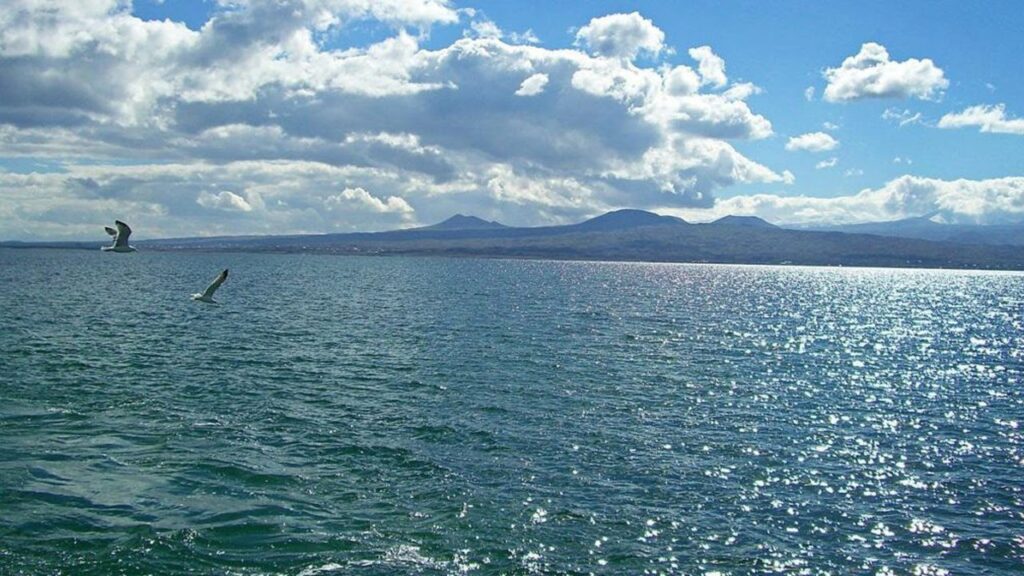
This is not the first time that official Baku has made statements hinting at its ambitions toward Lake Sevan. In this sense, Sevan already figures into Azerbaijan’s regional geopolitical calculations. This opinion was expressed by political analyst Vahe Davtyan, commenting on Aliyev’s recent remarks.
According to him, UN data show that if the current pace of freshwater use continues until 2030, around 700 million people will lack access to drinking water. “That number will continue to grow, reaching up to one billion. This is already a serious risk factor. Experts also warn about potential flows of so-called ‘water’ or ‘climate refugees’ driven by growing water scarcity,” Davtyan said.
Citing a World Bank report prepared two years ago, the expert noted that Azerbaijan faces a critical situation.
“According to the World Bank, Armenia’s per capita renewable freshwater resource stands at 2,320 cubic meters, while in Azerbaijan it is only 850 — one of the lowest figures in the post-Soviet space,” he explained.
Azerbaijan failed to solve its water deficit even after taking control of Artsakh, despite the fact that around 25% of its drinking water resources come from there. “Azerbaijan gained control over the large Sarsang Reservoir, with a capacity of about 560 million cubic meters, among others. Yet the issue remains highly relevant for Baku, which is why this is far from the first time that official Azerbaijan has voiced intentions regarding Sevan. In my view, Sevan already plays a role in Azerbaijan’s regional geopolitical strategy, and I hope Armenia will be able to respond properly,” he said.
Political technologist Armen Badalyan agrees. In his assessment, Baku is in no hurry to sign a peace treaty because it “expects concessions from the Armenian authorities.” Among them are an uninterrupted road through Meghri and access to Sevan.
“There are serious water issues in the region: Lake Urmia has almost dried up, many reservoirs in Iran have only 7–10% of their water left — enough for 10–15 days. Rainfall has dropped by 77–83% compared to last year. Lake Van is also shrinking, with submerged structures beginning to surface. Recently, media reported that the Tigris River has significantly dried up, and the same could soon happen to the Euphrates. In this context, it was no coincidence that Azerbaijan referred to Sevan as ‘Goycha,’” Badalyan said.
According to the expert, Azerbaijan will likely try to gain access to Sevan at all costs.
“It is no accident that Baku uses the Turkish name Basargechar for Vardenis. By resettling Azerbaijanis there, Baku will do everything possible to reach Sevan and draw water for drinking purposes. In other words, water will be pumped into Sevan from the Arpa-Sevan system, and Azerbaijan will try to extract it from the other side to solve its water shortage,” he concluded.