
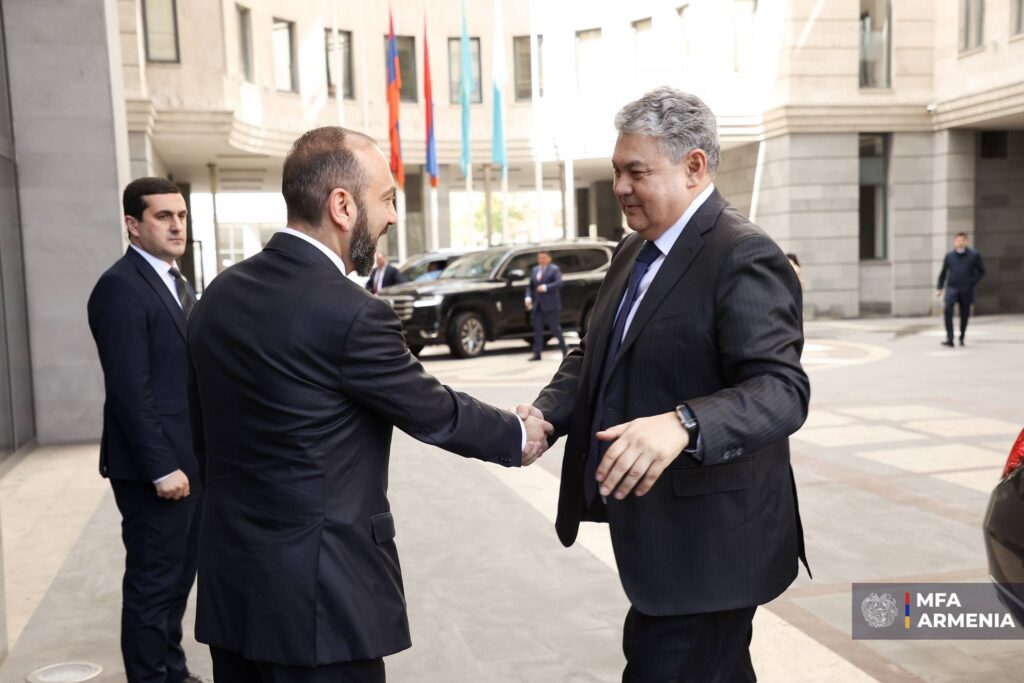
Recently, Kazakhstan’s Minister of Foreign Affairs visited Armenia, having previously traveled to Azerbaijan. Following the visit, Prime Minister Nikol Pashinyan stated at a press conference that Kazakhstan is interested in the TRIPP project, as well as in the South Caucasus Railway. According to him, discussions on these directions have already taken place, but he emphasized that no steps will be taken behind Russia’s back.
What agreements were reached during these visits? What was the purpose of the Kazakh Foreign Minister’s trip to Azerbaijan, and how interested is Baku in railway projects? These and other issues were addressed by political technologist Vigen Hakobyan.
Baku’s “Headache”: The Fate of TRIPP
According to Hakobyan, Azerbaijan’s concerns regarding TRIPP are more geopolitical than technical. He notes that Baku’s “headache” is not related to Russian participation in managing Armenia’s railway system. Azerbaijan is interested in implementing the project but understands that it is currently uncertain.
Hakobyan emphasizes that the project’s fate largely depends on regional developments, particularly tensions between the United States and Iran and possible conflict scenarios. “I believe Azerbaijan is concerned about TRIPP’s future because it is directly tied to potential outcomes of the U.S.–Iran confrontation—specifically, what the result will be for Iran,” he says, adding that in the case of a favorable outcome for Iran, Tehran is likely to hinder the project’s implementation.
He also notes that even in the event of Iran’s defeat, the project could still come into question, as it may lose its relevance for the United States.
According to Hakobyan, it is important to understand that TRIPP was initially not an economic but a political project. “TRIPP was primarily a geopolitical tool for the United States, which may affect Washington’s future interest in participation,” he stated.
At the same time, the project continues to be of full importance for Turkey and Azerbaijan.
A “Soft Option”: Why Kazakhstan?
Speaking about the Kazakhstan factor, Hakobyan does not rule out that Yerevan’s choice was influenced not only by internal considerations but also by external signals. In his view, the focus on Kazakhstan may have been “suggested” from outside, given the country’s significant role in Turkic integration projects.
According to him, Kazakhstan is a key player in the framework of cooperation among Turkic states and, together with Turkey, seeks to take leading positions by leveraging its resources and capabilities. “I believe Pashinyan was advised to choose this option as a softer solution,” he noted.
Even the “Soft” Option Is Unacceptable for Russia
At the same time, Hakobyan is convinced that even such a “soft” option is unacceptable for Russia. He states that Moscow views the South Caucasus as a region of strategic importance and maintains a firm position both on the TRIPP project and on Armenia’s current foreign policy course.
He recalls that Russia’s stance has been repeatedly expressed at the official level, and there is nothing new in this regard: Russia has rejected and continues to reject both the project itself and the possibility of transferring control over Armenia’s railway to another party.
Meanwhile, Hakobyan points out that Azerbaijan and Turkey maintain a relatively restrained public position in this process. According to him, initiatives mainly come from the Armenian side, while Ankara and Baku support them in a more behind-the-scenes format.
“This is natural diplomacy: if there is a country willing to take the main blow and enter into confrontation with a great power, why should you put yourself on the front line?” he concluded.