
The current Armenian government has launched a campaign against the Church. Many believe this undermines the foundations of our statehood. The question arises: what does the Church have to do with the foundations of the state? Armenia is a secular state, church and state are separated, we live in the 21st century, and religion is separated from politics and public life. In this sense, such an opinion sounds strange. However, I believe that it is precisely the policy pursued by the current government that undermines the foundations of statehood. Why — we will discuss this in more detail.
First, let’s look at what the Prime Minister and his team accuse the Church of.
The first accusation is that the Church has interfered in politics and is claiming power. In response, the thesis is voiced: let it create a party and participate in elections. However, the Church and clergy have not put forward political ambitions, although any priest, as an Armenian citizen, has the right to participate in elections.
As for politics — yes, the Church as an institution can engage in politics. But engaging in politics and striving for power are different things. Pope Francis, shortly before his death, expressed concern about what was happening in Gaza, calling it genocide and calling for an end to the violence. Is this politics or not? Of course, it is politics. When U.S. religious organizations oppose abortions, euthanasia, advocate for preserving the traditional family, and even achieve changes in legislation — isn’t that politics?
The U.S. President takes the oath on the Bible, and religious communities play a key role in his election. Is this politics or not? That is, the Church can participate in politics, expressing its position based on religious doctrine.
When persecution of the Church began and Catholicos of All Armenians Garegin II visited Switzerland, he initiated a major church council where he raised the issue of Armenian prisoners of war in Baku and the right of Artsakh residents to return to their homeland. After that, the Prime Minister intensified pressure on him. In this sense, Garegin II was indeed engaged in politics — based on religious and national duty.
Another accusation is that priests are allegedly forced to participate in rallies, citing an old audio recording. The Prime Minister also accused some church hierarchs of spying for foreign states. However, the Prime Minister has no right to make such accusations — this is the prerogative of law enforcement agencies. And if no such cases are initiated, it means we are talking about a false denunciation, and the Prime Minister must bear responsibility for it.
There are also accusations that some priests do not observe the vow of celibacy. But this is not the Prime Minister’s business. Every believer can discuss such issues, shaping public opinion, but the head of state — no, especially if he himself, according to church canons, does not perform certain sacraments and therefore cannot be considered a true follower of the Church.
Another accusation is that some churches have turned into “pantries.” In any democratic country, historical and cultural monuments are under state protection. For example, Notre-Dame Cathedral and other French temples belong to the state, which fully funds their maintenance but transfers them to the Catholic Church for services. In Armenia, however, the care of churches is most often carried out at the expense of the Church itself, the diaspora, or private benefactors, including Samvel Karapetyan. Therefore, the Prime Minister has no moral right to make such accusations.
Now let’s look at what “solutions” the Prime Minister offers. He states that a new Catholicos needs to be elected, meaning the current one should resign. But the Prime Minister has no right to demand this. This is direct interference in the affairs of a religious organization and a violation of the Constitution.
He also says that the people should choose the Catholicos themselves, and a married priest should become the interim head. Why specifically a married one? Probably because such a person has no vow of celibacy. But such a requirement is characteristic of Protestant churches. In fact, the Prime Minister is raising the question of changing the faith — turning the Armenian Apostolic Church into a Protestant, decentralized structure.
This means that the Armenian diaspora, based on church identity, will cease to exist. It is no coincidence that one of the first steps of the Prime Minister after coming to power in 2018 was the abolition of the Ministry of Diaspora. Meanwhile, in countries like Israel, working with the diaspora is the basis of state policy.
Thus, such steps lead to the destruction not only of the church structure but also of the very foundation of Armenian identity. It is no coincidence that in Turkey and Azerbaijan, analytical materials are regularly published claiming that to destroy Armenian nationalism, two pillars need to be eliminated — the Church and the diaspora.
Therefore, the policy being pursued destroys the foundations of statehood. The Church is the spiritual foundation of Armenian civilization, the source of those moral norms on which Armenian patriotism is based.
One of the greatest thinkers of the 20th century, Oswald Spengler, author of “The Decline of the West,” wrote: by excluding religion from political and cultural life, the West is heading toward its decline. Culture dies along with religion. It is religion that forms the system of values on which a people’s idea of the Motherland is built.
From the perspective of the model of patriotism inherent to Armenians, the current leadership of the country are apostates. To justify their apostasy, they must destroy the Church and dismantle the culture, changing the very image of the Motherland.
One of Armenia’s most important symbols — Ararat — is primarily a religious symbol: the mountain where, according to the Bible, Noah’s Ark stopped, the place where humanity began and Armenian statehood emerged. By destroying this symbolic layer, the authorities are destroying the very concept of the Motherland.
The Ukrainian tragedy began with attempts to destroy national identity and attacks on the Orthodox Church.
The same thing happened in Turkey, where Atatürk tried to create a secular nation, but later the authorities turned back to Islam, turning former church-museums into mosques — as a symbol of victory over Christianity.
Iran also relies on religious ideology: if the Shiite doctrine is destroyed, the state will collapse.
From all this, it is clear: the campaign against the Armenian Church is not just a fight against religion. It is an attack on national identity and the very foundation of Armenian statehood.
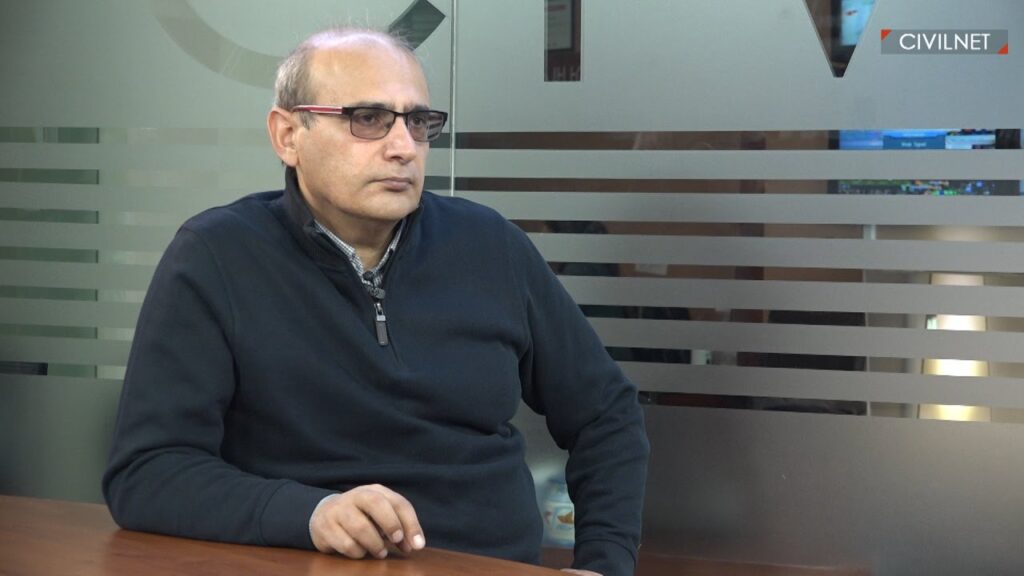
Political scientist Stepan Danielyan