
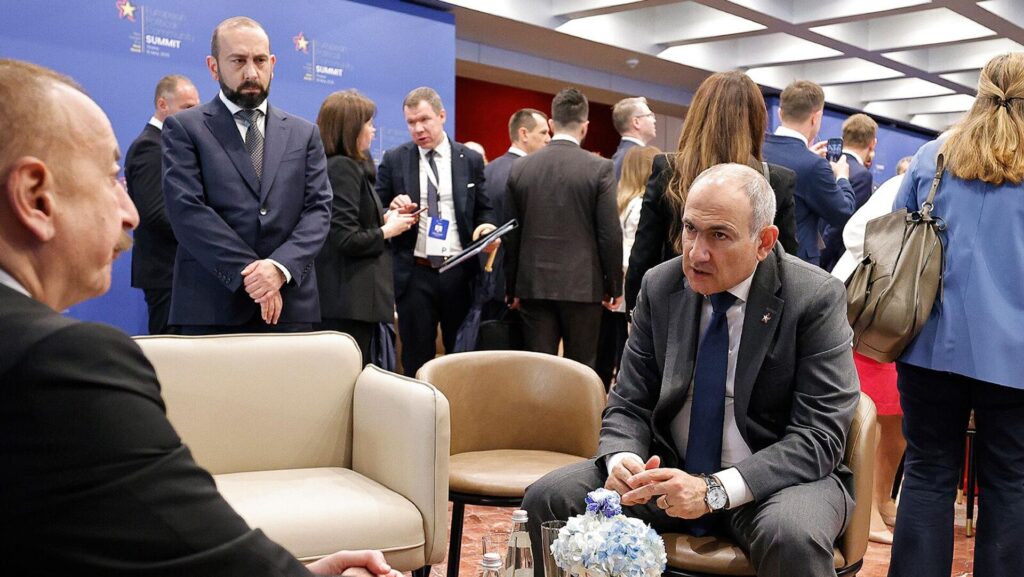
Over the weekend, Armenian Prime Minister Nikol Pashinyan wrote on social media that as a result of the border delimitation and demarcation process, Armenia would “regain Artsvashen and other occupied territories.” However, he did not specify what he meant by “other occupied territories.” This raises the question of whether he was referring only to areas under Azerbaijani control since the 1990s in the Tavush region, or also to the territories occupied in 2021 and 2022.
According to political commentator Hakob Badalyan, this distinction is crucial. If the latter territories are included, it confirms that Azerbaijan, having seized parts of Armenia’s sovereign land, has turned them into bargaining chips—an object of exchange—using them to obtain concessions from Armenia.
Badalyan added that there is another, equally serious implication:
“By speaking about the return of Artsvashen, Pashinyan is effectively suggesting that Azerbaijan will, in return, receive the so-called ‘enclaves’ that Baku claims are located within Armenia’s borders—claims that, unfortunately, the Armenian government appears to accept.”
He recalled that last week the Azerbaijani Foreign Ministry spokesperson stated that three villages in the Gazakh region were a top priority and would be “returned” as part of the border delimitation process.
“In this sense, Pashinyan’s statement effectively confirmed that claim,” Badalyan said.
Even if one were to assume a perfectly symmetrical, millimeter-for-millimeter territorial swap, he argued, such an exchange could never be truly equivalent.
“A glance at the map is enough to see where Artsvashen is located, what it means strategically and tactically for Armenia, and where these so-called ‘Azerbaijani enclaves’ lie. Almost all of them are in zones of strategic importance for Armenia—on key infrastructure routes. By obtaining these enclaves, Azerbaijan would gain yet another layer of strategic dominance over Armenia,” he said.
Badalyan warned that if Azerbaijan achieves this and is allowed to exercise such control, the next step will be demands for the “return” of Azerbaijanis to these enclaves and guarantees for their security.
“Considering how Baku pursues its objectives and the precedents we’ve already seen, it’s not hard to imagine the strategic and tactical risks such a scenario would create for Armenia,” he said.
He also recalled President Ilham Aliyev’s recent statement that “Azerbaijanis will return to their historical lands”—a phrase he uses to refer to almost all of Armenia—adding that Armenians “should not worry.”
“Aliyev said they would return not in tanks but in cars. But once they ‘return by car,’ Aliyev will inevitably send tanks behind them—supposedly to protect those returning,” Badalyan remarked.
He did not rule out that in response, Yerevan might declare that Armenia too has the right to “protect Artsvashen with tanks.”
“On paper, everything would seem fair—both sides having their ‘rights.’ But once we step outside this mathematical logic and look at the map and its strategic content, it becomes clear that Azerbaijan, once again, has far greater capacity to capitalize on its ‘rights’ than, unfortunately, the Republic of Armenia,” he said.
Badalyan concluded that in international and interstate relations, particularly in matters of war and peace, what matters is not “paper balance” but balance of power.
“Today, this balance is, to put it mildly, not in Armenia’s favor. Azerbaijan, in turn, seeks to ensure that any prospect of restoring such balance—political, military, or moral—remains permanently blocked,” he concluded.