
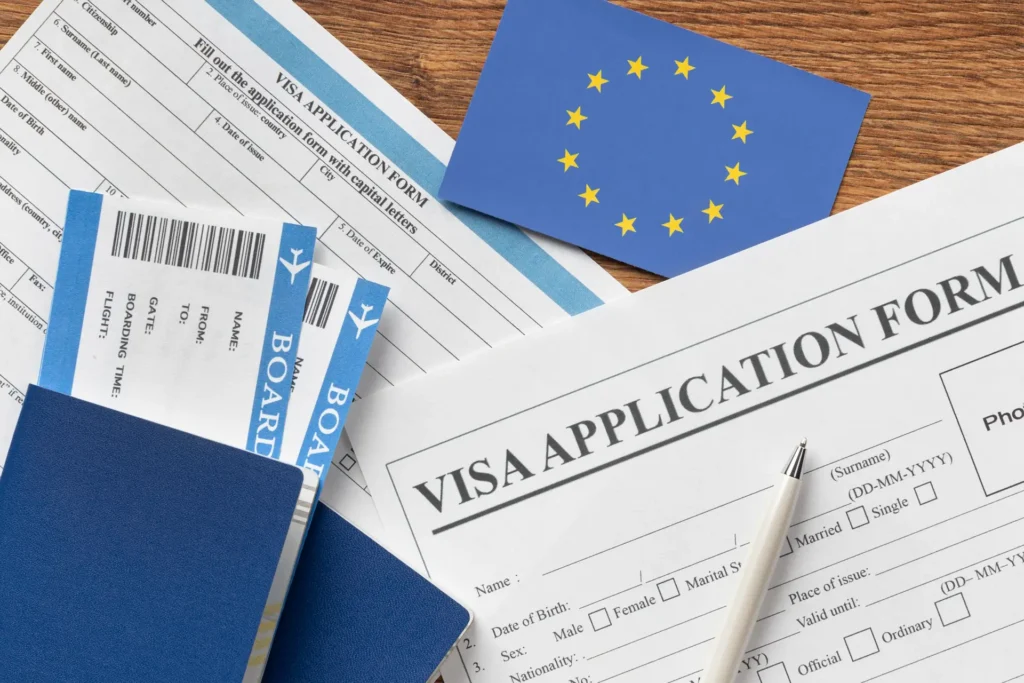
Vectors continues its series of analytical materials on the EU’s Visa Liberalisation Action Plan (VLAP) with Armenia. In this article, we examine one of the key VLAP pillars — document security and biometric data protection. We explain what the EU expects from Armenia, what steps have already been taken and why this part of the reform is so important for a future EU visa-free Armenia biometrics regime.
The EU Applies Strict Standards to Document Security
The EU’s first requirement is clear: a passport must be impossible to falsify. It must contain biometric data, including a digital photograph, fingerprints and, in some cases, iris data. These elements must be unique, encrypted and protected so that forgery becomes too costly and inefficient.
Materials of the passport — including the chip and security pages — must fully meet ICAO standards. For the EU, this is the minimum acceptable level.
However, physical forgery is only half the risk. The EU also expects Armenia to prevent individuals from obtaining several passports under the same or modified identity. This requires a secure, unified electronic population registry. All data — from birth records to home address — must be stored centrally and protected from external interference.
Access to this registry must follow strict protocols. Personal data must be secured not only technically, but also institutionally. In practice, this means compliance with GDPR, which Armenia has not yet fully implemented.
Control Over Lost and Stolen Passports
Another EU requirement concerns the handling of lost and stolen documents. Armenia is expected to transmit passport information to international systems — mainly Interpol’s SLTD database — immediately and automatically.
If a passport disappears, it should be “flagged” instantly. Any delay creates a security risk at EU borders.
Human Factor: Ethics and Accountability
The EU emphasises that technology alone is not enough. A passport system is considered secure only when its staff operate ethically and professionally. The EU expects:
- anti-corruption procedures,
- training in data handling and ethics,
- clear accountability for violations.
Without these elements, a country cannot meet EU standards for EU visa-free Armenia biometrics reforms.
Visa Liberalisation as a Test of State Capacity
EU Ambassador Vassilis Maragos states that member states will focus “not on laws but on implementation”. This is a critical point. In previous enlargement and liberalisation processes, the EU saw countries create a legal façade while corruption and weak control systems remained in place.
For Armenia, this means that the road to visa-free travel depends on more than legislation. It requires a transformation of administrative culture — from data protection to public sector discipline.
“Sense of Ownership” Over Reforms
Maragos also highlights the need for a “sense of ownership”. In diplomatic language, this means the EU wants to see that reforms are carried out not because of external pressure, but because Armenia sees them as necessary and strategic.
Armenia Launches a New Identity Document System
Armenia has already begun one of its largest institutional reforms in years. Minister of Internal Affairs Arpine Sargsyan announced the creation of a new identity-document infrastructure.
The country is building a vertically integrated system of trust that includes:
- a modern data centre,
- a protected personalisation chain,
- a network of regional offices,
- automated procedures with self-service elements,
- a unified secure population registry.
Implementation is handled by HayPass, a joint venture between IDEMIA Identity Security France and A.C.I. Technology S.à.r.l. The partnership is established for 11 years. The private partner collects biometric data, prints and distributes documents, while the state manages the registry and verification processes.
The final design of the new ID cards has already been approved. Mass issuance will begin in the second quarter of 2026.
Old Passports May Delay Visa Liberalisation
Armenian passports remain valid for ten years. As a result, older non-biometric passports issued in 2022–2025 will remain in circulation until 2032–2035.
This creates a major obstacle. Even after the launch of the new secure system, Armenia will have both highly protected biometric passports and older, weaker passports in use at the same time.
For the EU, this is a strong argument that “full and sustainable implementation” of the first VLAP block has not yet been achieved.