
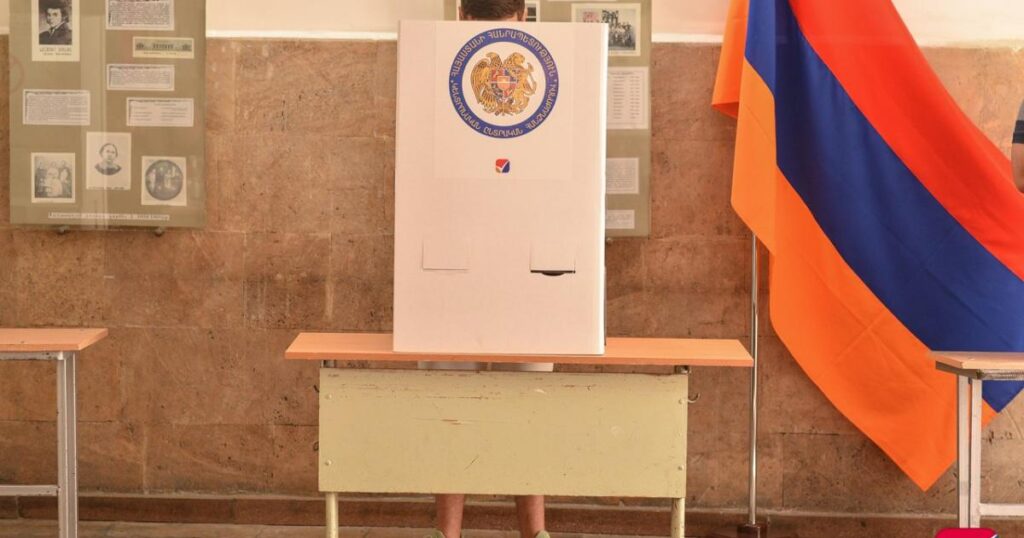
Armenia’s upcoming elections are taking place in an entirely unusual political environment. The core issue lies in the deep psychological and social condition of the voter. The electoral process has entered a phase where seriousness and frivolity have converged, creating the risk of fragmentation of the political system.
In today’s political landscape, it is possible to distinguish two relatively stable, clearly oriented small poles. Roughly 15 percent of voters are prepared to vote for the incumbent authorities regardless of the content of the pre-election process. Approximately the same number of voters consider the authorities absolutely unacceptable and will vote against them under any circumstances. These two groups have long since made up their minds, and pre-election campaigning can no longer have any significant influence on them.
The real political struggle is unfolding around the remaining voters, who make up more than half—around 50–60 percent. However, this group is not homogeneous. It consists of various social, age, and ideological layers, united by a shared dissatisfaction with the political system. These are voters who are “against everyone,” but that opposition to “everyone” has different reasons and manifestations.
The Social Base of the Authorities and Its Limits
The incumbent authorities have a certain social base, formed primarily among older, politically active voters. In particular, the 65+ age group is one of the most active participants in elections, and sociological studies show that within this group the percentage of voters supporting the authorities is relatively high.
The recently adopted mechanism of universal health insurance may, to some extent, expand this support. Although it bears the features of a pre-election social measure, it also has a real positive impact, especially on elderly citizens. However, this does not mean that all pensioners or older voters will unequivocally vote for the authorities. The lack of pension increases, overall social inadequacy, and uncertainty about the future continue to serve as serious counterweights.
Problems of the Opposition Field
In the opposition camp, the lack of consolidation is evident. The new political system, electoral rules, and the logic of political bonuses have led to a situation in which many political forces simply will not overcome the minimum threshold. This creates a phenomenon of fragmentation, where votes are distributed among numerous small entities without forming a genuinely competitive alternative.
Under these conditions, two or at most three relatively large poles may emerge within the opposition field, while the remaining forces will stay on the margins of politics, without real influence.
Youth: the Most Problematic Segment
The most complex and at the same time most important electoral group is young people. Citizens under the age of 30 participate in elections the least, and this has not only political but deep social causes.
A segment of young people is ideologically pro-Western, but this does not automatically mean support for the authorities. Some of them oppose the current government while simultaneously rejecting the former political system as well. This group is searching for new faces, new political proposals, and a new language, which is currently almost absent from the political arena.
The main issue for young people is not electoral promises, but their perception of the future. They ask themselves whether quality education, decent work, social mobility, and a predictable life are possible in this country. When convincing answers to these questions are not provided, participation in elections loses its meaning.
The Real Axis of Choice
The key question of the upcoming elections is not who will secure how many percent, but whether the political system will be able to speak to this large, uncertain, dissatisfied mass. If political forces continue to work only for already committed voters, elections will turn into a technical process without real political change.
In this situation, the seriousness of the choice lies precisely in the fact that it is taking place amid deep and serious problems, when society has lost faith in political discourse, promises, and institutions. Bridging this gap is a far more difficult task than simply winning an election.