
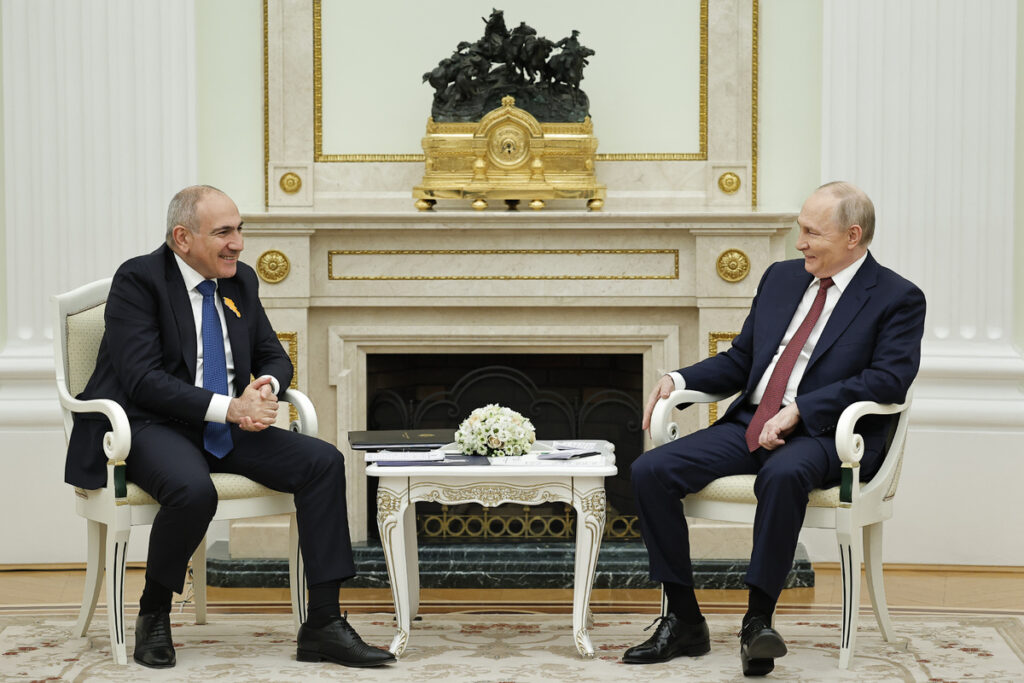
Recent statements by Russian propagandists regarding Armenia, including calls for stronger pressure and even military intervention, have reignited debate about Moscow’s role in Armenian politics. Political commentator Hakob Badalyan argues that such rhetoric does not weaken Prime Minister Nikol Pashinyan but instead strengthens his electoral narrative.
The Russian Issue as a Core Campaign Theme
According to Badalyan, Pashinyan has made accusations of Russian influence one of the central themes of his campaign.
The prime minister portrays major opposition forces as actors working in Moscow’s interests and attempting to remove the only government capable of preserving Armenia’s sovereignty.
The commentator believes this strategy emerged because the traditional “former versus current authorities” narrative has lost much of its effectiveness.
The political participation of Samvel Karapetyan has also complicated efforts to frame all opponents within older political stereotypes.
Moscow’s Actions Reinforce the Government’s Message
Badalyan argues that Russian statements and economic restrictions actually strengthen the government’s position.
Official remarks, trade measures, and aggressive rhetoric from Russian media figures provide additional material for the authorities to support claims about external interference.
In his view, if Moscow genuinely wanted to weaken the Armenian government, it would discourage such public discussions rather than allow them to dominate media coverage.
Russia Needs an Alibi, Not a Friendly Government
The commentator maintains that Russia currently benefits more from having an anti-Russian government in Armenia than from having openly pro-Russian authorities.
According to him, the existing political situation provides Moscow with a convenient explanation for decisions that may be unpopular in Armenian society.
“An anti-Russian government serves as an alibi that allows Russia to justify many of its actions,” Badalyan argues.
The Caucasus Remains Uncertain
Badalyan believes that the South Caucasus is entering a period of renewed uncertainty rather than lasting stability.
Questions related to regional power balances, security arrangements, and the emerging international order remain unresolved.
In such circumstances, Russia seeks to preserve flexibility and avoid assuming full responsibility for developments in the region.
Elections and the Future Political Environment
According to the commentator, the upcoming elections are also a choice about the future framework of Armenian-Russian relations.
He argues that voters will indirectly determine whether the current model continues or whether a different political environment emerges.
In his assessment, the broader issue concerns Armenia’s future position within an increasingly unstable regional landscape.