
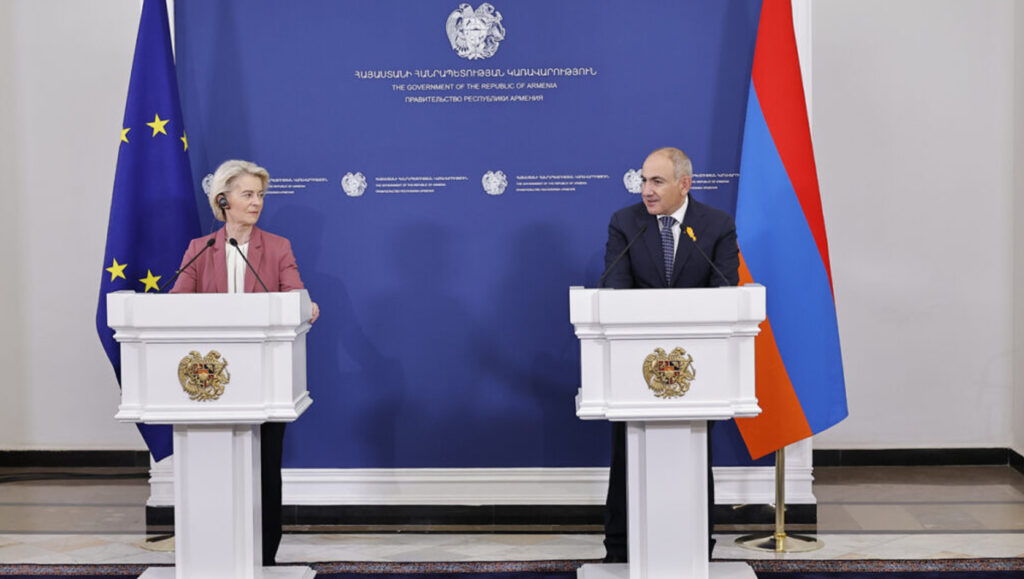
Armenia has entered a period of fundamental transformation of its security and economic systems. According to political analyst Stepa Safaryan, decades of concentrating virtually all strategic dependence on a single partner left the country highly vulnerable. He shared his assessment of Armenia’s diversification policy, why he believes Moscow failed to trigger domestic political unrest, and how Europe responded with unprecedented economic measures.
The Cost of Three Decades of Dependence
According to Safaryan, Armenia’s current vulnerabilities are the result of policies pursued over the past thirty years, during which the country’s security, economy, and strategic resources became overwhelmingly dependent on Russia.
To address these weaknesses, Armenia announced a diversification policy after 2020.
In his assessment, that strategy entered its most practical stage in 2023, when it became evident that Russia was unwilling to fulfill several obligations arising from previous agreements.
Safaryan noted that as early as 2021–2022, when Armenia lacked sufficient resources to address the Armenian-Azerbaijani conflict and the Karabakh issue independently, Yerevan began seeking alternative diplomatic and security frameworks involving both the United States and the European Union.
Moscow’s Resistance and Putin’s Direct Message
Safaryan argues that Armenia’s efforts to reduce its dependence on Russia inevitably provoked resistance from Moscow.
According to him, Russia has long relied on these dependencies as instruments of influence regardless of which government was in power in Yerevan.
He believes the situation intensified before the latest elections.
“Russian President Vladimir Putin realized that the rhetoric of his principal public advocates—including Margarita Simonyan, Vladimir Solovyov, Konstantin Zatulin, and Semyon Bagdasarov—was no longer influencing Armenian public opinion. As a result, he personally addressed Armenian society for the first time, effectively presenting a choice between moving toward Europe or remaining under Russian influence,” Safaryan said.
Economic Pressure and the Failed Domestic Unrest Scenario
According to the expert, Moscow was dissatisfied with the election outcome.
He argues that Russia began applying economic pressure even before the vote by restricting imports of Armenian apricots, Jermuk mineral water, and flowers, with additional restrictions following the elections.
Safaryan believes the objective was to make Armenian society “pay the price” for its political choice and provoke internal unrest.
According to his interpretation, Russia expected economic pressure to fuel public protests and bring demonstrators to the Constitutional Court in support of the opposition’s demands.
However, he says those expectations were not fulfilled.
“Only several hundred people gathered outside the Constitutional Court. Unlike previous years, when the opposition was capable of mobilizing large crowds, the anticipated domestic political explosion never occurred,” Safaryan stated.
Europe’s “Knight’s Move”
Safaryan argues that the European Union responded with an unprecedented economic initiative after recognizing the scale of pressure facing Armenia.
According to him, Brussels sought to offset some of the economic constraints created by Armenia’s accession to the Eurasian Economic Union in 2013.
“For roughly 80% of product categories, the European Union effectively eliminated customs duties. In practical terms, Armenia has been granted access comparable to participation in the EU customs area. This is an exceptional arrangement because Armenia has received substantial economic preferences without being either an EU member or even an official candidate,” he said.
Opening the Armenian-Turkish Border Could Complete the Process
According to Safaryan, one key element remains for this strategy to be fully realized: reopening the Armenian-Turkish border.
He notes that Turkey is part of the EU Customs Union.
In his assessment, once the border opens, Armenia would gain direct land access to European markets and become de facto integrated into Europe’s broader economic space, significantly reducing the risk of economic pressure from the north.