
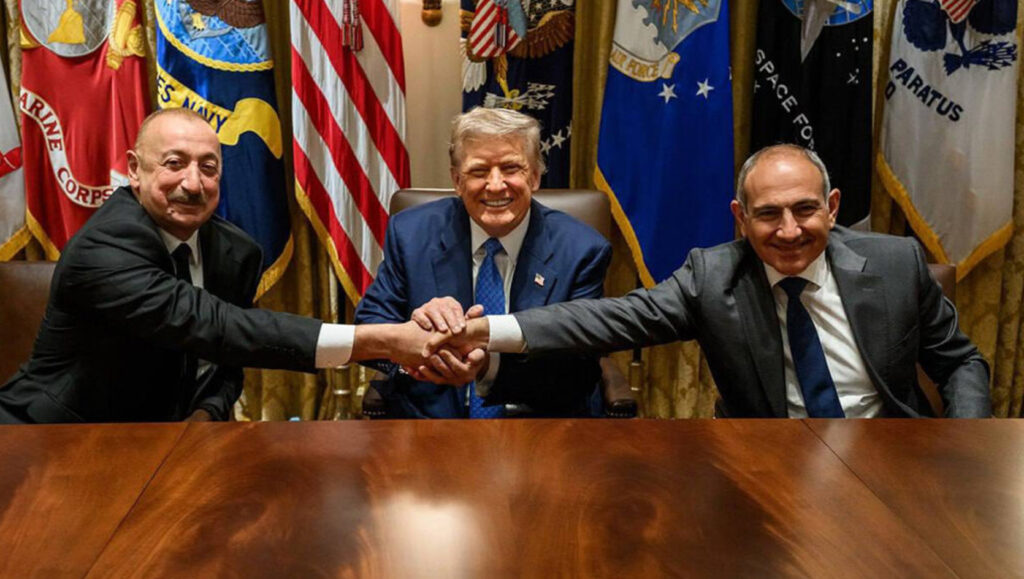
For the United States, the TRIPP project represents one of its key strategic initiatives in the South Caucasus. However, its importance for Washington extends far beyond the normalization of Armenian-Azerbaijani relations. This view was expressed by Suren Sargsyan, head of the Armenian Center for American Studies, who argues that the project’s real purpose is to serve long-term American geopolitical and economic interests.
The Largest US Engagement in the Region Since 1992
According to Sargsyan, TRIPP demonstrates that the United States currently has a level of involvement in the South Caucasus unprecedented since Armenia gained independence.
“Since 1992, the United States has never had this degree of involvement in our region. This represents the most significant and tangible American presence in the South Caucasus,” he stated.
According to the expert, it would be a mistake to view the project exclusively through the prism of Armenian-Azerbaijani relations.
“TRIPP is not fundamentally about Armenia and Azerbaijan. It is a much larger economic and geopolitical project, only a small part of which directly concerns our region,” Sargsyan said.
The Strategic Logic Dates Back to the 1990s
According to Sargsyan, the core idea behind TRIPP follows the same strategic logic that the United States pursued in the 1990s: creating routes to transport Central Asian resources to Europe while bypassing Russia, China, and Iran.
“This follows the same logic that underpinned discussions surrounding the Goble Plan. The mechanisms were somewhat different at the time, but the strategic objective remained the same: establishing transportation and economic corridors independent of Russia, China, and Iran,” he noted.
TRIPP Is Only One Component of a Broader Strategy
According to the expert, TRIPP constitutes only one element of a broader American regional strategy.
In Sargsyan’s view, US interests in the region also include the normalization of Armenian-Turkish and Armenian-Azerbaijani relations, limiting Russian influence in the South Caucasus, and counterbalancing Iranian influence.
He noted that since 1992, the United States has worked through various channels to promote normalization between Armenia and Turkey.
“The United States has used every available instrument of both public and private diplomacy to normalize Armenian-Turkish relations. Today, that process has reached its most advanced stage,” he said.
According to Sargsyan, US policymakers believe that normalization between Armenia, Turkey, and Azerbaijan would significantly reduce Russia’s leverage in the region.
“For years, Washington has developed the view that Russia maintains its influence in the South Caucasus through unresolved conflicts. Russia uses conflicts to preserve influence, whereas the United States seeks to build influence through economic cooperation and the absence of conflicts,” he explained.
US-Iran Relations Could Change the Entire Logic of the Project
According to the expert, the future of TRIPP depends heavily on relations between Washington and Tehran.
If the United States and Iran move toward normalization, Sargsyan does not rule out the possibility that Tehran could propose using existing transport infrastructure crossing Iranian territory.
“I cannot exclude the possibility that Iran could ask why a new route through Armenia is needed if normalization is achieved and existing infrastructure already exists within Iran,” he stated.
At the same time, he emphasized that such a scenario currently appears unlikely due to the extremely low level of trust between the United States and Iran.
“The problems are so deep, entrenched, and interconnected that even political will alone would not produce rapid solutions. Naturally, this factor will also affect the TRIPP project,” he said.
Iran Is Unlikely to Accept Expanded American Presence Near Its Borders
According to Sargsyan, it is equally important to understand which countries do not benefit from the implementation of TRIPP.
He noted that the project could become the closest American economic, political, and even strategic presence to Iran’s borders.
“During the war, Iran targeted not only US military facilities but also American business projects. If TRIPP had already existed at that time, I cannot rule out the possibility that it would also have become a target,” he said.
According to Sargsyan, even an improvement in US-Iran relations would not necessarily mean that Tehran would accept the emergence of a new American center of influence immediately adjacent to its borders.
The Israeli Factor Also Plays a Critical Role
The expert argues that Israel also directly influences developments surrounding TRIPP.
According to him, the United States cannot ignore Israel’s security interests, while Israel has already attempted to influence the course of US-Iran negotiations.
“We can see that Israel is attempting to obstruct negotiations between the United States and Iran, and at least for now those efforts appear to have achieved some degree of success,” Sargsyan noted.
For this reason, he believes that the future of TRIPP depends not only on relations between Yerevan and Baku, Yerevan and Ankara, or Washington and Baku, but also on the evolution of relations between Tehran and Washington.
The Timeline for Implementation Remains Unclear
Given the complexity of the geopolitical environment, predicting the implementation timeline for TRIPP remains extremely difficult.
According to Sargsyan, there is currently no definitive schedule for the project’s implementation.
“Various estimates and timelines continue to circulate, but at present there is no clear timeframe,” he said.
In his assessment, the implementation of TRIPP depends on numerous geopolitical developments, many of which remain highly uncertain.