
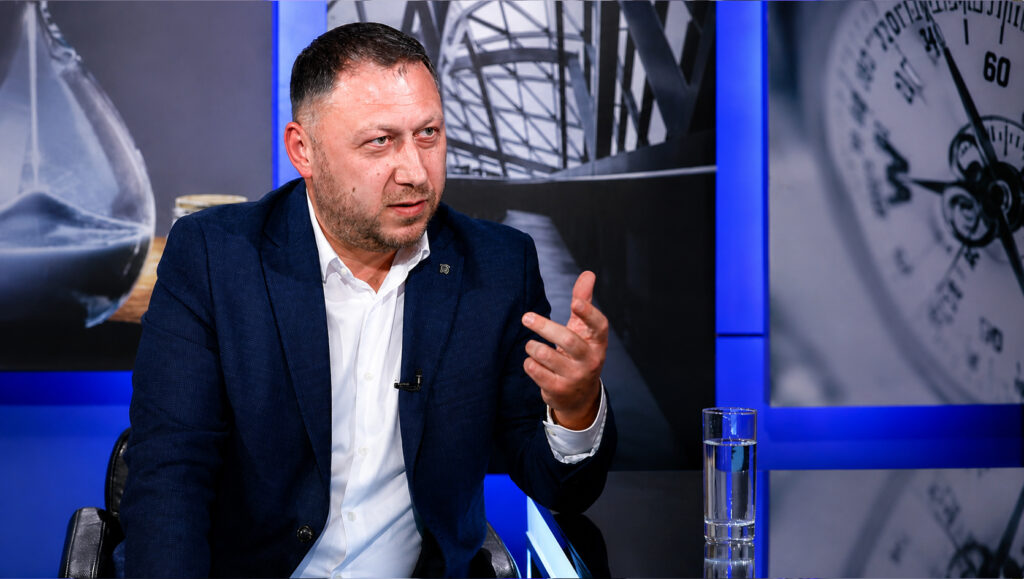
Armenia’s steadily rising public debt is a worrying trend, particularly given that the structure of the country’s economy has not changed sufficiently, while a significant share of economic growth in recent years has been driven by re-export operations. MP Hayk Farmanyan expressed this view.
According to Farmanyan, Armenia’s public debt has increased by approximately $8 billion in recent years. Around $1.8 billion of that increase was attributable to external debt, while the remainder came from domestic public debt.
Three Key Questions Must Be Answered When It Comes to Debt
According to Farmanyan, parliamentary oversight of public debt must consistently address three fundamental questions: why the debt is being taken on, where the borrowed funds will be spent, and what Armenian citizens will gain from it.
He said that the public debt-to-GDP ratio is often cited as a counterargument, as experts consider it to be within internationally acceptable levels.
Farmanyan, however, believes that structural differences between economies must be taken into account when comparing Armenia’s indicators with those of developed countries.
“Our colleagues forget one simple truth: what kind of economic structure those (developed) countries have, what kind of economic structure the Republic of Armenia has, and what kind of export structure those developed countries have,” he noted.
As an example, the MP cited the United States, whose public debt is approaching $40 trillion. According to him, comparing the US and Armenian economies is inappropriate because the American economy is more diversified and the dollar is a global reserve currency.
Farmanyan compared the situation to two entrepreneurs carrying the same amount of debt. One has diversified businesses across different sectors, while the other has only one seasonal and local business. The same amount of debt poses a greater risk to the latter.
Debt Servicing Accounts for More Than 10% of the State Budget
Farmanyan noted that although GDP and the state budget have doubled in recent years, attention must also be paid to the rising cost of servicing public debt.
According to him, interest payments alone have accounted for more than 10% of total state budget expenditures in recent years.
“This is a worrying development, and we must pay very close attention to it,” he said.
At the same time, the MP stressed that public debt itself is neither good nor bad. The problem arises when borrowed funds are not directed toward capital expenditures capable of generating sufficient economic growth.
Banks Should Play a Greater Role in Economic Growth
Farmanyan also sees a problem in the relationship between government bonds and commercial banks.
According to him, commercial banks invest a significant share of the funds they attract in government bonds, earning returns at relatively low risk. As a result, he argues, their incentive to invest in other sectors of the economy declines.
The MP also recalled the situation in the late 1990s, when yields on government bonds reached approximately 70% and banks, in his assessment, were making profits at the state’s expense.
According to Farmanyan, the issue was addressed through administrative measures at the time, during Vazgen Sargsyan’s tenure as prime minister.
A Predictable Tax System Is Necessary
The MP also emphasized the importance of establishing a fair and predictable tax system.
According to him, frequent changes to various provisions of tax legislation in recent years have reduced businesses’ ability to plan for the long term.
Farmanyan also identified dividend taxation and the mechanism for advance corporate income tax payments as issues requiring discussion.
“When a person plans business activity and suddenly, at a certain stage of that activity, some provision changes and disrupts normal operations,” he said, emphasizing the need for predictability.
Customs Administration Also Faces Problems
According to Farmanyan, while problems in the tax sphere are mainly related to policy, customs faces more administrative issues.
He said these problems indirectly harm businesses and may ultimately affect state budget revenues as well.
Farmanyan noted that the customs system has improved to some extent, but problems remain. He considers it unacceptable for the customs system to become a source of fines for citizens or businesses.
State Subsidies Should Be Assessed in Terms of Effectiveness
Farmanyan also addressed state subsidies and compensation schemes.
He noted that over the past year, businesses exporting goods to European Union countries have received compensation for customs duties from the state budget.
In the MP’s view, this raises a question of fairness, as one segment is being financed at the expense of another group of taxpayers.
At the same time, he said the effectiveness of these programs must be assessed to determine the extent to which they have contributed to changing the structure of Armenia’s exports.
“I think that so far they have not contributed sufficiently,” he said.
Farmanyan also believes that the effectiveness of government subsidies provided through banks to reduce interest rates on agricultural loans should be examined.
Economic Growth Has Been Largely Driven by Re-Exports
Farmanyan also highlighted the structure of Armenia’s economic growth.
According to him, since 2022, a significant share of the increase in economic growth and the economic activity index has been driven by re-export operations.
He believes that under these conditions, the government’s efforts to structurally transform the economy have yet to produce sufficiently tangible results.
“This growth could be described as spontaneous growth,” the MP said.
According to him, while GDP has doubled, public debt has increased by approximately $8 billion, and debt-servicing costs have risen as well.
Without Structural Economic Change, the Debt Problem Will Deepen
According to Farmanyan, if Armenia fails to change the structure of its economy, it could face challenges in maintaining sustainable public debt management over the medium and long term.
He said that amid rising public debt, Armenia needs structural economic transformation and industrialization.
“Without this, we cannot ensure sustainable public debt management,” Hayk Farmanyan stressed.
According to him, oversight of public debt should focus not only on the size of the debt but also on how effectively borrowed funds are used. The key question should be whether those funds generate economic results that will subsequently enable the country to service and manage the debt.