
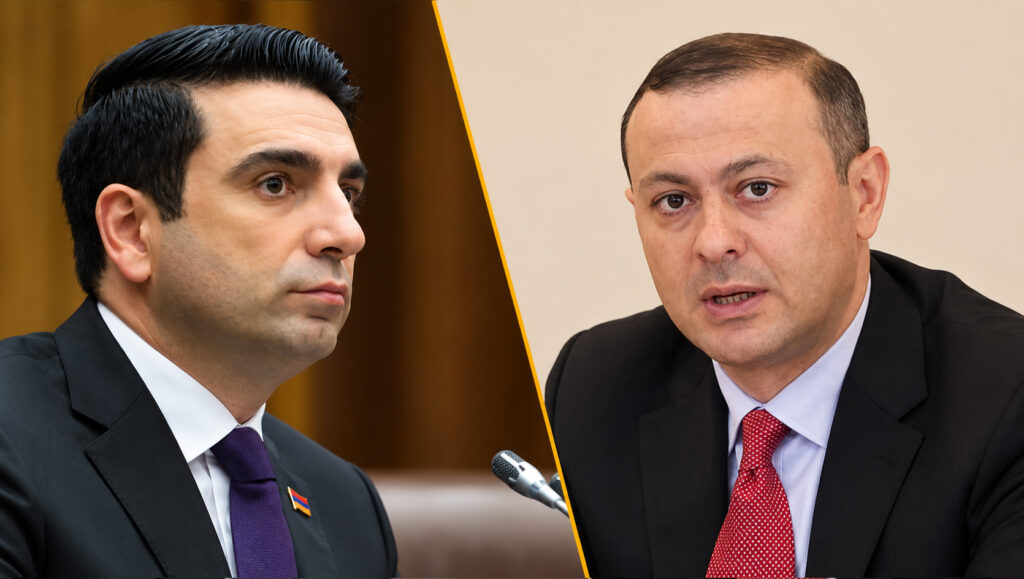
At a complex stage of Armenia’s foreign policy realignment, Prime Minister Nikol Pashinyan made an unexpected move by changing the leadership of one of the key institutions in the country’s security governance system — the secretary of the Security Council. Armen Grigoryan had held the position since the 2018 change of government, while these important functions have now been entrusted to former National Assembly Speaker Alen Simonyan. What consequences could this change have, and what should be expected from the newly appointed Security Council secretary?
The Security Council: From a Formal Structure to a Center of Policy Work
According to expert Davit Petrosyan, before 2018 the position of head of the Security Council Office was often perceived as a political appointment for people who had already completed the main phase of their state or political careers and needed to be given another position.
After 2018, according to the expert, the situation changed.
Under Armen Grigoryan, the Security Council Office played an important role in the diversification of Armenia’s foreign and security policy, Petrosyan said.
This was particularly significant because during that period Armenia was seeking to move away from a foreign policy structure dominated by relations with Russia and Russian-led platforms.
The Security Council Office began developing alternative channels with Europe and the United States.
At first, many did not believe that this policy could produce practical results, but according to Petrosyan, the process worked.
Many of these areas were later transferred under the coordination of the Ministry of Foreign Affairs, but they were initially launched within the Security Council Office, Petrosyan said.
For that reason, he argues, it is now important to understand what will happen not only to the leadership of the Security Council but also to the entire working system that has been built around it.
The Main Risk: Domestic Politicization of Foreign Policy
Petrosyan believes that Armen Grigoryan’s departure and Alen Simonyan’s appointment should not be viewed in the context of dissatisfaction with professional performance or an assessment of its effectiveness.
In his view, this is first and foremost a political change. It is precisely this factor that creates the principal risk.
Petrosyan considers it problematic if foreign policy begins to be shaped to a greater extent by domestic political processes.
Previously, the Security Council Office was largely focused on foreign policy, security and strategy development, while maintaining a degree of professional and institutional distance from domestic political debates.
A change in its political character could therefore also change the way the institution operates.
According to the expert, this raises not only an institutional issue but also a direct national security concern.
When foreign policy decisions are being made, the government must preserve mechanisms that allow different views, critical assessments and alternative scenarios to be presented.
If those mechanisms weaken, decision-making may become increasingly centralized.
Under a highly centralized model, the likelihood decreases that the same issue will be examined from different professional and political perspectives.
This may mean that alternative options are not sufficiently considered during decision-making and that potential risks are not assessed in their full depth.
When a Security Institution Can Become a Domestic Political Tool
This is the most sensitive aspect of the change.
The involvement of an institution such as the Security Council in domestic political agendas is dangerous not only because it could alter the institution’s working culture.
The issue goes much deeper: if the institution responsible for security policy becomes more directly involved in the logic of domestic political competition, the necessary boundary between national security and party-political interests could be undermined.
A security institution must assess the risks facing the state regardless of the domestic political objectives the government may be pursuing at a particular moment.
Otherwise, any foreign policy decision could begin to be viewed not only through the prism of the national interest but also through the government’s domestic political calculations.
In that case, the critical institutional environment would also be put at risk.
If different institutions within the state system no longer provide counterbalancing assessments but instead align around the same political logic, an illusion of consensus may emerge within the government.
Everyone may agree with the same agenda, but that does not necessarily mean that all of its risks have been assessed.
For this reason, the risk of centralization identified by Petrosyan should be viewed not as a possible consequence of an ordinary personnel change, but as an issue affecting the quality of state decisions and security governance.
Centralized Decision-Making Could Reduce the Role of Alternatives
Until now, important foreign policy decisions have been discussed on several platforms, including the Prime Minister’s Office, the Ministry of Foreign Affairs and the Security Council.
This multi-centered approach, even if it did not always produce agreement, at least made it possible to examine the same issue from different perspectives.
If the Security Council loses its professional autonomy within this system and becomes more closely integrated into the logic of domestic political decision-making, the opposite process may emerge: decision-making could become concentrated around a single political direction.
In that case, the problem is not simply that an alternative opinion may be rejected.
More dangerously, such an opinion may never be formulated at all or may never reach the level where decisions are made.
In other words, the dangerous scenario for the state is not only an incorrect decision, but also a situation in which alternative scenarios are not fully examined before that decision is made.
As a result, foreign policy risks may be assessed incompletely, while the consequences of decisions may be projected within an excessively narrow framework.
This Is Particularly Sensitive During Armenia’s Foreign Policy Realignment
All of this is taking place during an especially sensitive period.
Armenia is simultaneously reassessing its relations with Russia, developing cooperation with Western partners, seeking new economic and regional opportunities and reshaping its security system.
At such a stage, foreign policy requires not less but more professional disagreement, discussion of different scenarios and multidimensional risk assessment.
For this reason, a decline in critical thinking within the Security Council could have consequences far beyond changes in the work of a single state institution.
If the Security Council Office previously served as a platform where strategic foreign and security policy directions were developed, the key question now is whether that role will be preserved or whether the institution will gradually acquire a more pronounced political function.
The answer will determine not only the future work of the Security Council, but also the extent to which Armenia’s foreign and security policy continues to be based on institutional discussion, professional assessments and the comparison of alternatives.
Because the greatest danger for a security institution is not merely a wrong decision.
A greater danger is a system in which an alternative view of a wrong decision no longer reaches the people making it.
And if the Security Council, which in recent years had developed into a professional center for foreign and security policy, begins to operate increasingly according to the logic of domestic political processes, the risk will concern not one official or one appointment, but the entire system of national security decision-making.