
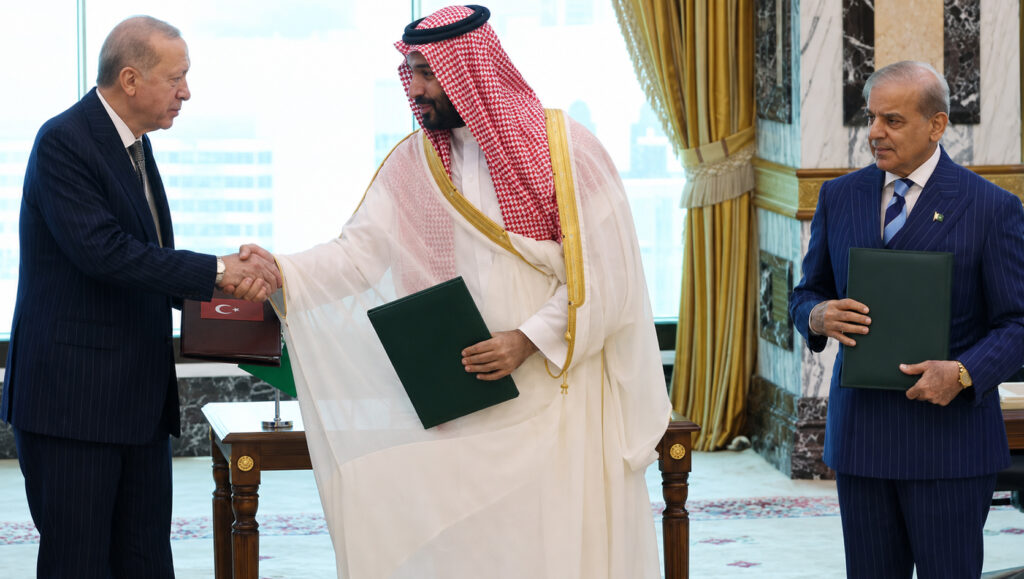
The mutual defense agreement signed by Saudi Arabia, Turkey and Pakistan is an important component of the emerging security architecture in the Middle East and could reshape the calculations of regional states, according to Arab affairs expert Hayk Kocharyan.
He argues that several different axes of cooperation have been taking shape in the region in recent years and that the Mecca agreement should be viewed within this broader process.
New Axes of Cooperation Are Emerging
Kocharyan said several distinct alignments can already be identified in the region. One consists of the countries participating in the new agreement, while another is emerging along the India–UAE–Israel–Greece–Cyprus axis.
According to him, around ten days before the Saudi-Turkish-Pakistani agreement was signed, it also became known that a document had been signed within the framework of this second alignment.
“These axes are emerging because of the new situation that has developed in the region,” the Arab affairs expert said.
Kocharyan identified unresolved U.S.-Iran tensions, the continuing military confrontation and often contradictory reports about negotiations, as well as Israel’s actions in the region, as important factors shaping this new environment.
Taken together, he said, these developments have made the search for new security systems increasingly relevant.
The Agreement’s Core Provision
According to Kocharyan, the full text of the Mecca agreement has not yet been made public, meaning its contents can currently be assessed only on the basis of limited information.
Turkish Foreign Minister Hakan Fidan has described it as a mechanism broadly resembling the logic of Article 5 of the NATO treaty. In other words, an attack on one party could trigger an obligation by the others to provide mutual support.
However, Kocharyan said this raises an important question. Saudi Arabia and Pakistan had certain mutual assistance arrangements in the past as well, yet those mechanisms were not activated when Iran carried out strikes or when the Houthis conducted operations.
Regarding Iranian actions, Kocharyan said Tehran’s position should also be taken into account. Iran has stated that it does not target states hosting a U.S. military presence simply because they host those forces, but rather directs its actions against American military infrastructure itself.
At the same time, the Houthis and other armed groups operating in the region are not state actors. A defense pact of this kind is essentially designed to establish a mechanism for responding to an attack by one state against another.
The Main Goal Is to Deter Israel
Kocharyan believes the agreement’s primary purpose is to consolidate the positions of the partner states in the event of possible action involving Israel.
“Everyone understands that the primary target of this pact is Israel,” he said.
At the same time, he emphasized that for now the agreement should primarily be understood as a deterrence mechanism and that a number of conditions would have to coincide before it could be activated.
If a new phase of actions directed against Israel begins in the region, Kocharyan said, the pact’s members could display a more pronounced level of consolidation. At present, however, such a situation does not exist.
He characterizes the agreement as a deterrent rather than an aggressive or offensive pact, one that is helping define the boundaries of a new regional security architecture.
Could Other Countries Join?
According to Kocharyan, the possibility of other states joining in the future will depend on how the regional situation develops.
He recalled that the foundations for this cooperation have been taking shape over the past two years, including preliminary or prototype agreements, efforts to establish different alliances and joint military exercises.
Egypt had previously also been considered as a possible participant, Kocharyan noted, although it is not part of the current agreement.
At the same time, statements by Turkey’s foreign minister suggest that Egypt could become involved later if certain technical conditions are met.
Kocharyan stressed, however, that the full text of the agreement is necessary before any final assessment can be made.
From Military Cooperation to Economic Ties
Kocharyan argues that the agreement’s military and economic dimensions are difficult to separate completely.
Turkey, for example, has significantly expanded its military exports in recent years, including supplies to Pakistan and Saudi Arabia.
Deeper defense cooperation could therefore also involve additional investment and wider economic cooperation in the defense industry.
According to Kocharyan, Saudi Arabia may be interested in such investments, particularly if other parallel agreements have also been signed whose contents have not yet been made public.
“A new field of cooperation is emerging, and it is changing the possible calculations in the Middle East,” the Arab affairs expert said.