
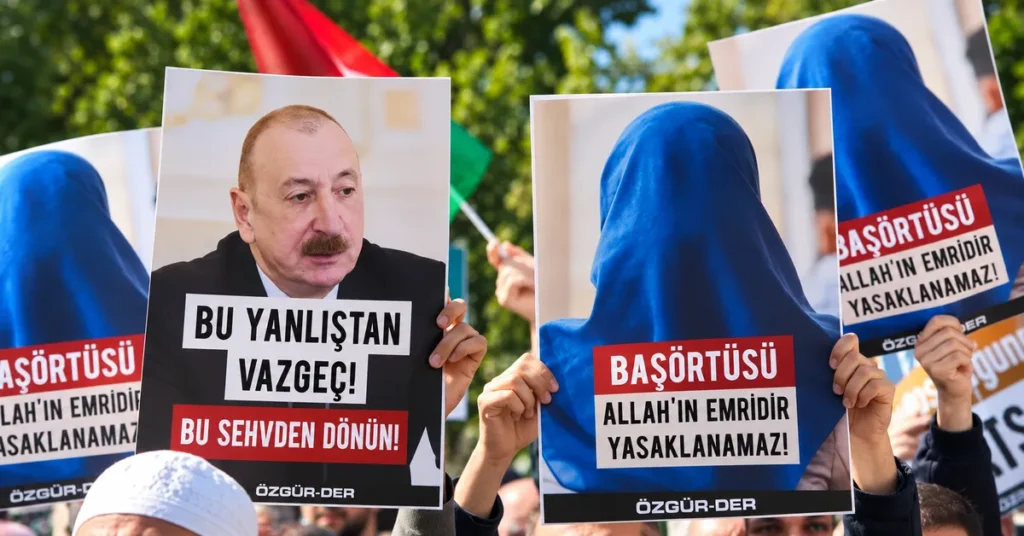
The wave of protests over the hijab in Azerbaijan has exposed tensions between the authorities and parts of society that follow a traditional Islamic way of life, as well as the government’s attitude toward the Shia religious community. The issue also fits into a broader pattern of disagreements between Baku and Ankara, according to Iran specialist Vardan Voskanyan.
“If we look at the formal side, a law was adopted on a uniform school dress code, and all pupils were supposed to wear the same uniform. But there is a contradiction here: the rule concerns pupils, yet teachers wearing hijabs were also barred from entering schools. It is therefore clear that, under the guise of a supposedly legislative regulation, actions are being taken against the believing Muslim population — more precisely, against its traditional way of life and dress. Overall, this is a process directed against Shia Islam,” the expert says.
In his assessment, the restrictions should be viewed in terms of both religious freedom and Azerbaijan’s domestic politics. Voskanyan identifies several reasons.
Aliyev’s confidence and society’s real problems
Voskanyan believes that, after gaining control of Artsakh, Azerbaijan’s president became more confident and assumes that his standing at home is strong enough to let him take any step without encountering serious public resistance. According to the expert, Aliyev does not understand the aspirations and feelings of social groups that are not represented in the governing system.
The expert describes Azerbaijani society as complex, with groups whose ways of life, values and worldviews often differ substantially from those of the ruling elite. In his view, Azerbaijan’s ruling family represents “a Russian-speaking elite formed within the Soviet nomenklatura system,” which governs a predominantly Azerbaijani-speaking population.
Voskanyan also points to the contrast between the ruling family’s secular lifestyle and the traditional values of a significant part of society. He describes the Aliyev family as living a luxurious, secular life, including expensive shopping in Paris and London, while traditional customs and social problems persist in many parts of Azerbaijan, particularly outside major cities.
“We are dealing with a very traditional society, especially outside Baku and the major cities. In many places in Azerbaijan, in rural communities, even today, when a queue forms, women and men stand separately. Alongside that traditional society, there is a government that essentially has neither an ancestral nor a behavioral connection with those people,” he says.
Anti-Armenian propaganda as a source of political legitimacy
In Voskanyan’s assessment, anti-Armenian propaganda has long been an important tool for sustaining the legitimacy of Azerbaijan’s government. He says responsibility for the public’s social and economic problems was repeatedly placed on Artsakh and Armenians, with people told that the source of their difficulties was Artsakh’s being under Armenian control.
In his account, Azerbaijani citizens were led to believe that they would not face those problems if Artsakh were no longer under Armenian control. He argues that, after Azerbaijan gained control of the territory, this narrative lost some of its former effectiveness. Some people now ask what has changed in their daily lives and what benefit they have received.
“The average Azerbaijani who is not part of the ruling elite thinks: what do I gain? Artsakh used to be under Armenian control; now it is under Ilham Aliyev’s control. I received none of Artsakh’s wealth then, and I receive none of it now,” the expert says, describing that perspective.
Religious opposition in place of political opposition
Voskanyan says Azerbaijani authorities have spent decades trying to keep society away from politics by suppressing opposition groups, imprisoning their members or driving them out of the country. In his view, restricting political activity has not removed discontent; it has encouraged other ways of expressing it.
“If you depoliticize society for decades, that does not mean social problems disappear. Azerbaijani society is no longer engaged in politics — Aliyev achieved that. What did he get instead? A religious opposition,” the expert says.
In his assessment, religious opposition in a Muslim society cannot be entirely apolitical, even if it presents its work as purely religious. Voskanyan attaches particular importance to Iran’s influence because of the religious, ideological and social links between the two countries.
Most of Azerbaijan’s population is Shia Muslim, as in Iran. According to the expert, that shared affiliation matters: religious and political developments in Iran cannot leave Azerbaijan unaffected.
He also points to Turkic-language television channels broadcasting from Iran. He says they mainly carry religious content and have a broad audience in Azerbaijan, especially in the country’s southern regions.
Another factor, Voskanyan says, is the education of Azerbaijan’s Shia clergy. Many clerics have studied at Shia religious centers in Iran, including Qom, and in Iraq. This connects them to a wider network within the Shia religious world.
Why the authorities do not control the entire Shia religious sphere
Voskanyan considers the distinction between Azerbaijan’s official religious institution and clerics who hold authority among believers a defining feature of the country’s religious landscape.
The Caucasus Muslims Board, an institution dating back to the Soviet era, operates in Azerbaijan. Voskanyan argues that its leader, Allahshukur Pashazadeh, does not have the religious rank or educational qualifications required of the highest spiritual authorities in Shia Islam.
He explains that a Shia believer may follow a spiritual authority of their choice, known as a marja al-taqlid, literally a “source of emulation.” Such an authority must have the relevant knowledge and religious standing. Religious leaders in Iran and Iraq are among the ayatollahs regarded as having high spiritual authority.
According to Voskanyan, there is no ayatollah in Azerbaijan, and Shia believers there may follow religious authorities in Iran, Iraq and even Afghanistan. The existence of an official religious institution therefore does not, in his view, mean that the government controls believers’ convictions or spiritual allegiances.
“Spiritual questions within Azerbaijan, which cannot be separated from political questions, create quite a complicated picture. Many people follow different Iranian or Iraqi ayatollahs. So we are dealing with a complex mosaic that the authorities in Baku generally do not know well,” the expert says.
In his assessment, Azerbaijan’s leadership is so focused on geopolitical ambitions, oil and gas resources, and the country’s standing in international relations that it pays insufficient attention to domestic religious and social developments.
The leaders’ different worldviews and Baku–Ankara tensions
Voskanyan believes the hijab dispute has revealed differences between Azerbaijan and Turkey that run deeper than a disagreement about religious dress.
He describes Ilham Aliyev as a member of a Russian-speaking elite formed within the Soviet nomenklatura system, with a strongly secular lifestyle, who came to power through his father. At the same time, Voskanyan stresses that Aliyev should not be underestimated because of his background or family ties: maintaining an entrenched authoritarian system and sidelining potential rivals is a difficult political undertaking.
Erdogan’s political path, according to Voskanyan, is entirely different. He came to power through a long political struggle, rather than through an inherited position, and made use of Islamic ideology.
“We have two different poles in terms of ideology and personal conduct: Ilham Aliyev, devoted to distinctly secular pleasures, and Erdogan, with a traditional Muslim worldview. Sooner or later, a certain conflict was bound to arise between these two people,” the expert says.
Voskanyan notes that the two leaders had shared interests during Azerbaijan and Turkey’s cooperation against Armenia and Artsakh. In his assessment, having a common adversary may have pushed other disagreements into the background. After Azerbaijan gained control of Artsakh, however, that common goal lost some of its former importance in his view, while the other issues remained.
Aliyev does not want to share the credit for victory with Erdogan
The expert believes one important source of tension between Azerbaijan and Turkey is Aliyev’s desire to present the establishment of control over Artsakh as his victory alone.
Voskanyan emphasizes Turkey’s direct involvement in Azerbaijan’s military successes. He recalls that Aliyev and Erdogan stood side by side to review the victory parade in Baku. According to him, both Azerbaijani and Turkish flags were placed by the graves of those killed in many parts of Azerbaijan at the time. Later, he says, that gradually changed, leaving mainly Azerbaijani flags.
The expert sees the change as a symbol of Aliyev’s desire to tie the victory to his own rule. “The dictator in Baku believes he should share that victory with no one. It is his victory alone. And that is important to him domestically as well,” Voskanyan says.
Voskanyan says the restrictions also affect Erdogan’s position
In Voskanyan’s assessment, the hijab restrictions also affect Turkish President Recep Tayyip Erdogan. He points out that Erdogan’s wife, Emine Erdogan, wears an Islamic hijab in keeping with its religious rules, while women wearing similar clothing have faced restrictions on entering schools in Azerbaijan.
He says the issue carries political significance for Erdogan, who has also drawn on the hijab question during his political career. In Turkey, following Mustafa Kemal Atatürk’s reforms, the wearing of the hijab faced restrictions at different times, including after military interventions.
In Voskanyan’s view, what is happening in Azerbaijan resembles, in some respects, the restrictions Erdogan opposed in Turkey. “What was done against Erdogan in Turkey is now being done by Ilham Aliyev in the context of the hijab. This is directed not only against Iran but also against Erdogan,” he says.
The expert believes Aliyev is also seeking to weaken the influence of pro-Turkish groups within Azerbaijan.
Unlike Shia believers, Voskanyan says, these groups are largely secular, but their members hold important positions in the army and elsewhere in the state. Limiting Turkish influence could therefore also strengthen Aliyev’s domestic position.
Turkey–Israel tensions narrow Baku’s room for maneuver
Another factor Voskanyan identifies is the sharp deterioration in relations between Turkey and Israel. He believes this limits Azerbaijan’s foreign policy options because Baku maintains close ties with both countries.
The expert does not attribute the deterioration in Turkish–Israeli relations to Erdogan’s statements in support of Palestinians. He believes the two countries’ interests have clashed in Syria and that this has deepened their differences.
Azerbaijan, which has close relations with Israel, tried at one stage to mediate between Turkey and Israel. In Voskanyan’s assessment, however, events are moving in the opposite direction: the sides’ positions are not drawing closer, and their differences are deepening.
Baku thus faces a difficult situation, in which the need to maintain its alliance with Turkey intersects with its interest in cooperating with Israel.
Iranian and Turkish interests may coincide on some issues
Voskanyan also points to what he sees as a paradox: Iran and Turkey could find themselves on the same side on certain questions involving potential counterweights to Aliyev’s government.
He emphasizes, however, that the process is only at an early stage and that neither its course nor its possible consequences can yet be predicted.
“This is another paradoxical situation. In the context of opposing Aliyev, Iran and Turkey have, in a certain sense, effectively become allies. But we are seeing only the beginnings of this process, and it is still unclear how it will develop and what consequences it will have,” the Iran specialist says.
Disagreements do not mean Azerbaijan–Turkey relations will collapse
Voskanyan specifically cautions against interpreting the differences between Azerbaijan and Turkey as a prediction of inevitable confrontation or war.
He says it would be mistaken to assume that these disagreements will cause Azerbaijan to collapse, lead Turkey and Azerbaijan or Iran to fight one another, or trigger a regional redistribution of power. In his view, there is no basis for such conclusions, although the tensions should not be ignored.
He concludes that Armenia should do more than observe these differences: it should understand their nature and assess whether they could create political opportunities. “If you are a player, you have to play. If the opportunity arises, you should widen those cracks, if that is your aim,” the Iran specialist says.