
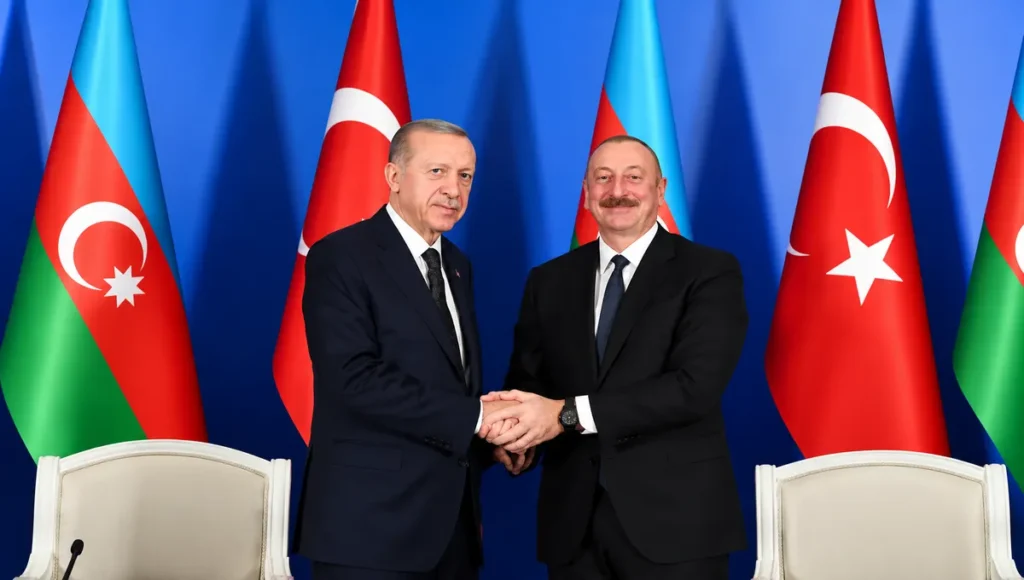
Azerbaijan’s authorities view the institutionalisation of peace with Armenia less as a foreign policy achievement than as a domestic political danger. According to international relations professor Anna Ohanyan, Ilham Aliyev’s government has little interest in a peace process that could limit its room for manoeuvre. At the same time, Baku is increasingly using authoritarian methods associated with Russia in its domestic politics, while political developments in Turkey are moving in a different direction.
Peace as a risk for Aliyev’s government
In Ohanyan’s assessment, even if Baku agrees to sign a peace agreement, that would not necessarily mean Azerbaijan’s leadership is prepared to turn the process into a system of stable and predictable relations. Institutionalising peace could restrict the political tools through which Aliyev retains the ability to exert pressure on Armenia and other regional actors.
Ohanyan observes that the United States could put pressure on Aliyev as part of its competition to expand its influence in Eurasia. Washington’s actions, however, have yet to show a clear readiness to engage more deeply in peacebuilding.
She points to another contradiction: Azerbaijan’s state institutions are comparatively weak, in her view, yet the country acts in international negotiations as though global developments depend on it.
Ohanyan sees this as an unusual reversal of influence. A small state can turn its position, geopolitical importance and the competing interests of outside powers into leverage to resist the demands of stronger states or set the terms of its relations with them.
For Azerbaijan, that leverage comes not only from energy infrastructure or regional location, but also from its ability to manoeuvre between different centres of power.
Aliyev’s approach and its resemblance to Putin’s methods
According to Ohanyan, features characteristic of Russia’s authoritarian methods of governance are visible in Azerbaijan’s domestic politics.
In her assessment, as an authoritarian system deepens and its leaders become concerned about their own stability, the image of an external enemy becomes an important tool for rallying support at home. Armenia is particularly easy to cast in that role because the Armenian-Azerbaijani conflict has long been used to shape public sentiment and the political agenda.
Ohanyan argues that Aliyev presents Azerbaijanis with a picture of their country surrounded by enemies, opposed by the world and itself a victim. Within that narrative, the West can also be portrayed as a force acting against Azerbaijan’s sovereignty or secular identity.
Anti-Western rhetoric can, at the same time, strengthen the government’s domestic position. Ohanyan sees parallels here with Putin’s politics, where talk of external threats and enemies is used to concentrate power and tighten control over society.
In this logic, the conflict with Armenia is more than a foreign policy issue. It can also serve a domestic political purpose, allowing the authorities to maintain a sense of constant threat and use it to justify their policies.
Turkey and Azerbaijan: diverging political cultures
Although Turkey and Azerbaijan often share foreign policy interests, Ohanyan notes that their domestic political trajectories are increasingly diverging.
In Turkey, Recep Tayyip Erdoğan came to power partly by drawing on the demands of a more religious society and challenging the tradition of secular governance. In Azerbaijan, by contrast, Aliyev’s government seeks to preserve the secular character of the state.
Ohanyan says the reasons for this choice are not entirely clear. One possibility, in her view, is that Baku sees its secular identity as an advantage in its relations with the West.
At the same time, some people in Azerbaijan want greater freedom to express their religious identity. When the state tries to restrict those expressions, tensions between parts of society and the authorities may deepen. For Baku, this is both a domestic governance issue and a foreign policy concern: developments surrounding religious identity could affect Azerbaijan’s relations with the Arab world and other international actors.
The distinction between Turkey and Azerbaijan matters in terms of political culture, Ohanyan observes. Ankara is moving further away from its earlier secular model, while Baku seeks to preserve the image of a secular state.
That difference should not, however, be seen as an immediate opportunity to open the Armenia-Turkey border, she cautions. In Ohanyan’s assessment, the decisive factors are more likely to be external pressure and geopolitical interests than differences between Turkey’s and Azerbaijan’s domestic politics alone.
👉 Regional