
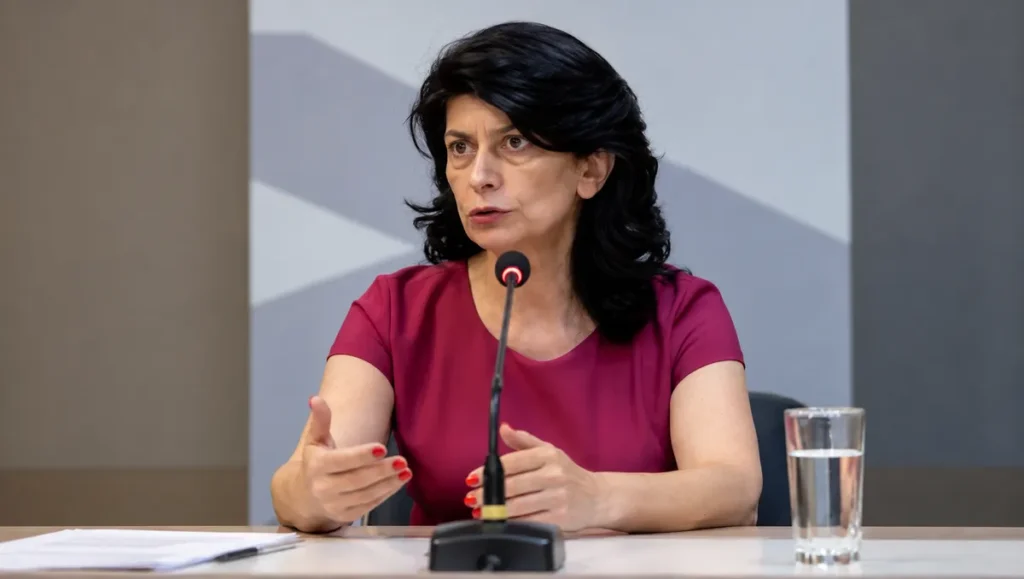
Operating the Amulsar gold mine is unacceptable because of seismic hazards, landslides, acid rock drainage and radiation risks, environmental lawyer Nazeli Vardanyan has said.
Vardanyan represented residents of the Gndevaz and Jermuk communities in court for about ten years. She recalled that, as early as 2012, a commission concerned with Lake Sevan identified four main dangers associated with Amulsar. Other experts subsequently confirmed those concerns, she said.
Four main risks associated with mining at Amulsar
The first is seismic risk. According to Vardanyan, the area lies in a zone with a seismic intensity rating of 10. The second is the danger of landslides: she described Amulsar as Armenia’s second-largest landslide area.
The third is acid rock drainage, which she believes cannot be controlled. The fourth is a high radiation risk. Vardanyan said the area has been registered in geological records as a uranium and thorium occurrence since the 1950s.
“These four points are risks that cannot be changed or managed. Those who say they can be managed, or that new technologies exist for this, are mistaken. There are no technologies that can control or prevent seismic hazards, landslides, radiation and acid rock drainage,” Vardanyan said. She described mining at Amulsar as posing a risk of major disaster.
Potential consequences for Jermuk and Lake Sevan
According to Vardanyan, Amulsar lies within Lake Sevan’s drainage basin, making its operation impermissible under Armenia’s Law on Lake Sevan. She claims that project permits were also issued in breach of the Convention on Biological Diversity, the Bern Convention and the Aarhus Convention. In her assessment, the environmental risks directly threaten Jermuk and Lake Sevan.
“All the experts unanimously said those waters would be polluted. And even if you spent billions over 500 years, you could not restore them,” she said. Vardanyan argued that the risks concern not only the natural environment but also people’s rights to health and to live in a healthy environment.
Questions over the legality of continued work
Vardanyan placed particular emphasis on whether continued mining activity at Amulsar is lawful. According to her, following an application by campaigners, the Bern Convention Secretariat decided that construction and mining at Amulsar should stop immediately and that a new assessment should be conducted.
“Mining cannot take place without an expert assessment. It is an unlawful activity. Our government is ignoring the demand of an international organisation. Ahead of COP17, it is throwing down a challenge to the international community,” Vardanyan said.
She maintains that the mine must not operate without an expert review of its environmental impact assessment and compliance with international standards. If mining continues at Amulsar without the necessary legal grounds, those responsible should be held accountable, she said.
Dust, damaged land and lost harvests
Vardanyan also discussed the effects of work carried out in the area over many years. According to her, land and pastures have been occupied during the roughly 21 years of the mining project. Blasting has taken place, and the ecosystem has been damaged.
She claimed that dust covered the apricot orchards of Gndevaz for years. Residents were consequently forced to discard their harvests because of the dust that had settled on the orchards, she said.
In her assessment, these circumstances further demonstrate why the project’s continuation cannot be viewed solely in terms of economic gain. She stressed that extracting gold cannot justify putting water resources, the natural environment and human health at risk.
“Our gold is our water; our gold is Jermuk. We have no right to lose our homeland and what we have for the sake of some gold reserves or the interests of a few people,” she said.
Appeals to financial institutions
On the question of the mine’s legality, Vardanyan said opponents continue their campaign internationally and their work with financial institutions, urging them not to fund the project. According to her, the European Bank for Reconstruction and Development and the International Finance Corporation, or IFC, previously withdrew from the project following their demands.
Vardanyan argues that financing for the mining project remains problematic. She believes financial institutions should bear responsibility for environmental problems arising from their involvement.
She said their demand regarding Amulsar remains unchanged: the mine must not be allowed to operate until all environmental and legal requirements have been met.
👉 Economy