
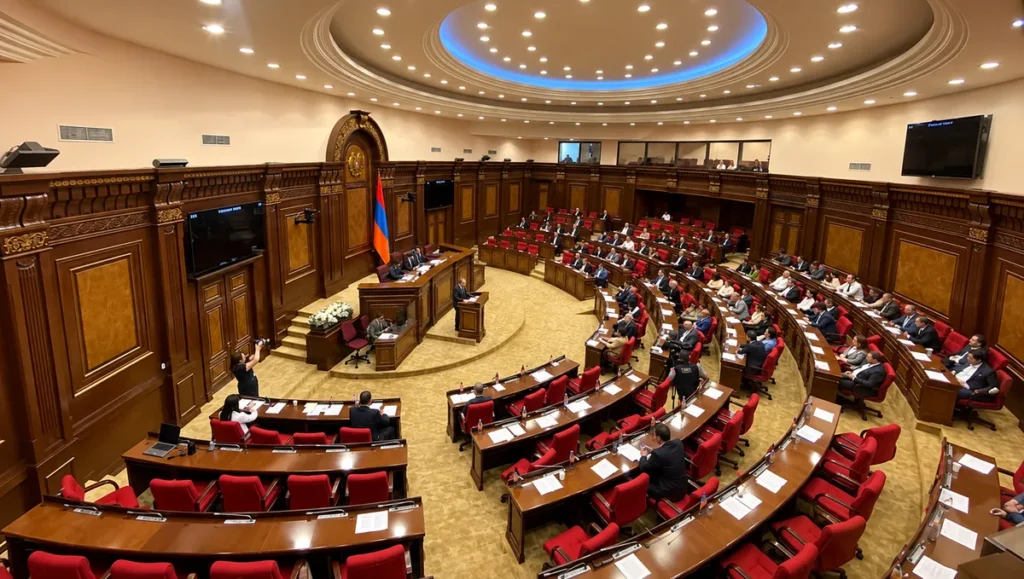
The development of political parties is a central challenge for Armenia’s political system and those of several other post-Soviet countries. Had the necessary problems been addressed in time, Armenia could be in a much stronger position today and Artsakh would not have been surrendered, according to former National Assembly speaker and political science scholar Tigran Torosyan.
Torosyan says some of Armenia’s mistakes and shortcomings are also found in other post-Soviet countries, including Ukraine, Georgia and Moldova. The failure to develop strong parties is one of the most important of these problems, in his assessment.
The opportunities of the 2005 constitutional amendments went unused
Torosyan recalled that Armenia’s constitutional amendments of 2005 gave political parties an opportunity to take on a more important role in the country’s political life.
After the 2007 parliamentary elections, however, it became clear that building effective parties would be difficult. According to Torosyan, the presence in parliament of forces willing to form a majority with the ruling party created an imbalance between the majority and the opposition.
Another factor was the limited political experience of the second-largest force in parliament, Prosperous Armenia. It had been formed only a year earlier. “This was also a very serious blow to the development of the political system as a whole,” Torosyan said.
Strong parties matter, he explained, because they form the parliament. Parliament, in turn, approves the composition and programme of the government and makes appointments to a number of positions.
Torosyan said that making use of the opportunities created by the 2005 amendments required the adoption of about 60 laws or changes to existing laws. According to him, the legislative changes were made, and a 2007 resolution of the Parliamentary Assembly of the Council of Europe recognised Armenia’s progress. Nevertheless, he believes the country did not continue along a path that could have strengthened its political system.
Moving to parliamentary government with weak parties was a mistake
In Torosyan’s view, parliament should have become an important place for relatively new parties, already equipped with several years of political experience, to develop and learn.
He argues that political forces in Armenia and other post-Soviet countries often do not function as parties in the modern sense. Under those conditions, moving to a parliamentary system without using the opportunities to develop parties carried serious risks.
“To create parliamentary government with parties that have not matured, you would either have to know absolutely nothing about the experience and knowledge available in this field, or… I do not know. I do not want to think that someone deliberately led things down that path,” he said.
Torosyan cited Belarus as an example. He said that under Alexander Lukashenko, who came to power amid a system described as parliamentary democracy, the central role in the political system became concentrated in the hands of the president.
A system burdened by such contradictions and problems cannot effectively address the difficult issues facing a country, Torosyan argued.
A party is not merely a formal mechanism
Discussing why parties have struggled to develop across the post-Soviet region, Torosyan pointed to the legacy of the Soviet period. People have often viewed a party as a formal vehicle through which an influential person gathers supporters, comes to power and then acts as they wish, regardless of the Constitution and the law, he said.
The first step towards solving the problem, Torosyan argued, is understanding what a party is and how it should work. A party should engage with society continually, explain the problems facing the country and present ways to address them. In Armenia, however, parties often forget people after elections, he said.
👉 Law