
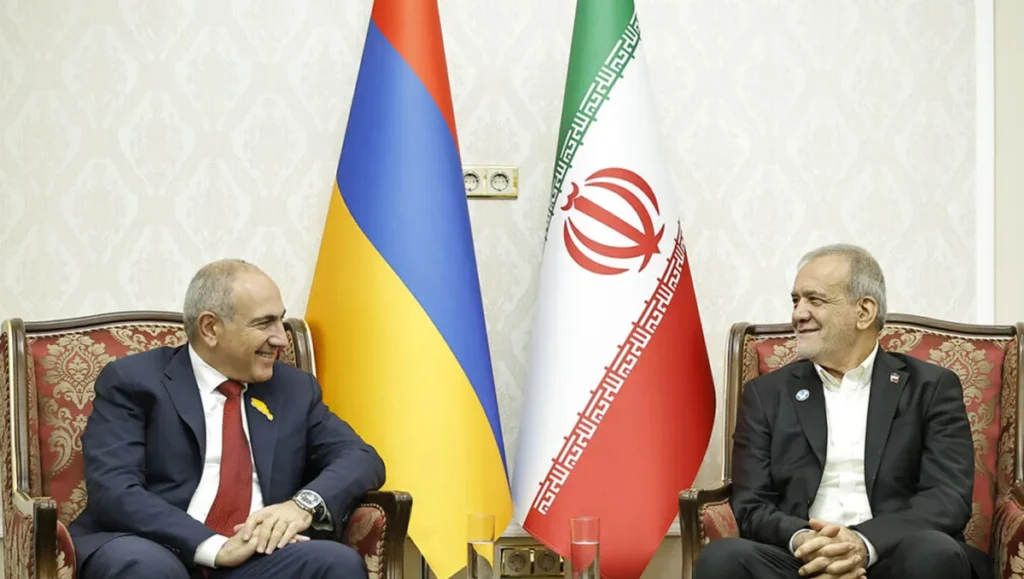
The past week saw a series of Armenian-Iranian meetings and contacts. Armenian Foreign Minister Ararat Mirzoyan met his Iranian counterpart and Iran’s president. Prime Minister Nikol Pashinyan subsequently held a telephone conversation with Iranian President Masoud Pezeshkian. The two leaders later met on the sidelines of the summit of CIS heads of state.
These contacts were followed by statements that Armenia-Iran relations were developing and moving towards a new level. What does the increased frequency of contacts actually indicate, and what processes underpin it? Iranian political analyst Pouya Hosseini offered his assessment.
“All steps concerning Armenian-Iranian relations deserve appreciation. The more frequent the contacts, the more opportunities both sides will have to discuss issues,” Hosseini said.
According to him, the situation surrounding Iran has intensified against the backdrop of new US sanctions. The analyst considers this more than the imposition of sanctions, describing it as an economic war against Iran. He recalled that the US Treasury secretary had also characterised these actions as part of the war. The Iranian side, he said, considers them economic terrorism.
Hosseini stressed that Washington is trying to draw Iran’s neighbours into this policy of economic pressure by demanding restrictions on their relations with Tehran. According to him, Iran has warned that actions by countries joining the economic war against its people will not go unanswered.
At the same time, Tehran is seeking to prevent US pressure from damaging its relations with neighbouring countries. In this context, he highlighted Armenia’s efforts to preserve Iran’s trust and avoid joining restrictions directed against Tehran.
Sanctions on Iran and Armenia’s choices
According to Hosseini, Armenia has not joined this policy of restrictions so far, but must also consider its relations with the United States. He believes Yerevan is trying to maintain a balance. It seeks to avoid jeopardising relations with Washington while protecting its vital ties with Iran.
The analyst noted that other countries have negotiated certain exemptions or concessions by drawing on their relations with the United States.
“If a country complies, the United States can increase the pressure further and make new demands. But some countries have negotiated and secured exemptions for themselves,” he said.
According to Hosseini, nobody has an interest in Armenia coming under sanctions. However, preventing damage to Armenian-Iranian relations is equally important.
He stressed that the issue extends beyond the level of trust between Armenia and Iran. US pressure also targets Iran’s neighbours. This could limit the options even of countries wishing to maintain normal relations with Tehran.
In the analyst’s assessment, subsequent stages of pressure could involve restrictions on land routes as well as maritime and air connections. If Washington makes such demands of Iran’s neighbours, the impact on regional transport links and economic ties could deepen.
TRIPP’s future also depends on US-Iran relations
Hosseini did not rule out the possibility that an expansion of pressure against Iran could affect TRIPP. According to him, US attempts to restrict land connections with Iran could create problems for regional transport projects.
“This could even directly affect the TRIPP project. The project could also become an instrument through which attempts are made to restrict land routes,” the analyst said.
In his assessment, an important task for Armenia’s authorities is to explain to the United States why preserving relations with Iran is vital for Armenia. Hosseini believes Yerevan can explain that avoiding participation in restrictions against Iran serves Armenia’s national interests.
He argues that the United States should also consider its own interests in the region. These include implementing TRIPP and maintaining its regional presence.
Hosseini did not rule out strong pressure from Washington on Armenia to restrict relations with Tehran. In his assessment, however, such a policy could also conflict with US interests. Iran would take retaliatory steps that would create problems for TRIPP.
Regional developments depend on the course of the US-Iran conflict
According to Hosseini, it is currently impossible to predict precisely how Iran’s relations with its neighbours will develop or what will happen to regional transport projects. Their future will depend heavily on the course and eventual outcome of the US-Iran conflict.
He noted that even the possibility of expanded military operations against Iran could change regional calculations. If the conflict deepens, Iran could adopt a tougher position towards a US presence near its borders.
The analyst believes the same applies to possible restrictions on land connections. If the United States seeks to restrict neighbouring countries’ land connections with Iran as part of its economic pressure, the consequences for the region could become more complicated.
“Everything is closely tied to the course of the war between the United States and Iran,” Hosseini concluded.
👉 Region