
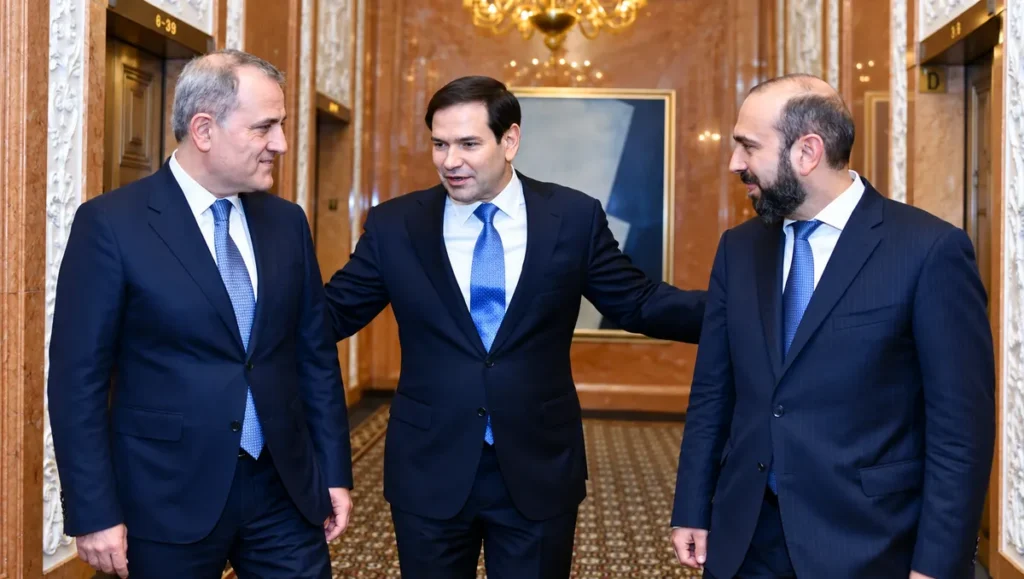
One week apart, Tehran received both Azerbaijan’s deputy prime minister and Armenia’s foreign minister. Was this a coincidence or part of a deliberate pattern?
Political analyst Davit Karapetyan believes the visits were planned in advance. Their sequence reflected Iran’s need for clarity on regional developments, particularly the Trump Route and logistics corridors. According to him, Tehran still has unanswered questions. These concern both the project’s practical implementation and the statements and actual intentions of Yerevan and Baku.
Karapetyan said Iran wants to understand what arrangements are being reached with Armenia and Azerbaijan and what roles different parties will play. It also wants to assess the consequences of the planned infrastructure for the security of its northern border.
“These were visits planned in advance. There are no coincidences in politics. These are calculated steps to clarify positions on both sides through diplomatic channels,” he said.
The analyst believes Tehran has activated a diplomatic mechanism to understand what arrangements might be reached with the two countries. He considers it significant that Azerbaijan was invited first.
“In my view, there are more questions to clarify and directions to establish with Azerbaijan, and only then with Yerevan. Tehran’s overriding goal is to clarify these regional configurations, particularly matters concerning its northern border,” Karapetyan said.
According to him, Armenia is already discussing the launch of the Trump Route. Legal and contractual arrangements have reached the practical stage, when planned changes must materialise on the ground. During this transition, Iran has certain reservations. It wants to hear the political positions of both official Baku and Yerevan.
Although little information is available about the substance of the Tehran meetings, Karapetyan believes the discussions primarily concerned Iranian-Azerbaijani relations and the parties’ roles. Another issue was Azerbaijan’s position on regional developments.
The analyst considers it important to understand Baku’s position first, followed by Armenia’s. In this way, Iran seeks to formulate its own position. It is assessing the emerging situation through the lens of its national interests, rather than acting as a third party or mediator.
Iran’s three main concerns about TRIPP
According to Davit Karapetyan, Iran has several reservations about the Trump Route and new regional infrastructure. While there are many, the analyst identifies three main issues. They directly concern Iran’s security, the regional balance of power and the status of the Armenia-Iran border.
First concern: a US presence along Iran’s northern border
The first issue is an American presence along Iran’s northern border. According to Karapetyan, establishing such a presence along its entire length is a red line for Iran. The issue goes beyond building economic or transport infrastructure. Security becomes the primary consideration.
“Iran’s overriding objective is for Armenian forces to exercise full control over all planned facilities on Armenia’s sovereign territory, including customs, taxation and other areas. The security component must also remain entirely under Armenian control,” the analyst said.
In his assessment, Iran might also prefer the involvement of a power already present in the region—in this case, Russia. Karapetyan attributes this to the allied and strategic relations between the two countries.
“They find a Russian presence more appropriate and acceptable than an American one. They rule out an American presence,” he said.
Thus, according to the analyst, Tehran considers it essential to establish who will control the security of infrastructure built along the Armenia-Iran border. Under Iran’s preferred options, Armenia would exercise that control or, in the best case, Russia, while excluding an American presence.
Second concern: infrastructure management and security providers
The second issue concerns the nature of the infrastructure and the identity of those responsible for its security.
According to Karapetyan, the Armenian side has repeatedly tried to dispel Iran’s concerns about potential developments directed against it. However, those concerns persist. Tehran wants to know whether the infrastructure to be built and operated will be controlled by American companies or companies from other countries. Above all, it wants to know who will provide security.
“The question is who will protect this infrastructure when the need to ensure its security arises. For example, if an American company assumes that responsibility, even the presence of someone in military uniform would be a major problem for Iran,” the analyst said.
According to him, Iran fears that representatives of these entities could provide intelligence for purposes directed against it. Tehran’s concern therefore goes beyond the possible involvement of American companies. It also relates to the risk that border infrastructure could be used for intelligence operations against Iran.
Karapetyan believes Iran considers any American presence immediately adjacent to its northern border unacceptable, regardless of its form. Tehran therefore wants to exclude every possible form of American involvement.
Third concern: preserving the border and Armenia’s territorial integrity
The third issue is preserving the Armenia-Iran border without changes and maintaining Armenia’s territorial integrity.
According to Karapetyan, Iran considers it essential that the historic Armenia-Iran border undergo no alteration or distortion. Traffic along the border must remain uninterrupted and unobstructed, while existing arrangements must be preserved.
“It is crucial for Iran that the historic Armenia-Iran border undergo no alteration or distortion. Border traffic and everything else must remain uninterrupted and unobstructed. What existed before must be preserved,” the analyst said.
In his assessment, this concern also relates to Türkiye and Azerbaijan. Iran rules out an extraterritorial corridor that would endanger the preservation of the Armenia-Iran border or Armenia’s sovereignty.
Karapetyan said Iran considers it important that Armenia’s borders remain inviolable and its territorial integrity be preserved. All border processes must take place exclusively under Armenian jurisdiction.
“This concerns preserving the Armenia-Iran border, the inviolability of Armenia’s borders and its territorial integrity. All of this must remain exclusively within Armenia’s authority,” he stressed.
According to the analyst, these are the three issues on which Iran regularly seeks clarity through diplomatic channels. Meetings with Armenia’s foreign minister in Iran and the work of Iran’s ambassador in Armenia both play important roles in this process.
Karapetyan believes official Yerevan’s task during these contacts is to dispel Iran’s concerns. It must clarify that reopening regional transport links will not threaten Armenia’s sovereignty, the inviolability of its borders or Iran’s security.
👉 Politics