
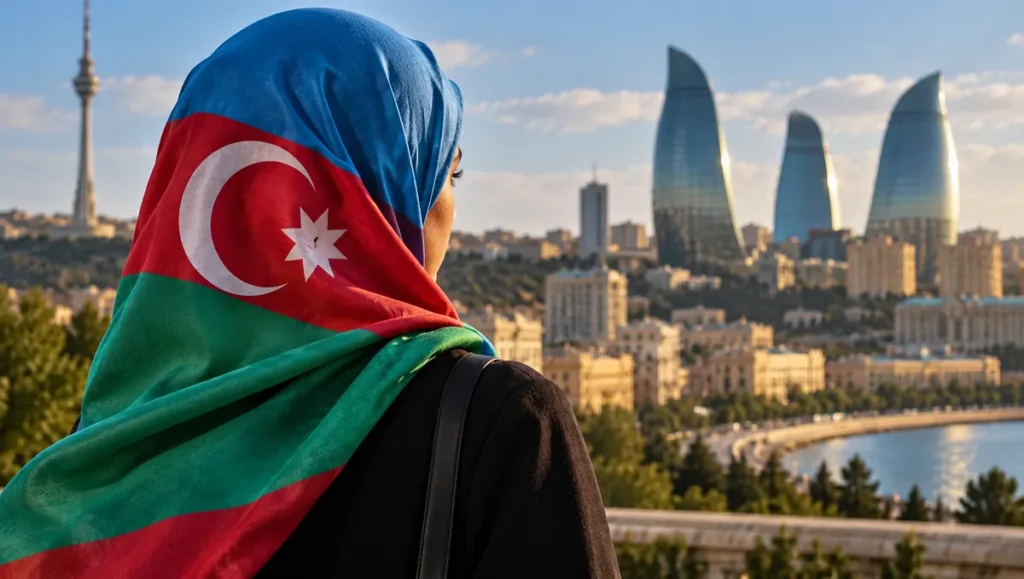
The enforcement of restrictions affecting schoolgirls and teachers who wear the hijab has sparked protests in Azerbaijan. The dispute has exposed tensions between the authorities’ religious policies and public attitudes. Armenian analysts say the situation reflects social problems as well as religious ones. They believe the unrest could lead to broader political demands.
Restrictions aim to tighten control over religious communities
According to Turkologist Varuzhan Geghamyan, new clothing rules for pupils were approved in a September 21 government decision, while separate rules for teachers were adopted on October 6. Their enforcement began later.
Geghamyan says Azerbaijan’s state messaging presents the new rules as a social measure intended to reduce differences between rich and poor. In his assessment, however, their real purpose is to strengthen control over the country’s religious communities.
He noted that the overwhelming majority of Azerbaijan’s population is Muslim and that a substantial share adheres to Shia Islam. In his view, the authorities take a dual approach to religion: they see Islam as part of national identity and social solidarity, but also as a potential threat to their power.
According to Geghamyan, religion helps bring together different groups in Azerbaijani society despite their ethnic differences. At the same time, the authorities are concerned about outside influence, particularly the possible influence of Iran and Türkiye.
Geghamyan believes that a considerable part of Azerbaijani society does not identify with the state ideology. During social crises, religion can become an important source of public solidarity. For that reason, he argues, people see religious restrictions as part of a wider problem, as well as a limitation on religious rights.
The Turkologist recalled earlier attempts by the Azerbaijani authorities to restrict headscarves. He said they retreated after large protests. Social media have given the current demonstrations considerable visibility, he added, but it would be wrong to describe them as unprecedented.
Disagreements are unlikely to seriously harm Baku–Ankara ties
Asked about Türkiye’s reaction, Geghamyan said Azerbaijan’s actions had drawn criticism from various groups in Turkish society and politics. In his assessment, however, these disagreements cannot seriously damage the two countries’ strategic relationship because their ties run deep.
He also believes the protests show that Azerbaijan’s social problems did not disappear after its victory in the 2020 war.
“In the past, under the slogan ‘Let’s take Karabakh and we’ll live well,’ state propaganda had some ability to ease public tensions. Today, ‘Karabakh is there,’ but the average Azerbaijani, who has also suffered losses, has neither prosperity nor a prospect of attaining it,” Geghamyan said.
The “Western Azerbaijan” narrative could gain momentum
Geghamyan expects Aliyev’s administration to contain the current wave of protests, making some concessions if necessary. Nevertheless, he believes the demonstrations will have consequences. The authorities may try to redirect public frustration towards foreign policy goals and the creation of an enemy image, he said.
In this context, Geghamyan argues, efforts to spread the anti-Armenian “Western Azerbaijan” narrative and develop ways to put it into practice could intensify. He concludes that talk of prospects for peace is unjustified under these conditions.
A question of religious tradition has become a demand for social justice
Iran specialist Vardan Voskanyan identifies two main reasons behind the Azerbaijani authorities’ decision to introduce restrictions affecting the hijab.
First, he says Azerbaijan’s leaders became overly confident after their success in Artsakh. They came to believe they could even take steps to restrict the religious traditions of the country’s majority.
Second, Voskanyan argues, Azerbaijan’s leaders attach too much importance to foreign policy successes. They assume these successes will also resolve domestic problems automatically, including those involving religion.
In his assessment, this policy has produced a new wave of domestic discontent.
“In reality, through its own grave mistake, Baku’s barbaric regime has essentially opened a Pandora’s box of domestic discontent out of nowhere. A question of religious tradition has effectively become a demand for social justice, whether or not those expressing discontent are religious,” Voskanyan said.
According to him, in societies kept out of politics by coercive means, social demands can eventually give rise to explicitly political ones. Voskanyan believes the current situation in Azerbaijan could also create conditions for such a development.
👉 Regional