
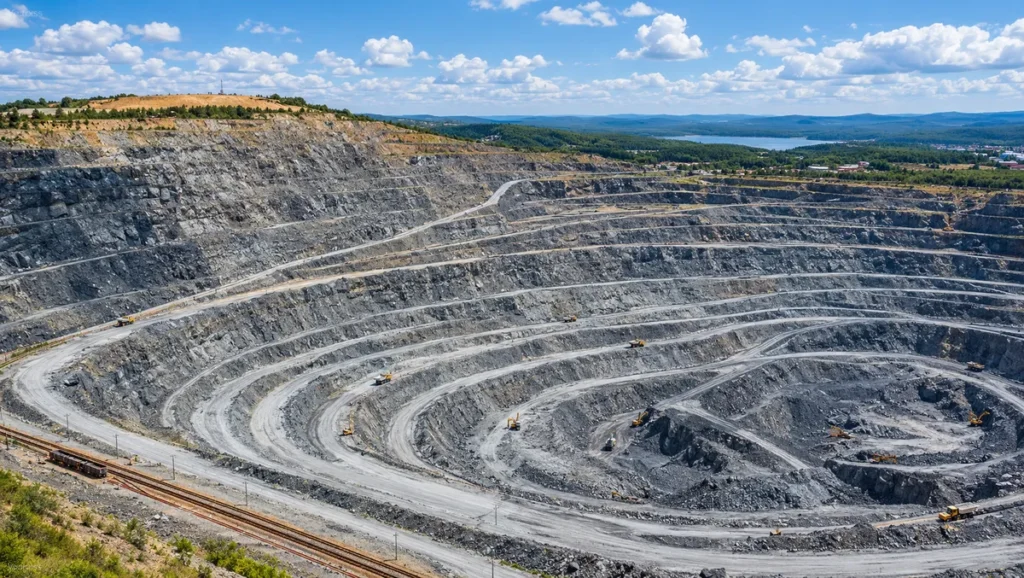
Mining could become an important driver of economic growth in Armenia, yet the use of its subsoil continues to raise questions. How intensively should the country’s mineral resources be explored? Where is the boundary between economic development and nature conservation? And how can Armenia avoid a situation in which the economic benefits of finding and developing new deposits overshadow the environment and people’s quality of life?
The debate over the scale and methods of mineral exploration is particularly relevant. Industry representatives speak of Armenia’s untapped potential and insufficient exploration. International experts caution that, for a country with a limited land area, the priority is careful site selection and effective investment, rather than exploration on a mass scale.
Armenia needs to confirm new reserves, not just operate existing mines
Discussing the prospects for Armenia’s mining industry, Vardan Jhanyan, first deputy general director of the Zangezur Copper Molybdenum Combine, identified insufficient geological exploration as one of its main obstacles. He said spending on this work in Armenia has fallen by about 50% compared with 2015. He also presented a comparison of exploration expenditure per square kilometre across several countries, placing Armenia last among those he examined.
Jhanyan said exploration spending has risen in recent years in Australia and Canada, while the overall trend in Armenia has moved in the opposite direction. Referring to Armenian statistical data, he argued that annual exploration expenditure is insufficient to reveal the country’s potential. In his assessment, if Armenia wants to participate in the growth of the global critical metals market, it must do more than operate existing mines: it must explore more actively and confirm new reserves.
Jhanyan said mining infrastructure occupies just 43 square kilometres of Armenia, about 0.15% of the country’s territory. At the same time, according to him, the sector accounts for approximately 5.1% of GDP. He used these figures to illustrate mining’s economic contribution relative to the area it occupies. He also said agriculture uses around 60% of the country’s territory and accounts for about 7.9% of GDP.
Mass exploration or carefully selected investors?
According to Timur Odilov, a partner at Haller Lomax, the size of a country matters when deciding how to organise mineral exploration.
He argued that Armenia should not mechanically adopt the model used by countries with vast territories, which can accommodate exploration on a large scale. Instead, it should attract qualified small and medium-sized companies.
Odilov said a clear mechanism is needed to select those companies. He pointed to insufficient clarity in the procedures for awarding licences on a “first come, first served” basis. In his assessment, a lack of transparent and predictable rules could hinder investment.
He also stressed the need to regulate how licensed areas are reassigned. If a company studies a site for several years without obtaining results, a mechanism should allow that area to be returned and offered to another investor.
Should the state oversee technical work or investment commitments?
Odilov also argued that the state should not carry out exploration itself. He warned that if a state geological service became an exploration operator, it could develop an incentive to keep spending money without producing clear results. In his view, this is a risk Armenia should avoid when establishing such a service.
Nor, he said, should the state intervene in private companies’ technical work by checking how many metres they have drilled or how much work they have completed. Instead, the regulator should monitor whether companies meet their investment commitments.
Odilov noted that some countries set minimum spending obligations for companies. According to him, this approach is used in Australia, Canada and Kazakhstan.
The institutional gap
Developing Armenia’s mineral resources could undoubtedly become a significant source of economic growth. The figures presented suggest that mining makes a substantial contribution to GDP while occupying a relatively small area. Yet in a country with limited territory, mass exploration and rapid development of new deposits cannot be the only approach. It is more important to adopt a model that directs investment towards the most promising areas with the lowest environmental risks. Transparent licensing rules, strict oversight of investment commitments and mechanisms for returning unused sites are necessary, but they are not sufficient.
Environmental concerns cannot be treated as secondary. Armenia’s limited water and land resources, the vulnerability of mountain ecosystems and the quality of life of its people require every new project to be assessed for its long-term environmental effects as well as its economic value. Independent environmental assessments, rigorous monitoring, modern methods of preventing water and soil pollution, and meaningful participation by local communities in decisions are all needed. Most of all, these measures must have substance in practice.
Only then can Armenia avoid allowing economic benefits to overshadow nature and human health. The potential of its mineral resources should be explored, but not at any cost: it should be pursued according to the principles of responsible and sustainable development.