
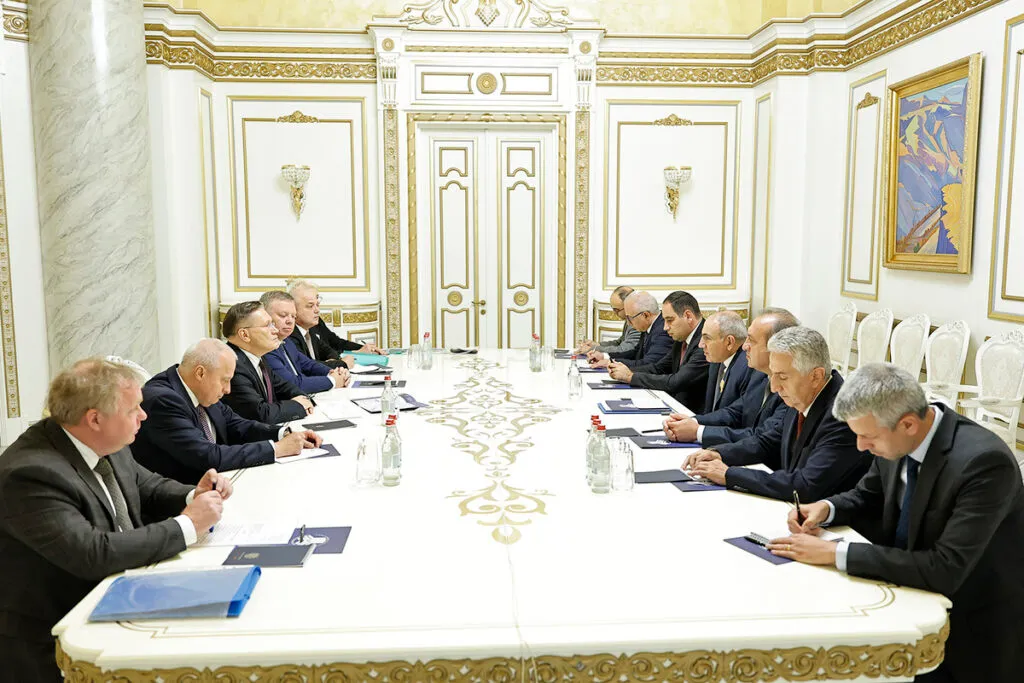
A new element has emerged in Armenia’s choice of a partner for its next nuclear power plant. Following Rosatom chief Alexey Likhachev’s meeting with Prime Minister Nikol Pashinyan, the Russian company said it could pursue its proposal through an international consortium, involving manufacturers from France, South Korea and China if Yerevan wishes.
Days earlier, on September 23, Pashinyan had said Armenia was holding parallel talks on a new plant with the United States, Russia, France, South Korea and China. Most of the countries mentioned by Likhachev therefore overlap with the options Yerevan says it is considering.
Russia sees no technical barrier at the existing plant
Pashinyan and Likhachev discussed work to extend the operating life of the Armenian Nuclear Power Plant’s second unit. They also discussed Russia’s proposals for a new nuclear unit.
The prime minister said his government was continuing to review proposals from international partners and would decide in the foreseeable future. He named price, quality, safety, schedules and guarantees as the criteria. His office said the final choice would be based exclusively on economic considerations. primeminister.am
Extending the life of the existing unit and choosing a new plant are now separate decisions for Armenia. Rosatom is already involved in the former and says it sees no technical obstacle to continued operation. For the new plant, Armenia is comparing competing proposals, making the attractiveness of the Russian offer more important.
Speaking to Russian reporters at Yerevan airport, Likhachev said he saw no “technical obstacle” to extending operation until 2036. He also said a further extension to 2046 was technically possible.
The latter date, however, is not solely a technical matter. Likhachev said its economic feasibility would also have to be assessed. Technical capability therefore does not itself settle whether a longer extension would make economic sense for Armenia.
The distinction may also be read against the political background of Armenia’s choice of a partner. Any suggestion that Russia might create political obstacles remains an editorial inference: Likhachev’s public comments addressed technical feasibility and economic viability.
Rosatom’s consortium proposal
The most notable announcement during the visit concerned a possible international consortium for the new plant.
Likhachev said Russia was prepared to work with manufacturers from France, South Korea and China if Armenia wanted that arrangement. He described an integrated consortium linked to Rosatom’s proposal and said the company had submitted an offer for a VVER-1000 unit. Коммерсантъ
This broadens the previously presented image of the Russian option as a Rosatom-led project carried out without such international participation. Moscow is now publicly open to combining its proposal with contributions from companies in other countries.
The countries named also matter. Pashinyan had listed the United States, Russia, France, South Korea and China as directions for Armenia’s talks. Likhachev mentioned three of those potential partners — France, South Korea and China — but did not name the United States.
That omission does not establish that US participation is ruled out under every possible arrangement. It does show which partners Rosatom publicly identified for its own consortium concept. Given the timing, the proposal can be viewed as an adjustment to Armenia’s decision to consider several options in parallel. That is an interpretation of the sequence of statements.
What Likhachev told Putin
Likhachev travelled to Yerevan after meeting Russian President Vladimir Putin on Russia’s Nuclear Industry Workers’ Day.
In a published excerpt from that meeting, he said Armenia “cannot be removed” from Rosatom’s work because the company was extending the life of its nuclear plant. He added that Armenia’s leadership would decide which path to take, while Rosatom remained present there. His words distinguish the company’s current work at the existing plant from Armenia’s pending choice about future nuclear generation. АРМЕНПРЕСС Армянское новостное агентство
Likhachev also mentioned the Nairit chemical plant, saying Rosatom was working with Armenian partners on the matter and hoped to help. He gave no details of a specific role.
Separately, Armenia has received World Bank grant funding to prepare an environmental remediation project at Nairit. The preparatory work includes studying hazardous chemicals and options for treatment. No published information establishes that Rosatom’s possible involvement is part of that grant-funded work.
👉 Politics